
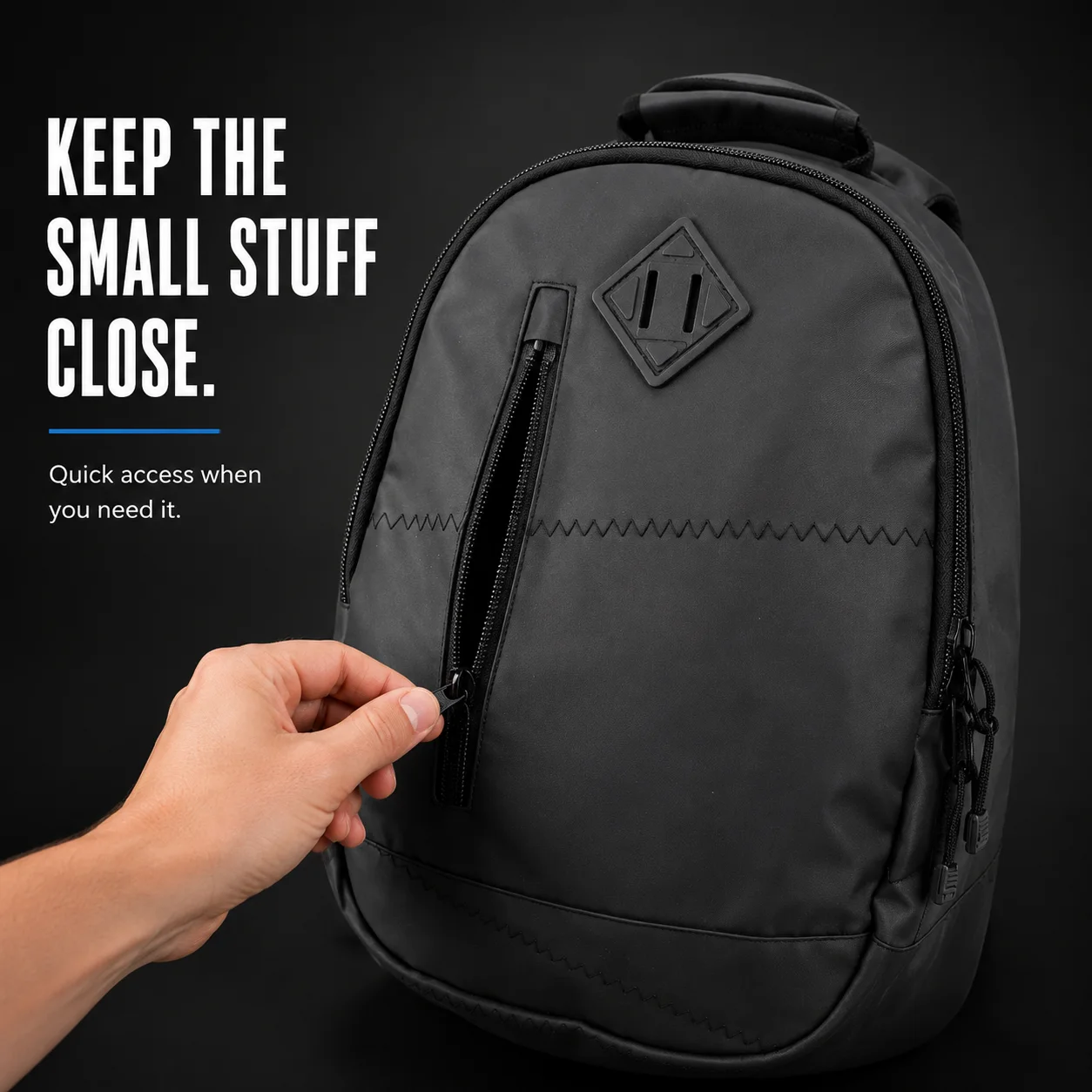
A sports backpack can have a correctly supplied zipper and still have the wrong pocket opening. The component order may describe one length, the cutting pattern another, and the finished product brief a third. Before asking a supplier to make the zipper longer, put those three dimensions on separate lines.
For a front pocket on a lightweight sports backpack, the task is to connect the zipper supplier's measuring points with the pattern and the user's access requirement. This guide proposes a practical handover record. It does not measure the pictured product, identify its zipper manufacturer or report a production trial.
01
Separate the three length questions
Component, tape and opening
Record the ordered zipper length, the tape available beyond the working closure and the usable opening after sewing. Give each a distinct name in the drawing. A single arrow labelled length is not enough when different teams can place its ends on different features.
The ordered dimension belongs to a particular zipper configuration and supplier convention. Tape extensions describe material available at the ends for the intended construction. Finished access describes what remains available after the bag panels, seams, covers and end finishes are assembled.
A pocket may have sufficient tape for sewing but inadequate access for its intended contents. Conversely, a longer component may leave excess material at an end without improving access. Treat either observation as a reason to inspect the drawing and sample, not as proof that the zipper shipment is incorrect.
02
Confirm the supplier's reference points
YKK Africa's measurement guide distinguishes measuring points by zipper configuration. Its closed-end example uses the slider and bottom stop, while its two double-slider arrangements use different endpoints. The guide also treats tape extensions separately. This is why a nominal length needs an identified configuration and an agreed drawing.
Ask the actual supplier to mark both endpoints on a photograph or dimensioned sketch of the selected component. Retain its product reference and the state in which the measurement is taken. Do not transfer a measuring convention from a visually similar zipper without confirmation, particularly when the slider or end construction changes.
Avoid copying a universal tolerance into the order. Obtain the tolerance applicable to that component and quantity, then check whether the bag construction can accommodate it. The supplier's component tolerance and the buyer's finished-opening requirement are related design inputs, not interchangeable acceptance criteria.
03
Place the component inside the sewing drawing
Show where the two component endpoints sit relative to the pocket seam, the visible opening and any folded end finish. Include the actual material stack in the sample request. A clean flat sketch can hide the space needed to turn an end or keep the slider clear of a seam junction.
Keep tape cut edges distinct from stitch lines. If the sewing team needs an extension beyond the ordered dimension, specify that requirement rather than expecting it to be inferred from the finished opening. Equally, do not add an allowance twice because both the component order and the pattern already include it.
Use one drawing revision for the zipper purchase and the pocket assembly. When an end location changes, identify whether the ordered component length, extension, seam position or more than one item must change. This prevents a correction to the pattern from becoming an undocumented instruction to alter incoming components.
04
Use a small assembly to answer the access question
Sample the pocket with its surrounding panel and end construction before judging the component in isolation. Include lining or backing that occupies the opening. If a cover or adjacent seam restricts movement, keep it in the sample rather than approving an artificially open construction.
Use the intended object or a documented representative object for insertion and retrieval. Note its orientation and whether the bag is empty or packed. A flat ruler measurement can help describe the opening, but it cannot show every obstruction encountered by a rigid object passing through it.
Separate the result into two records: component dimensions and assembled access. If the component meets its drawing but access fails, review the construction first. The related interior pocket access guide addresses retrieval; the present check keeps the dimensional handover traceable.
05
Resolve a disagreement before adjusting production
If the supplier and factory report different lengths, exchange annotated photographs showing the exact measuring points. Confirm the component reference, configuration, measuring state and units. Check that both parties are evaluating the same sample, rather than a development zipper and a later substitution.
Do not immediately stretch the tape to match a target, trim an end or move a stop. Those actions change the item being assessed and can conceal the original discrepancy. Any proposed modification needs supplier guidance and a separate assembly review before becoming an accepted production instruction.
If the endpoints agree but readings remain different, agree how the measurement will be repeated and who will resolve the result. Keep the original observations as well as the repeat measurement. A final accepted number without its basis leaves the next shipment exposed to the same dispute.
06
Keep substitutions tied to the dimensional record
A replacement zipper should not be approved solely because its nominal length matches the order. Confirm its configuration, endpoint convention and supplied tape extensions. Then compare the relevant end geometry and the space available in the sewn assembly.
A change in slider arrangement is particularly important because it can alter both how the component is described and how the opening behaves. Use the double-slider closing arrangement review to identify the closure state, then return to the selected supplier's dimensional drawing for the length definition.
Record the affected pocket or compartment in the bill of materials. If similar-looking zippers serve several positions on one sports bag, give each a separate location reference. This makes an otherwise correct component less likely to be assessed against the wrong pocket drawing.
07
Release a record that can be checked again
The approval package should contain the component reference, configuration, marked measuring points, nominal dimension, agreed tolerance and tape-extension requirements. Add the pocket drawing revision, sample identity and assembled-access result. Keep component conformity and finished-product approval as separate decisions.
An incoming check can then answer a narrow question: does this identified zipper meet its agreed dimensional record? A sample review answers another: does the assembled pocket provide the required access? Neither answer alone establishes durability, operating force or strength.
Carry the record into the zipper sample library so the approved physical reference and purchase description remain connected. For the next revision, change the identified dimension rather than sending a vague request for a slightly longer zipper. That is a manageable instruction for purchasing, cutting, sewing and inspection to share.
Discuss your bag development project
ANSON XIE
General Manager & Founder
Quanzhou Junkai Pengda Special Equipment Co., Ltd.
Email: ansonxie@jkpdtime.com
Phone: +86 177 5095 3355
WhatsApp: +86 177 5095 3355
Factory address: Floors 2–4, Building 1, Phase I, Huixin Intelligent Manufacturing Industrial Park, Hui'an County, Quanzhou, Fujian, China