
Specify the fully closed state and slider movement before ordering. Distinguish closed double-slider arrangements from separating two-way zippers.
01
Why is two-way an incomplete order description?
Two-way alone does not identify the required zipper arrangement. The YKK Americas explanation distinguishes closed head-to-head, closed bottom-to-bottom and separating two-way versions. Specify the closing arrangement and whether the zipper separates as different attributes.
Start with the fully closed state. Where should the sliders sit, which slider does the user move and where should the opening appear? These questions translate a broad feature request into an arrangement that the supplier can confirm. Keep a simple operation sketch with the quotation so a change of terminology does not alter the intended access function. Slider count alone cannot answer those questions.
02
Describe the fully closed position
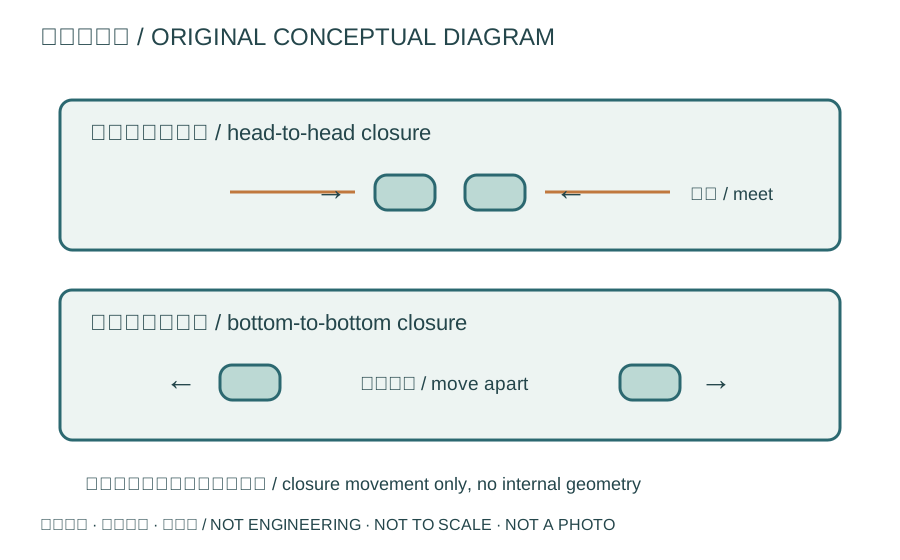
In YKK's description, closed head-to-head sliders meet to close the zipper. Closed bottom-to-bottom sliders move away from one another to close it. Neither closed arrangement becomes separating merely because it has two sliders.
These are general operating distinctions, not specifications for a particular zipper model. Do not identify the arrangement only by pull-tab appearance. Pull tabs can have different forms, so have the supplier confirm slider-body orientation and chain compatibility. Retain the closed-state description with the component reference. That is more reliable than an isolated photograph of two decorative pull tabs whose internal orientation has not been identified.
03
Specify separation independently
The YKK two-way separating description concerns an arrangement that can come completely apart. Wanting access from either side of a bag compartment does not, by itself, establish a requirement for that separating construction. State the requirement explicitly rather than deriving it from two sliders.
Give separation its own field in the order and ask the supplier to identify the end construction. The original diagram shows the general movement towards or away from the other slider in a closed arrangement. It does not reproduce end components, prescribe installation dimensions or establish compatibility with a selected chain. Confirm those details through the actual component specification.
Original conceptual diagram; not engineering, not to scale, not a photograph or product/test evidence.
04
Review slider parking on the assembled bag
Map the closed parking area, access starting point and usable opening on the bag. Check whether handles, compression straps or flaps obstruct the pull tabs. A loose straight zipper can demonstrate its arrangement without representing access after installation around a curved opening.
Rehearse movement of one slider and any two-slider action that the use case requires. Use the agreed target objects and packing state. Being able to move a slider does not prove adequate opening size or one-handed operation. Record the sequence that actually works. If the closed parking point changes during development, review reach and neighbouring components again rather than carrying the earlier approval forward.
05
Approve the chain and sliders as a combination
A chain that operates with one slider does not establish that adding an arbitrary second slider will provide the required function. Ask the supplier to confirm chain type, slider direction, component references, ends and assembly as a complete combination. Treat that as a specific compatibility question.
Avoid describing every component of the same nominal size as interchangeable. For a proposed substitution, retain the original and replacement identities, their actual open and closed states and the assembled-bag result. Loose components can answer only part of the question. The approval needs to show that the named combination produces the intended operation in its installation, without claiming a performance rating from appearance.
06
Review the operating states separately
Document full closure, intended retrieval and return to closure. Inspect the meeting area, end parking areas and curved sections for interference from lining or nearby construction. Record the reach path for each slider rather than demonstrating only the easier one.
Keep functional review separate from durability, chain strength, locking behaviour and water resistance. Two sliders and a specified closing direction do not establish those properties. If they form part of the procurement requirement, request relevant evidence for the actual model and combination. Do not infer a rating from a smooth short demonstration. The functional sample should still identify which arrangement was reviewed and where its sliders were parked.
07
Write the arrangement into the order
Keep the reviewed combination traceable
State separation, closed arrangement, chain and slider references, ends, length-measurement basis, installed parking area and operation sketch. Keep the same closed-state illustration beside the Chinese and English terminology. This helps prevent an informal shorthand from changing the requested function between teams.
Ask the supplier to confirm through an identified physical sample. The article's concept drawing is not component certification or a statement that JKPD adopts a particular model. Approve the complete combination and operating conditions, not only the words two-way and two sliders. Retain that record when later changing the opening shape, component supplier or slider style so the functional intent remains traceable.
Related development guidance: Review the connected construction.
Discuss your bag development project
ANSON XIE
General Manager & Founder
Quanzhou Junkai Pengda Special Equipment Co., Ltd.
Email: ansonxie@jkpdtime.com
Phone: +86 177 5095 3355
WhatsApp: +86 177 5095 3355
Factory address: Floors 2–4, Building 1, Phase I, Huixin Intelligent Manufacturing Industrial Park, Hui'an County, Quanzhou, Fujian, China