
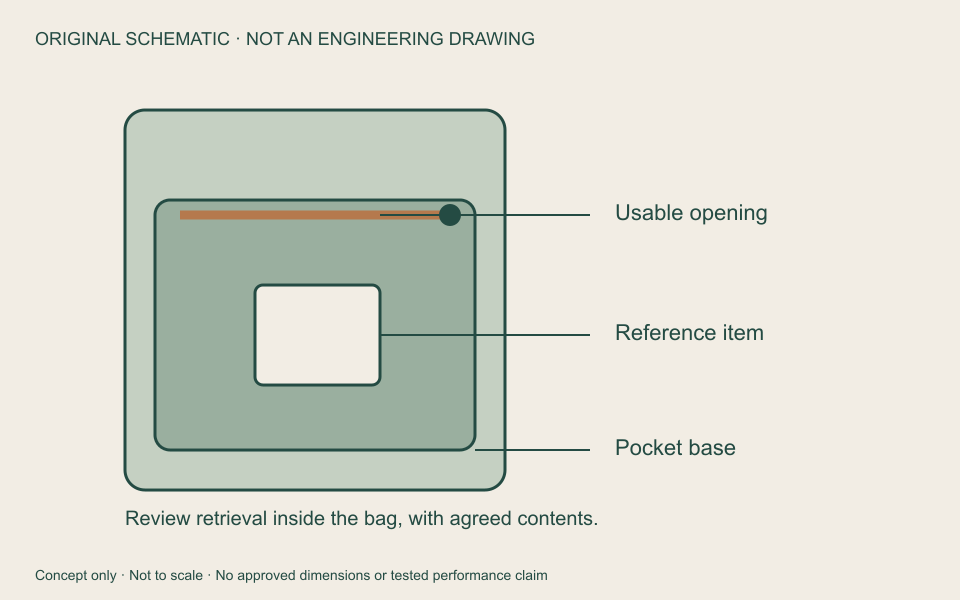
Review an interior zip pocket with its intended contents, usable opening, pocket depth and retrieval inside the finished bag.
01
Start with defined contents
List specific contents, such as a document holder, cable pouch or key case. Use the actual project reference and record its shape, thickness and whether a cover stays on. A flat card and a filled card holder are different review states.
Define the retrieval situation: the bag on a table, its main opening partly open, or clothing already packed in the main compartment. Select the states required for the project and retain packing photographs. This connects the pocket requirement to an action rather than panel dimensions alone.
02
Mark usable access and the pocket base
Distinguish the zipper assembly region, the opening through which an item can pass and the pocket base. Do not treat overall zipper length as usable access. Identify the host lining panel, the parked slider end and the direction of the user’s hand.
The original schematic separates the opening, storage area and reference item. It explains the review relationship without prescribing universal dimensions or a sewing sequence. Confirm opening size and end treatment through the project drawing and sample.
03
Operate it inside the assembled bag
Check the empty pocket, then insert the reference item. Retrieve, replace and close it under the agreed main-compartment load. Observe whether other contents must move first, the lining obscures the slider or the pocket base sits beyond comfortable reach. Record the action without assigning a material cause from appearance.
An example requirement is to retrieve the document holder with the main compartment packed to the agreed list, without first emptying it. Record the result and adjustments. State whether two-handed operation is permitted rather than imposing an unagreed one-handed criterion.
04
Retain end and reverse-side evidence
While the lining remains accessible, photograph both opening ends, the pocket reverse and the base. Record visible stitching, exposed edges, thread tails or trapped areas. Smooth operation does not confirm hidden finishing, and a tidy flat coupon does not replace the loaded-bag review.
Photographs establish visible details only. Agree separate verification where connection strength, durability or protection matters. A zipper alone is not a security or protection guarantee.
05
Deliver a pocket-specific approval record
Include the lining location drawing, reference-item ID and state, usable opening, packing list, retrieval action and sample photographs. Confirm dimensions and tolerances for the project and list unresolved checks explicitly.
Recheck access after changes to pocket position, the main opening or adjacent compartments. Buyers can then assess whether later samples preserve the approved relationship instead of comparing appearance alone.
Share material references and sample requirements through the JKPD inquiry page.
Discuss your bag development project
ANSON XIE
General Manager & Founder
Quanzhou Junkai Pengda Special Equipment Co., Ltd.
Email: ansonxie@jkpdtime.com
Phone: +86 177 5095 3355
WhatsApp: +86 177 5095 3355
Factory address: Floors 2–4, Building 1, Phase I, Huixin Intelligent Manufacturing Industrial Park, Hui'an County, Quanzhou, Fujian, China