
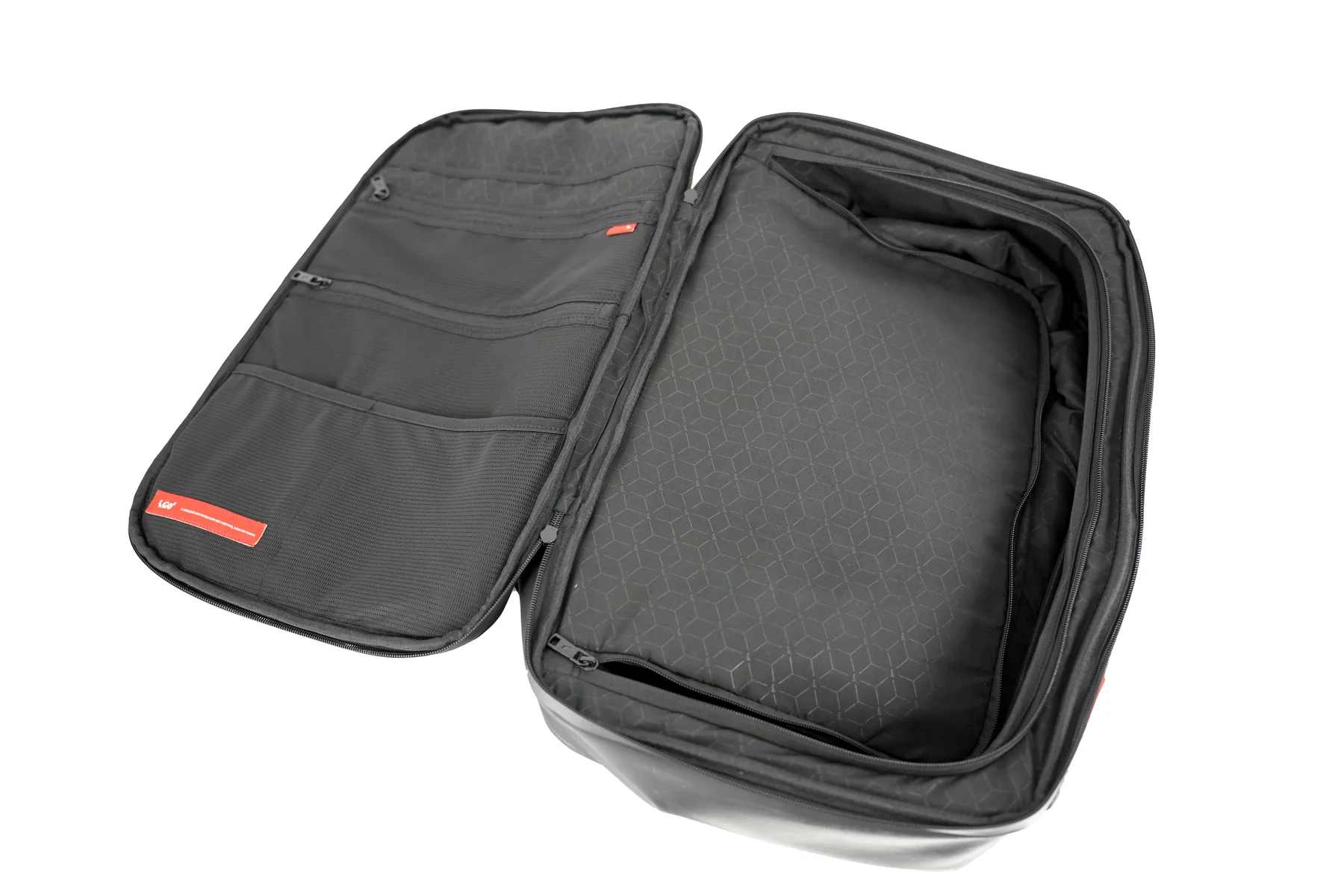
A business backpack lining can look flat in an empty sample yet become tight around a divider after a care exposure. The development question is not just whether the fabric shrinks. It is whether changes in two directions leave enough space for the shell, lining, pocket openings and fixed attachment points to work together.
Start with the open JK-039 business backpack as construction context, not as a washable-product claim. Its internal compartment illustrates why the relationship between layers matters. Nothing in the photograph establishes a cleaning method, a measured dimensional change or an approved material composition for that product.
- Identify the actual lining and the intended exposure before testing.
- Keep lengthwise and crosswise changes separate instead of averaging them.
- Compare material behaviour with assembled fit and pocket operation.
- Do not turn a fabric washing result into permission to wash a complete backpack.
01
Which exposure is relevant to the design?
Choose the exposure from the product's proposed care and use requirements, not from whichever laboratory result happens to be available. A full washing-and-drying evaluation and a local wiping trial answer different questions. If immersion is excluded for the finished bag, a fabric test must not quietly become a new consumer instruction.
ISO 5077:2007 concerns dimensional change of textiles under specified combinations of washing and drying procedures. Its public scope establishes the property being assessed, not a universal backpack washing recipe or pass limit. Ask the laboratory to identify the actual procedures and their suitability for the proposed specimen.
Keep exploratory material comparisons distinct from validation of customer-facing care instructions. A development team may investigate how candidate linings respond to an exposure without authorizing that exposure for saleable bags. Label the purpose so a later marketing summary cannot turn an internal comparison into an unsupported washable claim.
02
What needs to be identified before measurement?
Record the supplier article, colour, finish state and lot of the lining, together with any backing or bonded layer. A report for an untreated base textile does not automatically describe the fabric delivered to sewing. Keep the specimen's direction linked to the roll and to the pattern orientation used in the bag.
Agree the measurement procedure, reference marks, specimen preparation and pre- and post-exposure conditions with the laboratory. This guide does not replace those instructions. The same marks must represent the same distance at each reading; a fabric edge that frays or curls is a poor substitute for controlled reference points.
Use a consistent measurement state rather than pulling the specimen until it resembles its starting dimensions. If the procedure requires a particular conditioning or laying-out method, record it. The goal is a comparable observation, not a neat-looking photograph or the smallest possible reported change.
03
How do the two directions affect fit?
Retain results in both directions because the pattern places them into different relationships with the shell. A lengthwise change may affect the span between top and bottom attachments, while a crosswise change may affect pocket width. The relevant direction follows the actual cut orientation, not the page orientation of a test report.
As a hypothetical arithmetic example, a reference distance changing from 300 millimetres to 294 millimetres has decreased by 2 percent. A second direction changing from 200 to 202 millimetres has increased by 1 percent. Combining these into one average would conceal two different dimensional behaviours; neither number here is a product result or acceptance limit.
Translate change into the affected span
For an initial fit discussion, a 2 percent decrease over a 400-millimetre material span represents 8 millimetres. That calculation identifies a possible conflict to investigate, not a prediction of the sewn bag's final shape. Seams, constraints and neighbouring layers make the assembled response a separate question.
Do not enlarge every lining pattern automatically by that calculated amount. Added ease can create folds, interfere with zipper travel or reduce useful pocket space before any care exposure occurs. Review both initial and post-exposure fit before changing a production pattern.
04
Where should the assembled sample be checked?
Map the places where the lining cannot move freely: zipper attachments, pocket corners, divider edges, base seams and fixed tabs. Compare those locations with broad floating areas. Two constructions using the same fabric can behave differently when one anchors the lining continuously and the other leaves controlled freedom between attachment points.
Retain an untreated comparison and record the initial state of the sample. After the agreed procedure and recovery conditions, inspect for pulling, excess folds, altered divider position and changed access. Use the same intended contents to compare operation, keeping this review separate from any claim about protecting electronics.
Inspect the connection between the inner pocket and the main lining rather than evaluating each loose panel alone. A pocket may still measure acceptably while its opening becomes harder to use because the surrounding assembly has moved. The interior zip-pocket access review provides a complementary retrieval check.
05
How should a failed review be investigated?
Begin with the observed location and direction of the change. Confirm sample identity, procedure and measurements before blaming fibre composition or sewing tension. Compare the lining with adjacent components and determine whether the concern appeared in the loose material, the assembled sample or both.
Possible development responses include a different finished lining, revised attachment placement or a more carefully defined allowance. Each is a candidate for a controlled sample, not an automatic remedy. Changing several variables together may produce a better-looking bag without showing which change resolved the problem.
If a proposed care procedure conflicts with essential construction, reconsider the procedure or product brief rather than hiding the conflict in extra fabric. The care-instruction development guide covers the wider task of turning supported sample observations into usable instructions.
06
What does approval need to preserve?
Release the material identity, pattern revision, attachment arrangement, procedure and criteria together. Keep the directional results and assembled observations accessible to the next reviewer. A single statement such as shrinkage passed loses the information needed to decide whether a later substitution remains acceptable.
Define criteria around the intended fit and operation, with suitable laboratory input where quantitative limits are needed. Specify whether a dimensional limit, visible appearance requirement and pocket-function check must each pass. Do not let an acceptable average hide one direction or one critical location outside the agreed requirement.
When purchasing changes the lining article or finish, review which evidence still applies before releasing cutting. Preserve an approved sample and revision record through the sample-control process. For a new business-backpack project, share the compartment layout, proposed care expectations and candidate lining information through the project inquiry page.
Discuss your bag development project
ANSON XIE
General Manager & Founder
Quanzhou Junkai Pengda Special Equipment Co., Ltd.
Email: ansonxie@jkpdtime.com
Phone: +86 177 5095 3355
WhatsApp: +86 177 5095 3355
Factory address: Floors 2–4, Building 1, Phase I, Huixin Intelligent Manufacturing Industrial Park, Hui'an County, Quanzhou, Fujian, China