
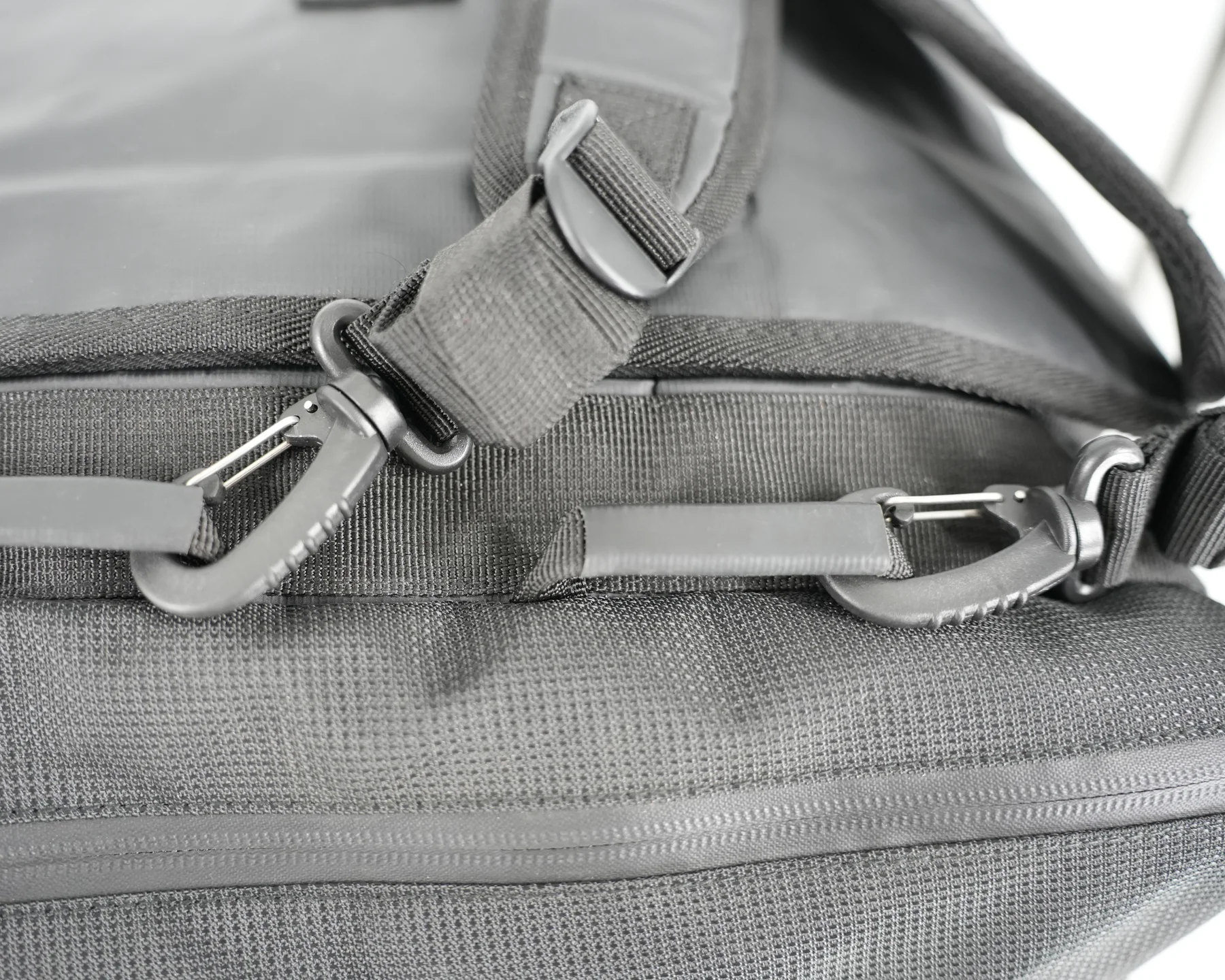
A salt-spray report with a long exposure time is not, by itself, an approval for a travel bag's metal hardware. The report must describe the part being purchased, the finish and the acceptance criteria. The finished component must also remain usable. A swivel hook that looks acceptable but no longer closes properly presents a different problem from a cosmetic mark on a decorative fitting.
Start with the travel organizer's actual metal components: shoulder-strap hooks, attachment rings, adjusters, rivets and any metal zipper parts. Define what the buyer needs to learn about each component before choosing a test. The photographed hardware is a product reference only; no corrosion result, alloy identity or service-life claim is implied by its appearance.
01
Create a part-and-finish register
Give each metal component a stable identifier tied to the bill of materials. Record its supplier reference, declared base material, finish designation and revision. If an assembly contains a separate spring, pin or moving insert, ask the supplier which parts are included in the declaration. A bright surface does not identify the underlying material or its protective system.
Keep the register practical. The purpose is to connect the sample, laboratory report and purchase order, not to collect descriptions that nobody can verify. Attach a clear image of the actual submitted part and record the sample lot. If the supplier changes the finish process while retaining the same colour name, treat that as a reviewable change rather than assuming the old report still applies.
Check the report-to-order connection
- Does the tested part number match the proposed production component?
- Is the finish identified beyond a colour such as silver or black?
- Are moving parts included, or was only a flat coated panel tested?
- Can the specimen lot and production supplier be traced without relying on an informal message?
A panel result can inform a finish discussion, but it does not automatically cover the geometry and working surfaces of a complete hook assembly.
02
Describe exposure without inventing a lifetime
Ask where and how the bag is intended to be used, stored and cleaned. A city travel organizer, a bag repeatedly packed with damp contents and a bag marketed for marine use do not have identical exposure assumptions. Keep those descriptions specific enough to guide the laboratory, while avoiding claims that an accelerated test recreates every part of actual service.
ISO 9227:2022 covers salt-spray methods and notes that product-specific specimen details, exposure duration and interpretation are not supplied by the standard itself. Its public abstract also warns against using these methods to rank different materials for corrosion resistance or predict long-term corrosion behaviour. Therefore, do not translate chamber hours into years of travel use.
The purchasing question is narrower: under the agreed method and evaluation conditions, does this identified component meet the project's stated requirements? If a buyer needs evidence for a broader environmental claim, ask a qualified laboratory to propose a suitable programme. Do not expand the marketing claim simply because a test report exists.
03
Agree appearance and function separately
Prepare two sets of observations. Appearance may concern visible corrosion products, discoloration, coating damage or staining adjacent material. Function may concern gate return, swivel movement, adjustment or zipper operation. Define the relevant observations for the actual part rather than imposing the same list on every trim.
Choose the evaluation areas in advance. A prominent outer face and a concealed contact face may have different cosmetic expectations, but concealment should not excuse a functional defect. Agree how the specimen will be conditioned and handled after exposure before inspection. Unrecorded cleaning, polishing or lubrication can make two evaluations difficult to compare.
Keep any load-related approval separate. A hook operating smoothly after exposure does not establish its load capacity, and a corrosion observation does not replace the mechanical review of the strap assembly. The bag hardware selection guide provides the broader component-selection context; this review addresses a specific environmental acceptance question.
04
Send a clear laboratory request
The request should name the method and edition to be used, identify the submitted components, describe their condition and state the required report contents. Agree the exposure period, number of specimens and acceptance criteria with the buyer and laboratory before testing. Do not choose a convenient duration after seeing the first result.
Ask for specimen photographs, deviations from the agreed procedure and individual observations rather than only a pass stamp. If the project compares a finish revision with an approved reference, explain that purpose and submit traceable samples. Keep a retained sample where feasible, and record which parts were actually exposed versus kept as references.
For example, a hypothetical travel-organizer project might compare a current hook finish with a proposed supplier revision. The decision could require an agreed cosmetic condition and continued gate return after the defined evaluation process. Those are proposed project requirements, not universal pass limits. If one sample develops a defect, investigate the affected location and specimen identity before extending the conclusion to every part from that supplier.
05
Include manufacturing and cleaning contacts
Do not limit the investigation to outdoor exposure. Review the materials and cleaning agents that contact the hardware during manufacture and the care instructions proposed for the finished bag. A late spot-cleaning operation can be relevant even when the component arrived with an acceptable finish.
YKK's technical guidance on spot-cleaning solvents describes discoloration and corrosion associated with certain cleaning-agent constituents and residues. That guidance concerns zipper products; it is a reason to verify chemical compatibility with the relevant component supplier, not proof that every travel-bag fitting responds in the same way.
Document any cleaning trial using the actual proposed agent, application and drying conditions. Avoid improvised chemical recipes or a stronger cleaner introduced only to improve a presentation sample. If a change is necessary, carry the reviewed process into production instructions and check whether the existing bag care guidance needs updating for that construction.
06
Close the decision at assembly level
After reviewing the component evidence, inspect a representative assembled sample. Check whether adjacent webbing, fabric or protective covers interfere with the moving parts, and whether the finish leaves an unacceptable visible mark on nearby material under the agreed review. Record these as assembly observations, distinct from the laboratory corrosion method.
Release the hardware with a bounded approval statement: part reference, finish revision, supplier, report reference, applicable acceptance criteria and assembly revision. A substitution should trigger a documented decision about what evidence must be repeated. An unchanged colour or nominal size is not enough to establish equivalence.
For a new travel bag, send JKPD the intended use, hardware register, finish references and any existing report together. This makes the next conversation concrete: whether the evidence covers the ordered component, which functional checks remain, and what the buyer can honestly claim. The goal is a traceable purchasing decision, not an impressive exposure-time number disconnected from the bag.
Discuss your bag development project
ANSON XIE
General Manager & Founder
Quanzhou Junkai Pengda Special Equipment Co., Ltd.
Email: ansonxie@jkpdtime.com
Phone: +86 177 5095 3355
WhatsApp: +86 177 5095 3355
Factory address: Floors 2–4, Building 1, Phase I, Huixin Intelligent Manufacturing Industrial Park, Hui'an County, Quanzhou, Fujian, China