
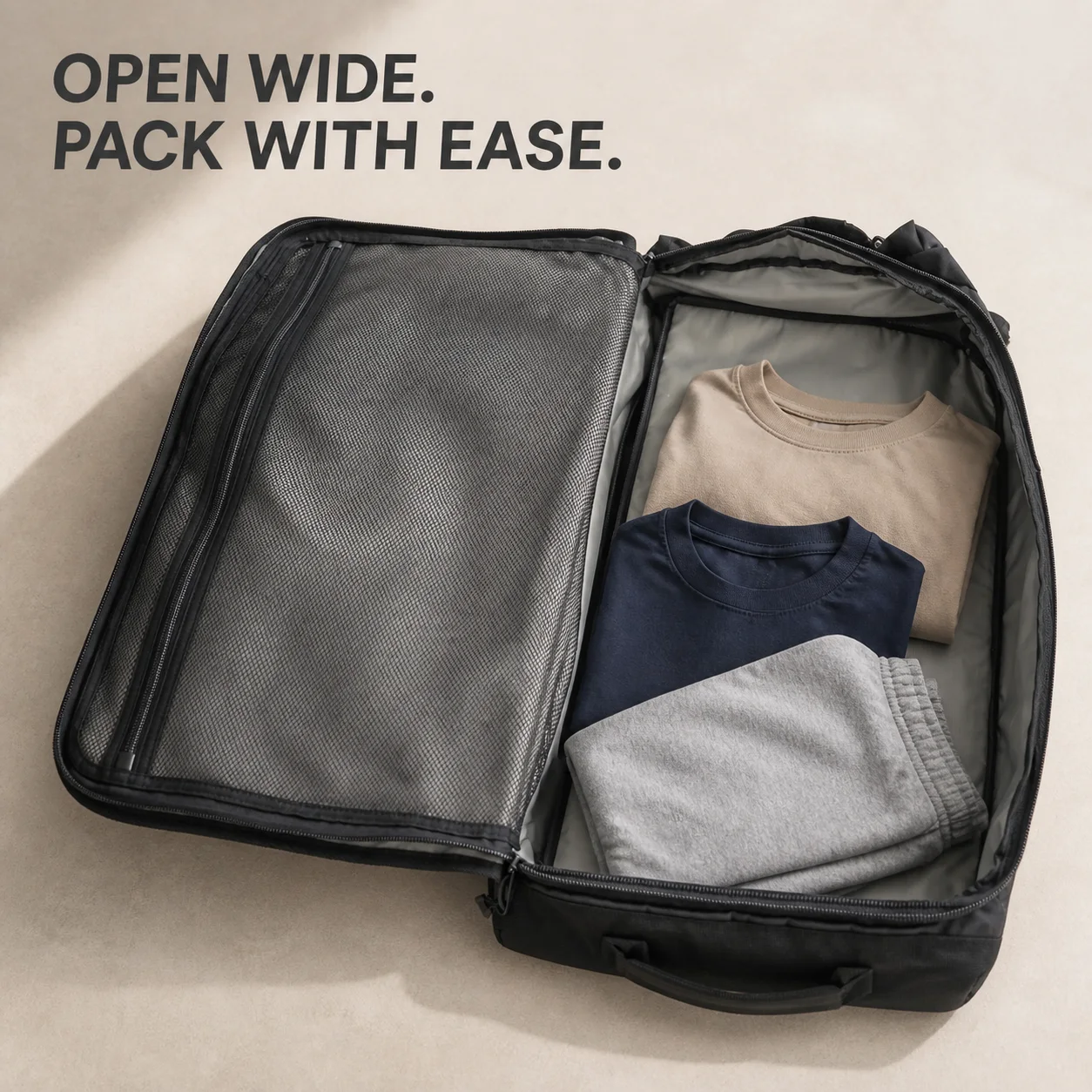
A travel bag can arrive with acceptable stitching and still be difficult to unfold if contacting surfaces stick together. When the design uses coated fabric, include blocking in the material and packing discussion before approving a compressed shipping arrangement. Review which faces touch, how the bag is stored and what happens when it is opened.
The starting product here is a soft travel organizer packed flat between trips or for shipment. This is a development review for proposed coated constructions, not a claim about the coating or performance of the pictured organizer. It separates material evidence from the additional evidence needed for the finished packed bag.
01
What does a blocking report actually address?
ISO 5978:2023 describes a method for evaluating resistance to blocking of rubber- or plastics-coated fabric sheets held in contact under specified temperature, time and pressure. Its public scope identifies the property; it does not give a universal bag acceptance limit or establish that a particular shipping pack is suitable.
If a supplier offers a report, ask for the complete report tied to the proposed material. Confirm the method and edition, specimen identity, contacting faces, conditions, observations and conclusion. The laboratory should use the applicable full method; a buyer's improvised stack of swatches is not an equivalent test just because it includes heat and weight.
Keep neighboring properties separate
Blocking concerns contact between surfaces during storage. Coated fabric flexing concerns repeated bending, while laminated panel peel review addresses separation within a layered construction. Evidence for one question should not be relabeled as evidence for another.
An unpacking observation also does not diagnose a chemical cause. If surfaces stick or show damage, preserve the samples and ask the material supplier or laboratory to investigate. Do not call every sticky coating hydrolysis, or infer a material formulation from touch alone.
02
Which surfaces touch in the proposed pack?
Open a production-representative sample, then follow the proposed folding sequence. Mark the surface pairs that meet: shell against shell, exposed backing against backing, coated panel against lining, or a panel against separate packing material. Use a photograph or annotated packing instruction to identify the location of each contact.
This contact map is a proposed review tool, not a laboratory method. It helps purchasing avoid asking only whether “the fabric” passes when the actual bag brings together several materials. A report covering one face pairing should not silently approve every contact in the finished product.
Check the final arrangement after straps and handles are stowed. A fold can bring a previously hidden surface into contact, while hardware or a thick seam may create a locally compressed area. Record those locations for the packed-sample review without treating the number of bags in a carton as a measured contact pressure.
03
How do you choose representative storage conditions?
Start with the intended logistics and storage information available to the project. Ask who packs the bags, how long they may remain packed, where they are stored and whether the packing configuration changes later. Separate documented conditions from assumptions so the buyer can see the gaps in the proposed evaluation.
Then ask the laboratory and material supplier to help define an appropriate evaluation. Record temperature, duration, loading arrangement, conditioning and recovery or opening procedure as applicable. These details make the result interpretable; this guide deliberately does not invent a generic temperature or exposure period for every shipping route.
Avoid unsupported shelf-life translations
An accelerated exposure is not automatically equivalent to a stated number of months in a warehouse. Require a justified basis for any such conversion. Otherwise, report the actual exposure and the observed result, with its limitations, rather than presenting a convenient commercial shelf-life claim.
Where route information is incomplete, record a pending decision. It is better to approve a defined sample condition with a clear boundary than to claim unrestricted storage suitability from a report that tested something narrower.
04
What should the unpacking review record?
Define the opening sequence and inspection points before the packed samples are opened. Retain an unpacked reference from the same material batch and photograph the packed state first. This preserves context if the act of separating the surfaces changes the evidence being discussed.
Give different observations their own entries rather than reducing them to “stuck” or “not stuck.” Depending on the agreed review, useful entries may include:
- The exact contacting pair and location where separation felt different.
- Visible marking, surface transfer or damage after opening.
- Whether the bag can be opened and arranged as intended without an unapproved intervention.
These are suggested record fields, not a replacement for a method's grading system. If a standard requires a particular assessment, follow it and retain the result separately. Do not erase a failed observation by warming, cleaning or pulling the sample differently unless that additional action is explicitly recorded as investigation rather than the original test.
05
Can a separator or revised fold solve the problem?
A separator is a proposal to evaluate, not an automatic material approval. Specify its identity, dimensions, location and how it stays in position. Then check the revised pack with the selected separator in place, including any new contact between that material and the bag surface.
Consider a hypothetical organizer with two exposed coated faces meeting at a fold. A revised fold might avoid that pairing but add packing bulk. A separator might preserve the carton arrangement but add a handling step and a material that must remain correctly positioned; compare both proposals against the same agreed opening criteria.
Keep material acceptance and packing acceptance distinct. If an unprotected material report is unsatisfactory, successful packing trials do not rewrite that result. The release record should state whether an approved packing condition is essential, who controls it and what happens if the separator or fold is changed.
06
What evidence closes the purchasing decision?
Collect the material reference and batch, relevant laboratory report, contact map, packing revision, sample IDs and unpacking observations in one release record. Identify which parts establish material behavior and which establish the finished configuration. Include photographs that locate observations, but retain physical evidence where appearance or separation is disputed.
The export packaging approval guide covers the broader packing handover. Attach the blocking-specific decision to that handover so a later carton-efficiency change does not remove a condition required by the approved sample. Reassess changes to the coating, finish, contacting material or packing sequence within the scope agreed with the supplier.
To discuss a travel bag development, provide the proposed material construction and folded shipping arrangement through the inquiry page. A useful brief explains which surfaces will touch and how the sample will be evaluated. That gives the material, sewing and packing teams a shared decision to resolve before production release.
Discuss your bag development project
ANSON XIE
General Manager & Founder
Quanzhou Junkai Pengda Special Equipment Co., Ltd.
Email: ansonxie@jkpdtime.com
Phone: +86 177 5095 3355
WhatsApp: +86 177 5095 3355
Factory address: Floors 2–4, Building 1, Phase I, Huixin Intelligent Manufacturing Industrial Park, Hui'an County, Quanzhou, Fujian, China