
Review repeated-flexing evidence through method, specimen state and damage criteria. Separate flexibility by hand from material testing and finished-bag use.
01
Separate hand flexibility from repeated flexing
A soft hand feel or an easy single fold does not establish behaviour under repeated flexing. The official ISO 7854:1995 abstract addresses assessment of damage to coated fabrics through repeated flexing and identifies different methods. That is a defined evaluation question, not a synonym for softness.
Begin development by deciding whether the buyer needs evidence about repeated material flexing or a movement at a particular assembled-bag location. The questions can be related while involving different specimens and conditions. Do not cover both with a broad good flexibility statement. State the object and purpose before asking the laboratory for an applicable evaluation arrangement.
02
Identify the selected method
The ISO public abstract names De Mattia, Schildknecht and crumple/flex approaches. A report labelled only ISO 7854 therefore needs further identification of the procedure and edition used. Do not assume that counts obtained through different approaches are interchangeable.
This article relies on the public scope description rather than reproducing the complete standard parameters. Have the laboratory confirm the applicable method, specimen and evaluation. Retain what it actually performed in the report. A sourcing team should not assemble a procedure from fragments of online introductions and then describe it as compliance. The method choice and its applicability need an identified technical basis.
03
Match the specimen to the material construction
Check material article, lot, coated face, thickness record, laminate layers and finished state. If the bag contains added reinforcement or another lining, state whether the report evaluates the standalone material or a particular combined specimen. Do not leave that boundary implicit.
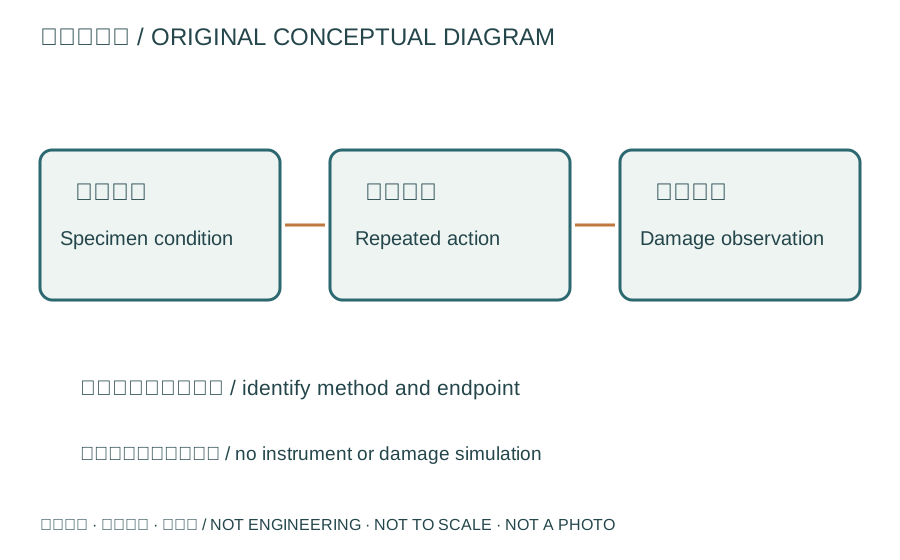
Use the bill of materials and retained reference to link identity. PU fabric, TPU fabric or similar material is insufficient for tracing a specific construction. The original diagram separates specimen condition, repeated action and damage observation. It is not a drawing of equipment or a standard specimen. Its role is to identify the information chain needed for interpretation, without implying an unverified product structure.
Original conceptual diagram; not engineering, not to scale, not a photograph or product/test evidence.
04
Read cycles with the damage criterion
Ask whether the report records observation after an agreed number of cycles or uses a defined damage endpoint. Retain the laboratory's criterion and observations. Completed cycles should not automatically become a claim that no change occurred in any aspect of the material.
When photographs accompany the result, identify the tested face and observation condition. A routine phone photograph cannot establish every subtle damage grade. Without supporting examination, do not label a visible crease as coating fracture or separation. Keep appearance, confirmed damage and a proposed explanation in separate fields. That makes a result clearer and avoids turning an ambiguous surface mark into a diagnosed failure.
05
Review the finished-bag movement separately
For a pack that folds or stows repeatedly, record fold locations, packing state, attached components and the intended user sequence. A material evaluation can supply useful evidence without recreating every corner and layer in the assembled product. Keep that distinction visible.
Use an identified bag sample to review stowing, reopening and returning to closure. Label the activity as a product-use observation rather than a standard material test. If the project needs a durability claim, establish evidence relevant to the intended use. Do not directly convert a laboratory count into years of service. Retain the actual sequence so later construction changes can be assessed against a defined movement.
06
Combine requirements without merging them
Repeated-flexing damage, coating adhesion and water resistance are different properties. A project may include them in one validation plan while retaining the object, state and method for each result. Passing one question cannot substitute for evidence on the other two.
If before-and-after evaluation is proposed, have the laboratory confirm sequence and specimen arrangements first. This article selects no universal cycle count, environment or acceptance limit. It also ranks no coating chemistry as inherently superior. The useful comparison is between identified constructions under relevant conditions, with the relationship between treatments and evaluations documented. Keep an incomplete plan marked as incomplete rather than filling gaps with assumptions.
07
Retain an approval another reviewer can follow
Keep the flexing evaluation traceable
Record material identity, method and edition, specimen condition, result expression, damage criterion and installed-use boundary. Separate data, supplier statements and questions awaiting verification. That makes review possible after a layer, finish or bag construction changes, rather than preserving an approval whose object is no longer clear.
This article reports no test and claims no JKPD adoption of a material. An approval should let the next reviewer identify what was evaluated, what was observed and which use conditions remain outside the evidence. A short flexing passed note cannot do that. Keep the reasoning and supporting documents with the actual material revision used in the project.
Related development guidance: PU layers and hydrolysis evidence.
Discuss your bag development project
ANSON XIE
General Manager & Founder
Quanzhou Junkai Pengda Special Equipment Co., Ltd.
Email: ansonxie@jkpdtime.com
Phone: +86 177 5095 3355
WhatsApp: +86 177 5095 3355
Factory address: Floors 2–4, Building 1, Phase I, Huixin Intelligent Manufacturing Industrial Park, Hui'an County, Quanzhou, Fujian, China