
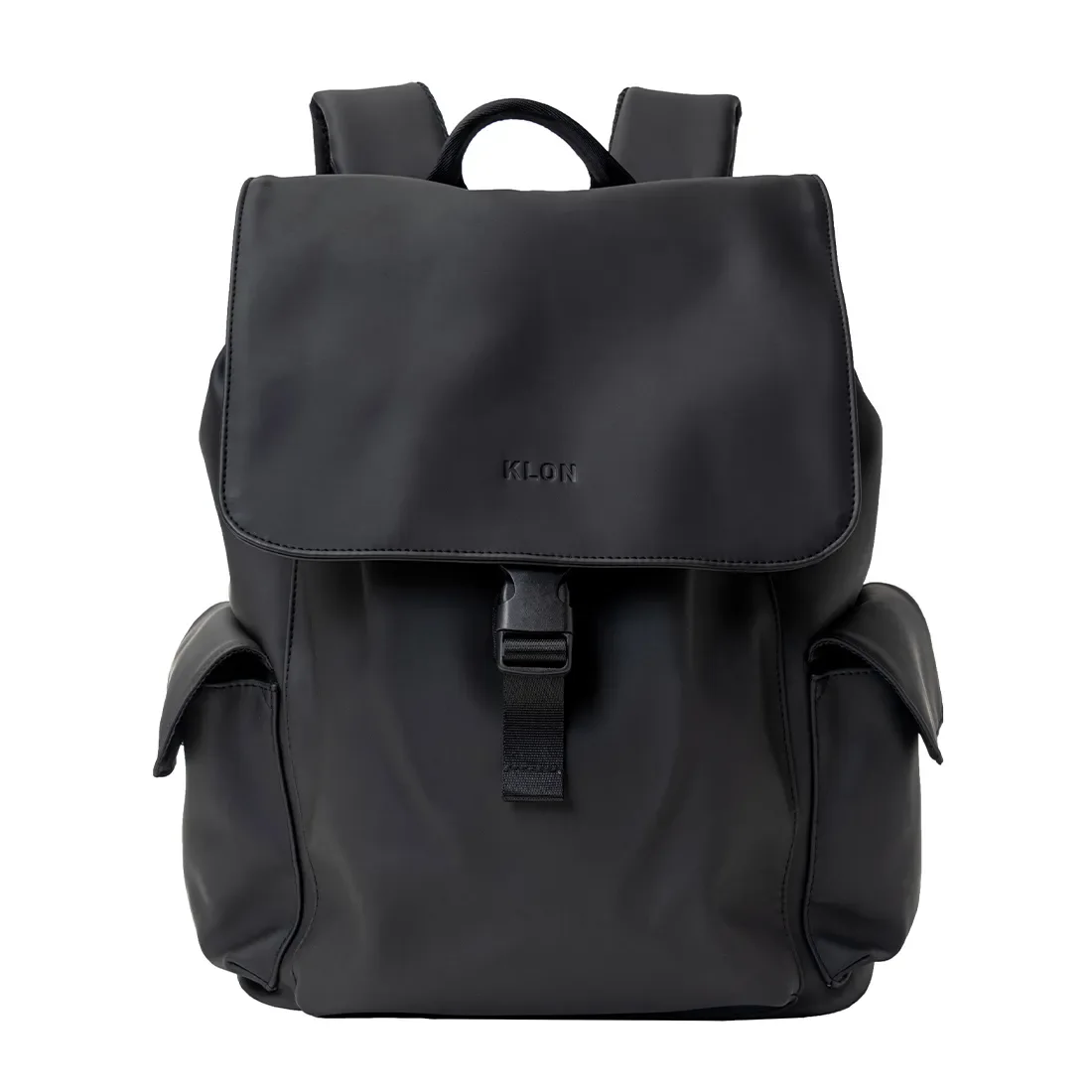
A smooth front flap can look approved while leaving an important question unanswered: what holds its layers together after cutting, folding and assembly? For a business backpack with a broad flap, the review should identify the proposed material stack and bond before accepting a supplier's peel-strength number.
The Klon 2 backpack reference provides a visible flap-and-pocket layout for this discussion. Its photograph does not reveal a laminate, adhesive chemistry or measured bond strength. The following checks apply when a development proposal uses bonded layers; they are not claims about the photographed sample or tests already performed by JKPD.
Treat appearance, bond performance and finished-panel behaviour as separate approval questions. A clean surface is worth checking, but it cannot establish how an unseen interface will behave. Equally, a strong laboratory result cannot by itself approve the shape and finish of a sewn flap.
01
Name every layer and the interface under review
Ask for a construction record rather than the shorthand “laminated fabric.” Identify the face material, backing, foam or reinforcement, adhesive system and the order of assembly. Record supplier references and revisions so a later material substitution does not inherit an approval for a different stack.
Mark which interface the proposed test will separate. A panel containing face fabric, foam and backing can fail at more than one location. A result for face-to-foam bonding does not automatically describe the foam-to-backing interface, even if both occur in the same finished panel.
The construction record should also distinguish supplier lamination from factory assembly. If a supplier delivers a finished composite and the bag factory adds another reinforcement, there are two processes to trace. Keep the foam specification separate from the evidence for the bond joining that foam to another layer.
02
Agree the peel method with the laboratory
ASTM D903-98(2025) concerns comparative peel or stripping characteristics of adhesive bonds under defined specimen and test conditions. Its public scope identifies pretreatment, temperature and machine speed as controlled conditions. It is a method reference, not a universal pass value for backpack panels.
Provide the actual proposed stack to the laboratory and ask whether that method and fixture suit the materials. Do not choose a test solely because a competitor's report names it. Thin flexible layers, a stiff backing and a fragile foam can present different gripping and separation problems.
Instron's peel-testing overview distinguishes tests involving flexible-to-flexible and flexible-to-rigid substrates. That distinction is a useful starting question, not permission to substitute one geometry for another. Request a report that identifies the geometry, specimen width, conditioning and calculation basis so the comparison can be understood.
03
Compare like-for-like results, including failure location
A number without its units and test conditions is not an approval record. Check whether the reported result is force or force per unit width, what part of the test trace contributes to it, and whether the specimen preparation matches the agreed procedure. Avoid combining results obtained by different methods into a single supplier ranking.
Instron's D903 guidance also calls for recording the type of failure. Ask for photographs of both separated faces and a description of where separation occurred. If a backing tears before the intended interface separates, the result should not be relabelled as a direct measurement of that interface's ultimate bond strength.
Use that evidence to decide what to investigate next. Separation at a boundary suggests different questions from tearing within a layer, but a photograph alone may not establish the root cause. Ask the material supplier and laboratory to interpret ambiguous residue or mixed failure before blaming the adhesive or increasing its application amount.
04
Connect coupon evidence to production processing
Retain the process record for the tested material. It should identify the relevant application and curing or setting conditions supplied by the material manufacturer, along with the actual production batch. Do not publish one generic temperature or dwell time as a recipe for every adhesive and substrate combination.
Then map what happens after lamination. Cutting, folding, printing, stitching and pressing may expose the composite to conditions that were absent from an incoming-material coupon. Select representative processed specimens with the laboratory and label any departures from the formal method; a cut-out from a finished bag is not automatically a standard specimen.
For a flap, include the fold line and turned edge in the practical review. Look for local lifting, surface distortion and areas where construction conceals a developing separation. These are observations to record, not proof of a particular failure mechanism. Keep the original coupon and processed-panel findings linked by material identity.
05
Choose conditioning from the intended use
Discuss expected storage and use with the buyer before ordering environmental exposure tests. Specify the exposure and the recovery state at which the sample will be examined. A test immediately after exposure answers a different question from one performed after a defined recovery period.
Compare conditioned specimens with appropriate controls and retain the full results, including appearance and the location of failure. Do not convert an accelerated exposure into a stated number of service years unless there is a defensible correlation for the system. A laboratory cycle is evidence under its stated conditions, not a general lifetime guarantee.
Keep this review distinct from the identity of a coated face material. The PU synthetic-leather material guide discusses the coating and backing evidence. Here, the question is whether the specific assembled stack and its bonding process support the intended panel design.
06
Resolve the trade-off instead of chasing the highest number
Write the acceptance criteria before comparing candidate constructions. Bond performance matters, but the panel must also bend as intended, sew cleanly and retain an acceptable surface. The highest peel result is not automatically the best construction if its stiffness conflicts with the flap design.
When stiffness and edge behaviour disagree
For an illustrative comparison, suppose one proposed stack keeps a flat face but resists folding, while another folds easily and shows edge lifting in the agreed review. Neither observation alone identifies the best adhesive. Review the layer thicknesses, fold construction and process evidence, then change one controlled factor at a time so the next comparison remains interpretable.
Avoid using added stitching to disguise an unexplained material change. Stitching may be part of an approved construction, but it changes the design question and introduces its own holes and edge constraints. If it becomes necessary, document the revision and repeat the relevant finished-panel checks rather than carrying over the previous approval unchanged.
07
Keep a traceable approval package
Release the panel with a material-stack drawing, supplier references, process revision, test reports and approved appearance sample. Include the laboratory's limitations and the buyer's acceptance decision. Production staff need to know which substitutions require review, not merely that a sample once passed.
During production, retain enough batch identity to connect an observed panel issue to its material and processing records. Use a defined inspection plan for visible lifting or distortion, while keeping visual inspection separate from laboratory bond verification. A good-looking batch does not make the underlying test record unnecessary.
The next useful supplier question is therefore specific: which interface was evaluated, under what conditions, and does that specimen represent the panel we will manufacture? Answering it makes the bond evidence usable without overstating what a photograph or a single peel value can prove.
Discuss your bag development project
ANSON XIE
General Manager & Founder
Quanzhou Junkai Pengda Special Equipment Co., Ltd.
Email: ansonxie@jkpdtime.com
Phone: +86 177 5095 3355
WhatsApp: +86 177 5095 3355
Factory address: Floors 2–4, Building 1, Phase I, Huixin Intelligent Manufacturing Industrial Park, Hui'an County, Quanzhou, Fujian, China