
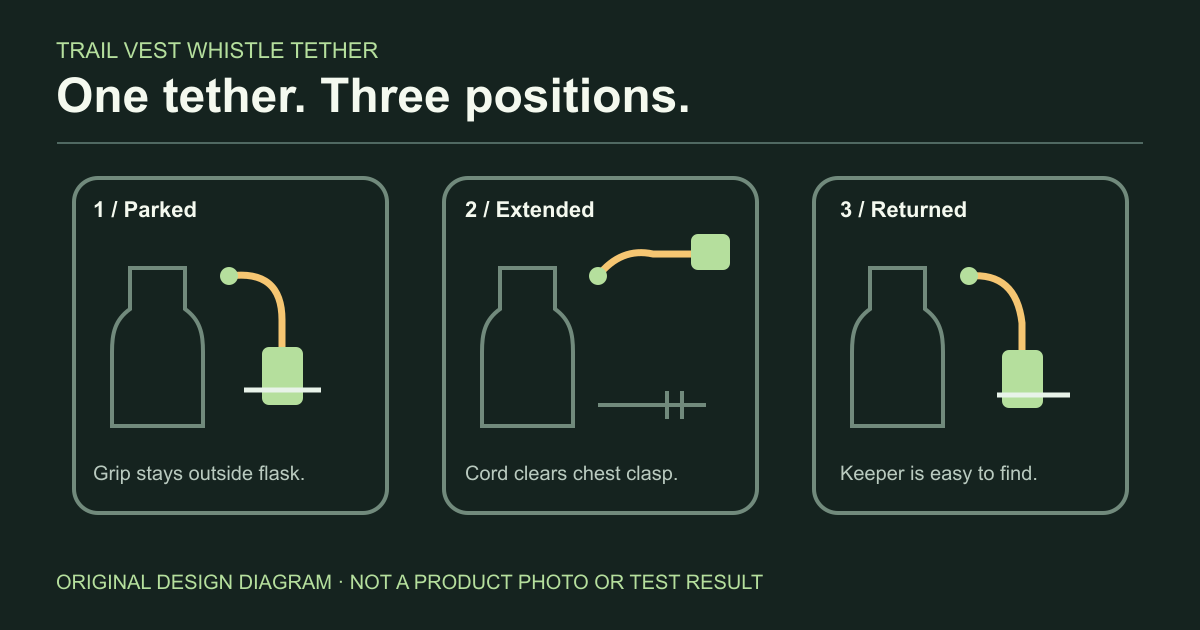
A whistle can be easy to find when the vest is empty and disappear behind a full soft flask on race day. Give it a fixed parking point, just enough reach to use it while the vest is worn, and a return path that does not cross the chest closure. Treat all three as parts of one design.
Key takeaways
- Test the parked, deployed and returned states with both front flasks filled.
- Keep the cord clear of the neck opening and neighboring closures.
- Check retention separately from access. Pulling harder is not the only way to keep a parked whistle in place.
- Follow each event's current gear rules; this is a sample check, not a race approval.
01
Give the whistle its own place
A fixed parking point is useful because the runner can find it by feel without searching through nutrition or fishing beside a phone. Put a sample on a wearer, mark the collar edge and the fullest part of the flask, and compare more than one anchor position. Choose a point that remains accessible on the intended size range.
A whistle included with a vest is not automatically accessible, and event rules can distinguish between carrying a whistle and carrying one that works. Check the event's equipment list separately. The design question here is whether the wearer can find, use and put away the proposed part without taking the vest off or opening something unrelated.
Decide what the hand touches first
A narrow pocket can give a rigid part a repeatable orientation. A loop can expose more of its end, but leaves more of the part free to rotate. Mock up both options with the actual hardware, not a paper outline. The hand should meet a graspable part before it encounters the cord or a neighboring pocket opening.
Use a clear visual or tactile distinction from a nearby zipper pull. For example, a broad parking tab need not feel like a thin cord pull. If the runner mistakes one for the other in gloves, change their shape or placement before trying a stronger keeper.
02
Check the cord while it is parked and extended
Set cord length with the vest on the body, not flat on a table. The front panel may shift when the flasks are full, a warmer layer is added or the chest is adjusted. Keep only the slack needed for the actual reach, and avoid a free loop across the neck opening or across shared hardware.
Look at the tether in two states. When parked, it should not form a loose loop the fingers can catch when retrieving a flask. When drawn out, it should not pull the shoulder panel into the neck, snag the chest clasp or drag a nearby pocket open. Have a second person stop the trial if a loop catches or a panel twists unexpectedly.
Keep the attachment separate from the main harness
Mark where the tether enters the seam, the local backing and the direction a normal pull applies. If tugging the tether visibly deforms the flask mouth, try a separate tab rather than stitching into the stretch binding by default. Compare the local change with an untreated sample so any restriction in the pocket is easier to see.
A tether attachment on a fabric vest is not a load-bearing point. Do not assume it can serve another job, such as attaching gear. If a removable whistle is specified, document what can be replaced and check that the replacement still parks in the intended orientation.
03
Separate release force from carrying position
Retention and retrieval are two different checks. A fitted keeper should stop the parked part from working out, but a wearer should still be able to slide it free without a sharp pull. Ask which direction the hand naturally moves. A keeper that resists motion in one direction can still release easily in another.
Check the whole sequence with the mouthpiece and sound outlet unobstructed. A sleeve can keep the rigid body from bouncing, but it can hide the grasp point when full or damp. An exposed loop can be quicker to locate but easier to snag. There is no universal winner: compare the actual keeper and the surroundings.
04
Run the check on a loaded sample
Start standing in a controlled space. Fill the flasks, close the intended pockets and fit the vest over both the lightest and the thickest layer in the brief. Ask the wearer to find the whistle without looking, withdraw it, bring it to the mouth and park it again. Check the sound only in an appropriate area without disturbing others.
Repeat with either hand, then with the gloves or wet sleeves expected in use. If a gloved pull opens a nearby zipper, mark the contact point instead of recording only a slow retrieval. If the keeper is hard to find after the whistle comes out, test a more distinct opening or a better return angle.
When the stationary sequence works, use a short, controlled movement check with the whistle parked. Reach for the flasks, open the neighboring pocket and recheck cord position. Record the wearer, vest size, layer, flask fill and hand used so a revised sample can be compared under the same conditions.
| Observation | First design change to compare |
|---|---|
| A full flask hides the grip | Shift the keeper outside the flask's loaded outline |
| The tether crosses the chest release | Change anchor or park location before increasing length |
| The whistle can be used but will not go back | Open the keeper entry or change its orientation |
| Pulling it distorts the pocket mouth | Test an independent backed tab and check pocket stretch again |
05
Write a testable requirement
A useful pattern note includes the parked position, anchor, working reach, release direction, compatible replacement part and adjacent controls that must remain free. Record the conditions the sample passed and any size or layer that still fails. A prototype that passes unloaded but not with water on board is not ready.
The race-kit access check covers the wider gear layout. The flask and chest-strap clearance review helps diagnose a nearby obstruction. For the whistle itself, approve the return to its keeper as deliberately as the first reach.
Discuss your bag development project
ANSON XIE
General Manager & Founder
Quanzhou Junkai Pengda Special Equipment Co., Ltd.
Email: ansonxie@jkpdtime.com
Phone: +86 177 5095 3355
WhatsApp: +86 177 5095 3355
Factory address: Floors 2–4, Building 1, Phase I, Huixin Intelligent Manufacturing Industrial Park, Hui'an County, Quanzhou, Fujian, China