
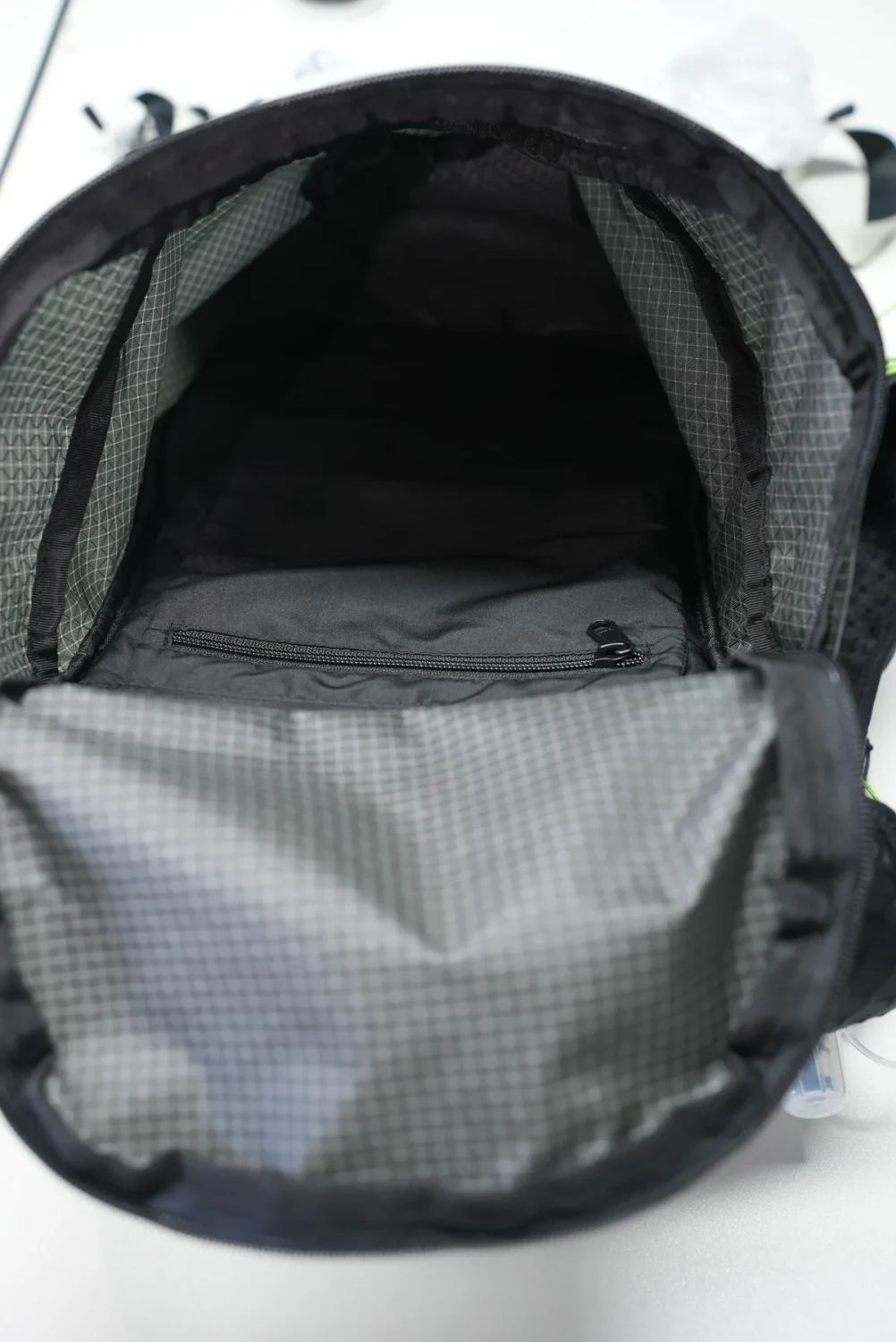
A trail running pack can hold every item on a race checklist and still be awkward on the course. A waterproof jacket can fit on the bottom while the only way to reach it is to pull out the water reservoir or set small items on the ground. A better sample review asks three questions: can the exact kit fit, can the runner retrieve the right item at the right time, and can the pack be closed again without losing track of anything?
Use the organizer’s list for the exact race, distance and edition as the starting point. The steps below describe a packing and design audit, not a universal gear list or a guarantee that any pack will pass an official check.
01
Build a real kit, not a list of names
The Ultra-Trail Australia mandatory gear page illustrates why specificity matters: the organizer publishes a distance-by-distance table, identifies weather-dependent equipment and describes separate procedures for some gear checks. A pack sample approved with one casual training load should not be assumed to accommodate the gear for a different event.
Lay out the actual items, including the phone in its case, the jacket packed as the runner intends to carry it and any separate dry protection the organizer specifies. Include the water containers filled to the intended starting level. An empty flask folds into a gap that disappears when it is full. Where rules or weather can add a layer, record a base kit and a second version with the extra item rather than counting the same storage space twice. If a buyer wants to design for several distances, keep a named kit for each instead of inventing a single average load.
02
Assign each item an access condition
Identify what the runner needs at a planned stop, what might come out quickly when conditions change, and what should stay protected until needed or inspected. A headlamp does not necessarily need the same entry as food, but it should not be buried under everything on a route that continues after dark. A phone can have its own location even when it is not normally used for navigation. The question is whether it can be found without emptying a full compartment.
For each item, write one sentence that describes the intended action. “Remove the shell at a stop without lifting out the filled reservoir” gives a developer something to check. “Provide easy jacket access” does not identify the blocker or even the state of the bag. Make it clear which actions are meant to be done with the pack worn and which deliberately take place with it off. There is no need to force moving or one-handed retrieval where a deliberate stop is the appropriate design assumption.
03
Trace the opening, not just the compartment
One way to organise access is to use a roll-top for loading the main chamber, a separate opening for the reservoir, and a lower zipper for gear packed underneath. Each opening needs a distinct job. Check whether the lower zipper actually lets the shell pass without removing the filled reservoir; an extra opening is not useful if the packed load still blocks the route.
When a second opening is worth adding
On the loaded sample, follow the intended path with your hand and the item together. Sometimes a long opening exposes the object but does not give enough room to turn it past the lip. A shorter opening can work when the jacket is deliberately oriented and held beside it. A second zipper may avoid unpacking, but it introduces another closure and can sit under tension from the contents. Compare it with the simpler alternative of moving the item near the existing opening. Record the space required to get the item out and put it back, not just the number of entry points.
04
Repeat the reclosure with a changed load
Start with the full kit and simulate an inspection at a clean, dry station. Ask for the same items in the same order on each sample. Note which other items have to be removed, where they are placed, and whether every closure can be checked again without dumping the rest. Then refill water and return the jacket after loosening its packed fold. Clothing that has just been taken off may not return to its original tightly rolled shape. If you need a separate container for wet gear, include the container and check where it fits without moving protected items out of place.
Run the same audit in a second state with less water and food but the required gear still present. A pocket can lose the support of a full neighbor; a pack that was neatly held by its full contents can need a new compression setting. Record the actual result rather than assuming an access path that worked once is inherently fast. Measure time only if it helps the decision and keep the start and finish criteria identical.
Check the packing map from the opposite direction, too: after returning each item, confirm that the next item can still be reached. A successful first retrieval can hide a problem if the repacked shell ends up hanging across a lamp pocket. The acceptance check should end with both the gear and the pack ready for the next leg.
05
Approve a packing map alongside the sample
Give the sample maker a list of reference items, named positions for the important ones, photos of the open and reclosed pack, and the actions it must support. For each failed step, record the obstruction precisely: the bottle body pushes into the zipper track, for example, or the shell clears the opening only after the lamp comes out. The next revision can then address that obstruction without unnecessarily increasing the entire pack volume.
For a runner comparing vests, bring real equipment and judge the pack by the access routes you will use, not by its empty shape or nominal capacity alone. For developers, treat a change in opening, liner, reservoir space or compression layout as a reason to run the same audit again. For related checks, see layered trail vest pockets and hydration sleeve compatibility.
Discuss your bag development project
ANSON XIE
General Manager & Founder
Quanzhou Junkai Pengda Special Equipment Co., Ltd.
Email: ansonxie@jkpdtime.com
Phone: +86 177 5095 3355
WhatsApp: +86 177 5095 3355
Factory address: Floors 2–4, Building 1, Phase I, Huixin Intelligent Manufacturing Industrial Park, Hui'an County, Quanzhou, Fujian, China