
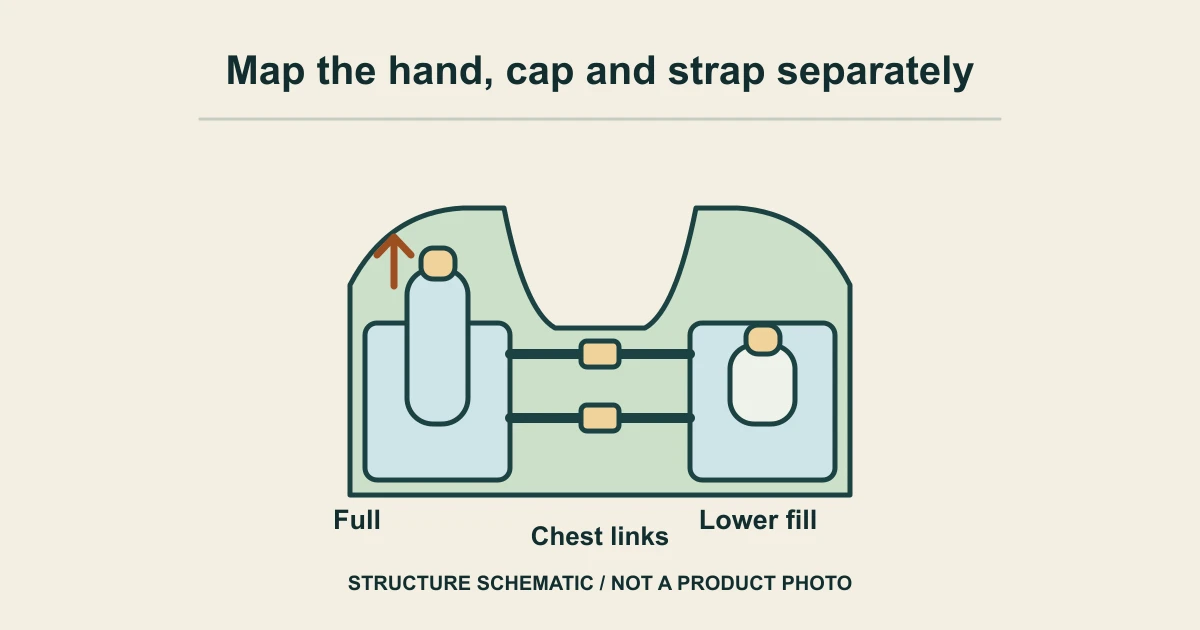
Moving hydration to the front lets the wearer drink without taking the pack off, but it also adds volume around the chest straps. The pocket mouth, cord and buckle can all work on a flat sample and still collide on a person. Check the shared space as the flask empties and the torso moves; tightening everything is not a reliable solution.
Key takeaways
- Draw the hand and cap paths.
- Keep the normal chest adjustment usable.
- Review an uneven water load as well as two full flasks.
01
Where should the hand enter?
Mark both the direction of the hand and the direction in which the flask leaves the pocket. They are not necessarily the same. A hand might approach from the center, for example, while the cap has to clear the top edge first. Sketch those two routes before marking the chest connection on the pattern.
Test the actual flask, including any protruding valve, with the wearer in their normal layer. A shorter stand-in can make a crowded shoulder area look usable. If either hand should reach either flask, test the cross-body approach as a different task rather than assuming symmetry.
02
Can the chest connection keep its adjustment range?
A workable strap has accessible adjustment positions when the neighboring pocket is loaded. It should not be necessary to leave a chest connection unusually high or low simply to free a zipper or flask cap. Include wearers whose comfortable settings put the connection close to the mouth.
Separate pocket movement from pack movement
Ask the reviewer to note whether the flask moves inside its sleeve, the pocket moves on its panel, or the whole pack moves on the body. Those observations point to different changes. Tightening a chest strap may address the last one without adding retention to the sleeve or stabilizing its mouth.
03
What happens when one side empties first?
Compare both flasks full, one noticeably lighter than the other, and both low. Prepare each condition on purpose. Use the same short walk or easy jog on a safe surface, with no need to reach for gear while moving. Stop for the retrieval and reinsert the flask before repeating the route.
Write down whether the cap changes angle, the pocket lip folds, or the free cord tail covers the opening. An asymmetrical load is useful because it can reveal which side pulls out of position when a symmetric demonstration looked fine. The soft-flask pocket guide deals with fill states inside the pocket; this check asks what they do to the nearby attachment and access routes.
04
What if the back load changes too?
Reduce the main load without moving the front contents. Use the pack's intended compression settings and repeat the check. The same front adjustment can feel or sit differently once the rear load stops holding the body of the pack in the shape seen at the start. A photo showing one packed state can't establish that the routes remain separate.
An easy mistake is refining the elastic pocket on one sample and altering the rear shell on another. Compare finished examples of the same revision before attributing a change to a single part. Keep the change list short enough that the test result can still guide the next sample.
05
What belongs in the supplier brief?
Identify the real flask, front closures, adjustment positions and two repeatable load conditions. Provide a separate observation for cap clearance, hand entry, contact between the closure and pocket, and movement on the body. Record what happened, not just whether a tester said the pack felt secure.
The approval goal is a layout where accessing a flask doesn't require disturbing the setting that makes the harness fit. Assess access and front-load control together rather than accepting an empty-pocket demonstration or a single tight strap setting.
Discuss your bag development project
ANSON XIE
General Manager & Founder
Quanzhou Junkai Pengda Special Equipment Co., Ltd.
Email: ansonxie@jkpdtime.com
Phone: +86 177 5095 3355
WhatsApp: +86 177 5095 3355
Factory address: Floors 2–4, Building 1, Phase I, Huixin Intelligent Manufacturing Industrial Park, Hui'an County, Quanzhou, Fujian, China