
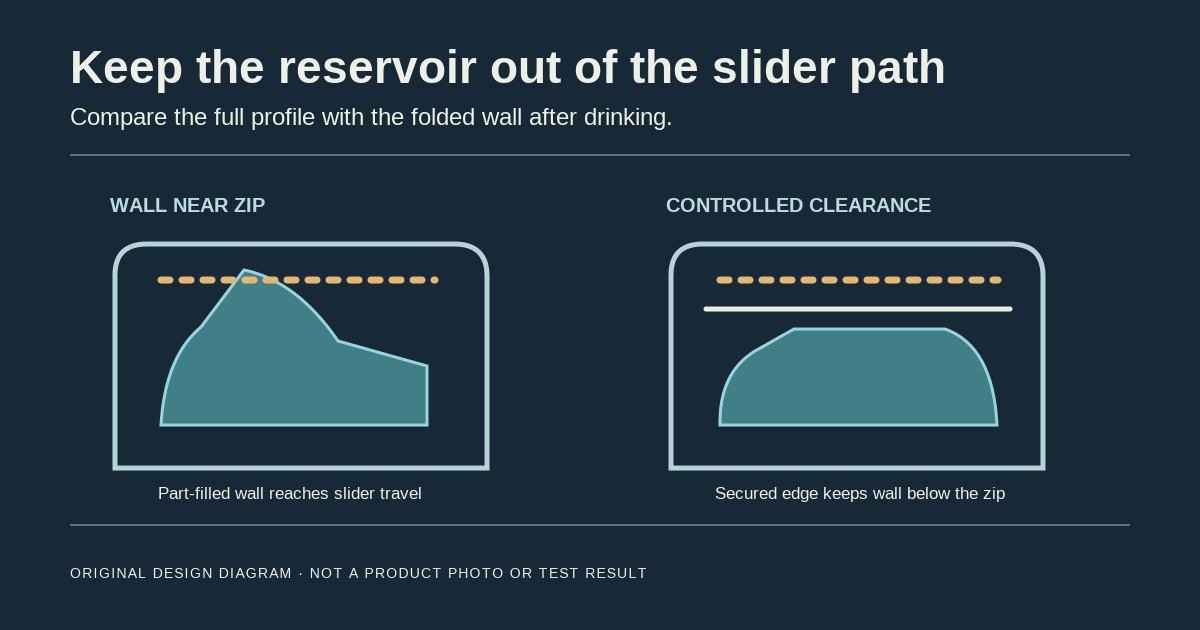
A full hydration reservoir can fit the sleeve and still obstruct the zipper. The opening moves when the bag is packed, the top closure is often wider and firmer than the reservoir wall, and a soft corner can drift toward the slider as the water level falls. Set a clearance zone around the zip's complete path, then check insertion, closure and removal with the actual reservoir. Measure the loading path as well as the storage space. They are not necessarily the same shape.
Check more than the advertised capacity
- Record the filled profile, upper seal, grab tab and lower connector of the chosen reservoir.
- Mark where the zip and its backing pass when the vest is loaded, not just where the sewing line sits.
- Compare a full, partly emptied and empty reservoir before approving the sample.
01
Draw the reservoir as an assembled part
Use the real reservoir, including its mouth closure, hanger tab, hose connection and any connector wings. Some flexible reservoirs are filled at a broad top opening and use a sliding closure, so the part that must turn through the bag opening is not simply a soft rectangle that can be squeezed anywhere. Ask the buyer to identify the exact variant and the fill condition to use. Two products with the same stated capacity can have different opening requirements.
Lay the closed reservoir next to the vest panel and mark its widest upper and lower features. Then insert it as a wearer would: with the connector in the intended orientation, and the other rear items still packed if they are expected to stay there. Note whether the seal passes under the zipper comfortably, whether the tab is accessible and whether the connector needs to be turned. Do not ask the user to press against the seal itself to make the part fit.
02
Put the zipper and the reservoir on different paths
Trace the slider's path with the vest empty, then watch it from inside while closing the pocket on a full load. Check the upper corner, the fitted end stop and the part of the path where the opening changes direction. A nominally wide entrance can still place a short, tight curve directly above the reservoir seal. When the slider pulls the tape toward the sleeve, a liner edge or a soft corner can be easier to catch than it was in the flat pattern.
A fixed divider can keep the reservoir on its intended side of the closure. If that divider is a loose sheet, it can become the next item caught. Secure its edge away from the elements and leave enough room for the wearer to guide the reservoir out again. A narrow bound edge or folded shield may need less space than a full panel, but check whether it can roll or curl into the slider as the pack wears. Supplier examples of anti-snag geometry can explain the mechanism; they do not replace that check on a complete vest.
03
Find the failure that appears after drinking
A full reservoir tends to hold its own shape. Partly emptied, the same wall can sag or fold, especially if wet gear presses against the pocket from the other side. Test the hanger and sleeve together: a hanger can hold the upper tab without controlling the softer side of the reservoir, and a deep sleeve can support the base while leaving the top free to move into the opening.
Run the loaded sample through a standing refill sequence and a short controlled movement sequence using water only. Open and close the zip with the reservoir full, at the intermediate fill used for development, and after draining it. If the closure sticks, stop and look. Identify whether it has caught the barrier, reservoir wall, hose, grab tab or something in the companion pocket. Do not use pull force to mask a collision; extra force can obscure which part actually interferes.
04
Compare a divider with a small geometry change
Make the first correction narrow enough to understand its effect. Extend a sleeve edge only where the wall moves into the zip, move the zip corner if the stiff seal has to turn, or shift the hanger if the tab rests where the slider parks. Keep the same reservoir, fill condition, companion load and zipper type while comparing prototypes. Otherwise a change in the water load can look like an improvement in pattern clearance.
| Observation | First change to investigate |
|---|---|
| Seal clears the mouth but wedges at the corner | Review the bend and opening length before increasing sleeve width. |
| Soft wall approaches zip only as water is used | Recheck the sleeve edge and top support in the partly filled state. |
| Divider edge gets caught | Secure the edge and check its curl, seam allowance and loaded position. |
| Hose obstructs the initial closing movement | Revise the exit or park the hose away from the start of slider travel. |
A shield costs space and adds an edge for the wearer to work around. A larger opening can make the part easier to insert but move the zipper toward another pocket. Compare which task actually fails. If the bag is also designed for flask-only use, repeat the zipper check with the reservoir removed and the normal gear in that area.
05
Record the approved refill sequence
Keep the exact reservoir and a loaded sample as references. Photograph the slide closure entering the bag, the connector orientation and the natural position of the zipper guard. Record which rear items could stay packed, whether gloves were used and any step that needed two hands. Agree what counts as a snag, an incomplete closure or an unnecessary unload before approving the design.
Repeat the check after changes to grading, zipper tape, seam allowances or the reservoir supplied with the pack. The dual hydration layout guide compares carrying water at the front and rear; the reservoir maintenance guide addresses removal and cleaning. The decision here is whether the reservoir can pass through a specific opening and stay away from the moving slider, even as its shape changes with use.
Discuss your bag development project
ANSON XIE
General Manager & Founder
Quanzhou Junkai Pengda Special Equipment Co., Ltd.
Email: ansonxie@jkpdtime.com
Phone: +86 177 5095 3355
WhatsApp: +86 177 5095 3355
Factory address: Floors 2–4, Building 1, Phase I, Huixin Intelligent Manufacturing Industrial Park, Hui'an County, Quanzhou, Fujian, China