
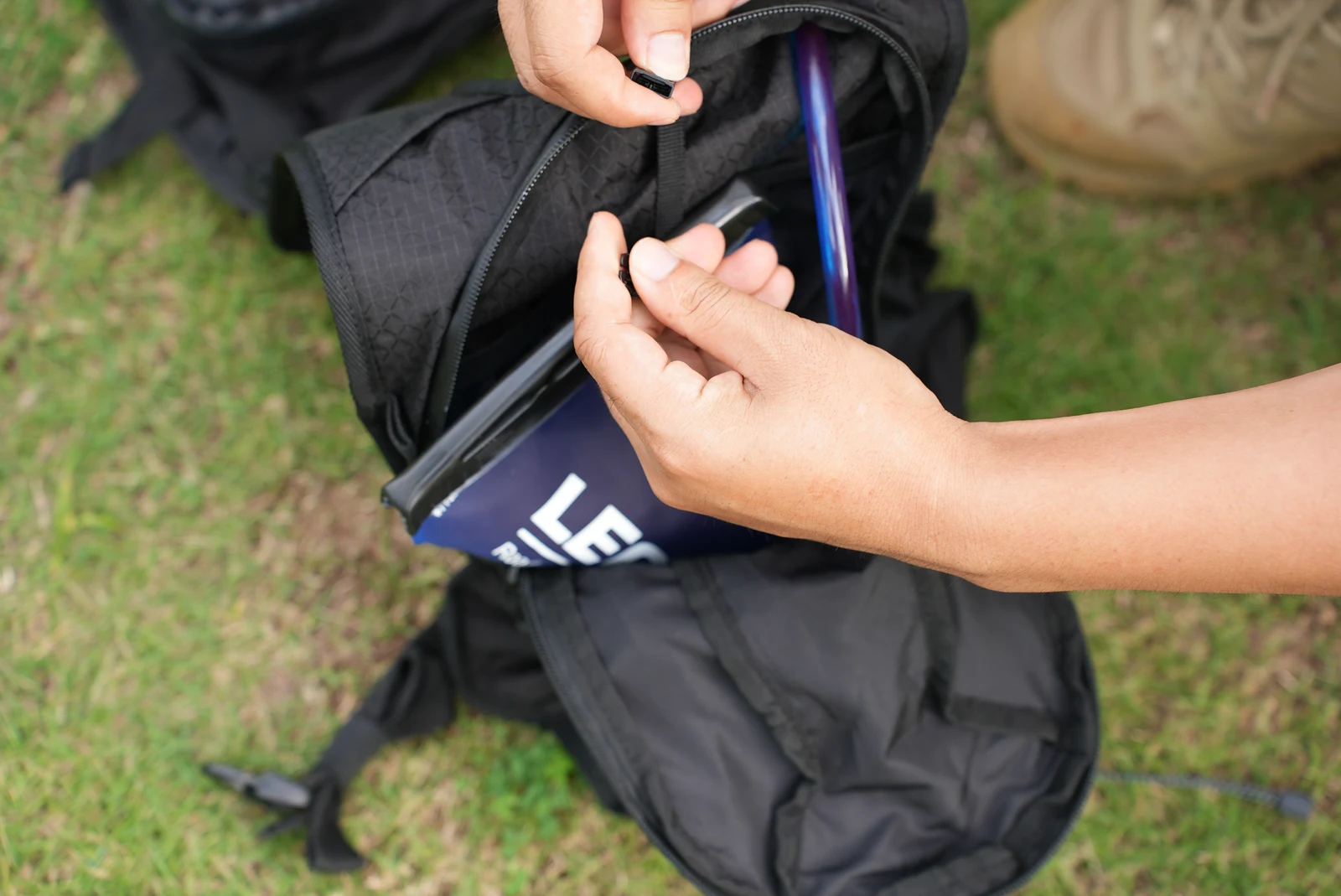
A hydration pack's maintenance access should let the user identify attachments, release the tube and remove the reservoir before reinstalling it in a clear sequence. Including maintenance during development can reveal an unreachable connection, a loose part that is easily misplaced or a tube caught during reassembly.
Define care requirements for the reservoir, textile carrier and tube. The photographs show assembly and open conditions. The selected equipment's instructions establish its cleaning and drying method.
01
Make the attachment area visible when open
The user needs to recognize where the reservoir is held and which parts require release. The opening should provide a view and working space, with an understandable relationship between the zipper, fabric panels and tube. This matters during removal as well as during the first installation.
Hands working near the compartment entry are visible in the photograph. Use that region as a construction reference, then record the actual release sequence on the sample. Establish whether a securing strap or a tube connection is handled first so routine maintenance does not depend on repeatedly trying different routes.
02
Provide room to grip and support the parts
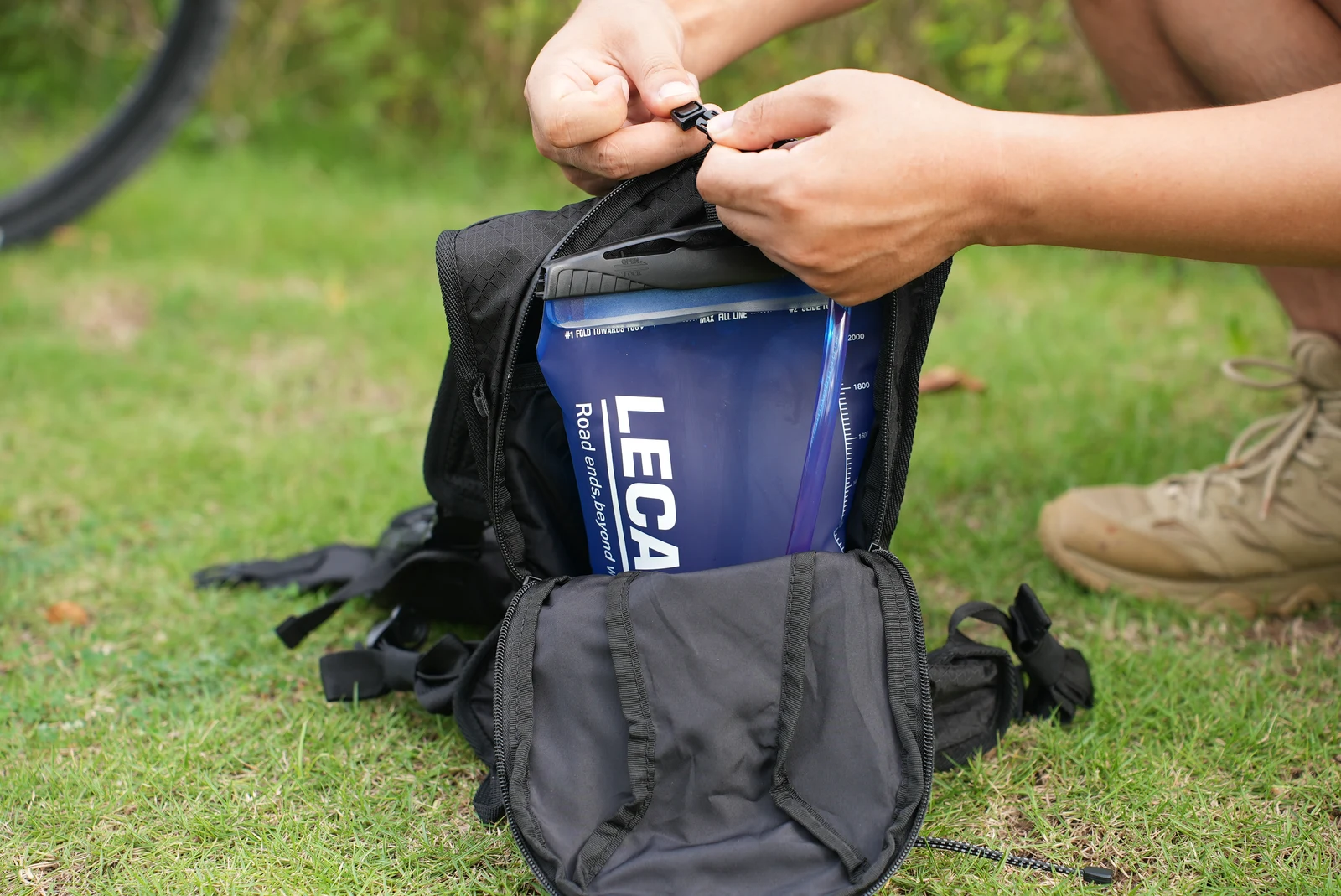
The fingers need access to a connection while another hand supports the reservoir or carrier. If the arrangement encourages pulling on the tube because nothing else is reachable, reconsider the opening extent, attachment location or direction in which the compartment unfolds. Compare the complete action on the matched sample.
The image does not reveal every internal connection. Procurement should identify the chosen reservoir and its physical reference. A different reservoir thickness, opening or fitting can change access around the same mounting location. Repeat the removal comparison when the reservoir changes, even if its advertised volume remains similar.
03
Connect removal with the drying arrangement
Manufacturer care guidance calls for cleaning the reservoir and associated tubing and allowing the components to dry before storage. For the carrier developer, that creates an access requirement. The reservoir and tube need a practical route out, while reachable textile surfaces and attachment areas need to remain available for inspection.
Use the selected equipment's instructions for cleaning agents, temperature and removable components. This article takes the general cleaning-and-drying requirement and applies it to maintenance access in a soft carrier. It does not prescribe another product's chemical process for the photographed reservoir. CamelBak care guidance
04
Specify textile care alongside reservoir care
The reservoir and pack fabric need their own confirmed care instructions. Record the reservoir-removal sequence, accessible carrier surfaces, cleaning method for the textile construction and the arrangement used for reassembly once the relevant components are ready. Keeping these details with the sample makes later revisions easier to compare.
When lining or reinforcement changes, inspect whether the new material alters opening movement, hand space or the way the carrier rests during drying. The photographs do not identify fiber composition. Confirm the appropriate fabric care from the selected specification rather than assigning a wash method from the product's appearance.
05
Follow the complete tube route during reinstallation
Trace the harness and tube positions on the matched open sample. Discuss reinstallation as placing the reservoir, restoring its attachment, arranging the tube and closing the entry. Then inspect the sections passing near moving panels, straps or other components that can change position during closure.
The chosen construction determines the actual order. Record that order during the sample demonstration. Where a fitting needs disconnection, follow its manufacturer's instructions when restoring it. No sealing or endurance evaluation of this photographed combination was performed for the article, so the assembly views are used only as visible references.
06
Retain a maintenance reference for later revisions
Keep the approved sample identifiable
For OEM/ODM handover, keep views or an action record for removal, the open conditions needed for drying and reinstallation. Identify the reservoir and carrier revisions. Use the same sequence when comparing changes to the securing strap, access opening or tube exit so the effect of the revision can be assessed.
The development discussion is original and the photographs come from the authorized company library. More product-development topics are available on the JKPD blog.
Related: hydration pack hip pocket access. See the photographed product reference.
Discuss your bag development project
ANSON XIE
General Manager & Founder
Quanzhou Junkai Pengda Special Equipment Co., Ltd.
Email: ansonxie@jkpdtime.com
Phone: +86 177 5095 3355
WhatsApp: +86 177 5095 3355
Factory address: Floors 2–4, Building 1, Phase I, Huixin Intelligent Manufacturing Industrial Park, Hui'an County, Quanzhou, Fujian, China