
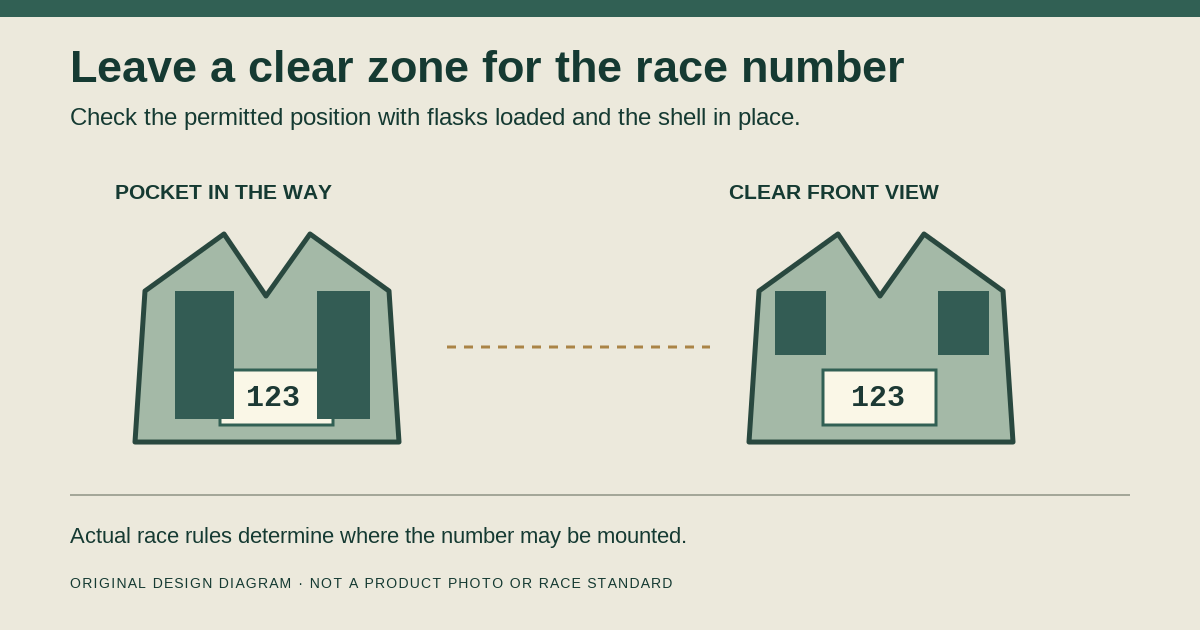
A race number has to stay readable after the vest is loaded and the runner changes layers, not just while the sample lies flat on a table. Start with the event's current placement rules. Then check the allowed location against the full flasks, chest closures, reachable pockets and jacket. The result may be an attachment option, but it can just as usefully be an unobstructed area on the runner's clothing. Do not add a hook to the vest until you know whether the organiser permits the number to be attached to the pack at all.
Three decisions to record
- Where can the number legally sit for the intended event?
- What crosses that space while the runner loads a flask or puts on a shell?
- Can the number remain flat, legible and in the same permitted area after the change?
01
Treat the rules as an input, not a product claim
Some organisers require the number on the front of the torso, over the outermost clothing, and do not permit attachment to the pack. Other events illustrate different permitted placements. Some also tell runners not to fold the number because it contains a timing device. Check the race and distance in the current runner guide. A garment accessory that works well on the sample is not proof that an event permits it, and a clear line of sight is not a timing-system test.
Place a plain paper template of the actual number dimensions at each allowed position before drawing any attachment hardware. Include the whole outline, not just the printed digits; an event may require names and other markings to remain readable. If official dimensions are not yet available, record the size range being designed around and repeat the exercise when the actual number is issued. The objective is to leave usable space, not to make an unqualified race-compatibility claim.
02
Mark the front of a loaded vest
Set up the pack as it will be worn, with two filled flasks and the normal front-pocket contents. Mark the edge of each flask pocket, the movement of a cap, the ends of adjustable chest cords, and the area swept by a zipper pull. A template that looks clear on the bench may disappear partly behind a flask or under a fully loaded pocket. A loosely parked cord can also land across it when the runner bends forward.
Ask the wearer to put a flask back without looking down, open a zip and reach across the body. Watch from the front rather than trying to infer the view from above. Separate a brief hand crossing the number from a cord or pocket that remains over it after the hand moves away. Reposition the relevant pocket edge, cord parking point or allowed number location if it remains covered. Avoid solving the problem by lowering both flasks if that interferes with drinking reach.
03
Decide what happens when a shell goes on
Run the check in the lightest layer and again with the actual shell. If the shell is under the vest, its zip, flap or loose hem can still affect a number pinned to the garment. If the shell goes over the vest, it can hide the entire front layout. Where the rules require the number on the outermost layer, start with the allowed way of moving the number to that layer; a permanent mount on the vest is not a solution.
Try putting on and removing the shell with the vest already loaded. During development the wearer should do this standing still, with time to see what catches. A number attached to a layer that is regularly stowed can be misplaced; attaching it to a removable piece of clothing should be consistent with the event's instructions. Use a mock number for prototype work rather than making holes or sharp folds in a live timing number.
04
Compare the clearance in real use
Repeat the same sequence on the smallest and largest fit samples selected for the brief. Put the chest adjustment at a comfortable position for each wearer; forcing everyone to use the same position hides the effect of grading. Check both pockets occupied, then empty one flask and repeat the return movement. For a short movement check, use representative apparel and have an observer note what is still readable when the runner bends at the waist or swings the arms.
| Situation | What to verify |
|---|---|
| Loaded front pockets | The complete number remains visible from the front after the hands are lowered. |
| Chest adjustment moved | Loose tails stay clear and there is still room to reach the permitted attachment. |
| Shell on and off | Number placement still follows the event instructions in both layer states. |
| Flask withdrawn and returned | Neither the paper corner nor its permitted attachment enters the cap or pocket path. |
Do not use an extra clip to solve a fit problem until the obstruction is identified. A clip needs somewhere it can live without rubbing, scratching a garment or restricting chest movement, and some organisers may not allow that arrangement. If the template buckles, record which edge lifts and what presses against it. A local change at the pocket mouth may be more useful than an entirely new panel.
05
Put the decision on the production brief
Save a front-view photo of each approved load and layer state with the plain template in position. Label the source date for the organiser's instructions, the intended placement, the sizes assessed and any limitations. Where the page specifies room for a number rather than an integrated mount, describe it as clearance and avoid stating that the pack itself satisfies race rules. Check the production sample after any change to chest cords, flask supplier, pocket height or shell-facing trim.
The race kit access audit covers reaching the contents used during a gear check. The flask and chest strap clearance guide isolates hand and flask travel. Here the acceptance decision is simpler: the intended number placement is permitted, it stays visible after normal handling and people can still operate the pack without fighting the paper.
Discuss your bag development project
ANSON XIE
General Manager & Founder
Quanzhou Junkai Pengda Special Equipment Co., Ltd.
Email: ansonxie@jkpdtime.com
Phone: +86 177 5095 3355
WhatsApp: +86 177 5095 3355
Factory address: Floors 2–4, Building 1, Phase I, Huixin Intelligent Manufacturing Industrial Park, Hui'an County, Quanzhou, Fujian, China