
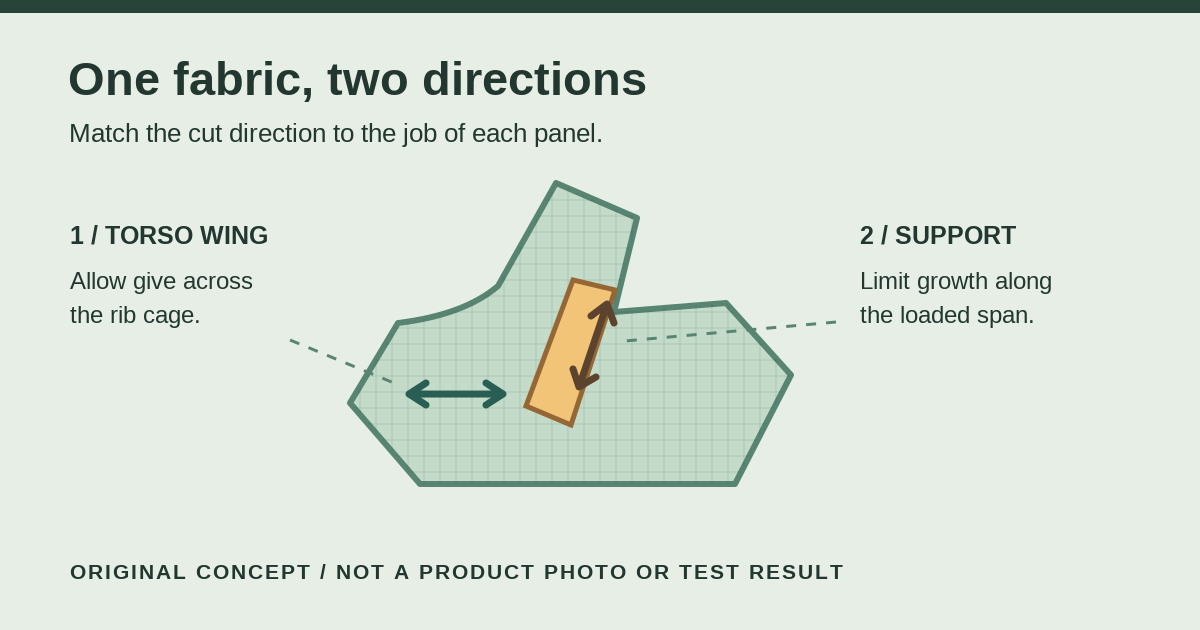
A running vest needs give around the ribs and restraint along the path from the front load to the shoulders. Those are different jobs. A knit described as stretching in both directions may still move much more easily one way, and a panel turned to save cutting space can change how the finished vest sits. Put the intended stretch direction on the pattern before comparing fabrics or approving a marker.
What to decide before cutting
- Where should the torso shell yield when the wearer takes a deep breath?
- Which load-bearing spans should avoid lengthening under a full flask?
- Which cut directions survive grading, nesting and a change in fabric lot?
01
Start with the forces on the assembled vest
Spread an empty vest on the bench, then put the same pattern on a wearer with both flasks filled and the rear compartment packed as intended. On the side wing, the principal job may be to follow changes in torso circumference. Under a front flask, the important span may run upward toward the shoulder rather than directly across the chest. A pocket or strap can also pull diagonally across the piece. Draw the directions that matter on the pattern while it is related to the body; edge shapes by themselves do not tell you which way the piece should yield.
Take one common failure: a side wing feels comfortable, but the front pocket drops when loaded. Tightening the chest closure can reduce visible movement without correcting growth in the support span above the pocket. The next sample could keep the side wing flexible and orient or reinforce the front connection differently. A directional change will not fix a poorly anchored seam, so identify whether the fabric, elastic binding or the attachment moves before choosing what to change.
02
Look beyond a four-way description
Compare strips along two marked axes on the same roll, using the same gauge length and observation conditions. A supplier's stretch percentage is difficult to use without the specimen direction, the way it was loaded and the point at which length was read. Ask for the force or loading basis and how much the specimen remains extended after release. The two readings answer different questions: whether a piece can accommodate movement and whether it comes back after the load is gone.
For low-power knits, ASTM D2594/D2594M distinguishes stretch under load from growth after extension. It is a fabric method, not a completed-vest test, and the standard notes that other methods may be better suited where the fabric is intended to provide support. Ask the lab to choose the relevant method and report both the setup and direction. If the harness takes load on a diagonal, a diagonal comparison can be useful as an internal development check; do not label a shop-floor comparison as a standardized result.
03
Separate pattern direction from fabric appearance
Keep two related marks on the pattern: one references the repeatable roll direction, and the other identifies the principal direction of give intended on the body. If those relationships are documented on a flat approved swatch and the pattern, a new designer can understand why an asymmetric part has a particular orientation. Terms such as lengthwise, widthwise or crosswise need a shared reference; on an unmarked replacement cut, the closest long edge is not necessarily the same direction.
The mesh can look symmetrical while behaving differently along its two axes. Turn a spare wing in the experimental sample rather than assuming an efficient nesting rotation is harmless. Identify left and right and the face of the fabric before checking both sides. Turning a piece end for end is not the same as rotating it by a right angle; finish, face or directional surface properties may impose their own constraints. Approve the rotation rules explicitly instead of asking production to infer them.
04
Compare two samples with the same cuts and loading
Use two samples with the same size, seams, binding, pocket shape and load. Change the orientation on one bounded panel only. Mark comparable points on both samples just above the flask and beside the closure. Read the panel unloaded, fully loaded and after a planned recovery interval. In a short worn comparison, look where movement begins: below the hand, at an attachment, along the seam or across the whole wing.
Do not let the wearer readjust one vest during the comparison unless adjustment is part of the check. If they need to tighten only one version, note that as a result. Compare full and partly emptied flasks, then check that the tighter-support version still allows breathing and arm movement. Measure vest position and ease separately so an apparently stable but restrictive sample is not approved on movement alone.
| Observation | First comparison to make |
|---|---|
| A loaded flask drops but the wing feels stable | Compare the shoulder-to-pocket span with matching flask loads. |
| The ribs feel restricted before the closure reaches its intended position | Compare the wing orientation and entry travel separately. |
| One half twists when the other sits flat | Confirm mirrored pieces, face and cut arrows before adjusting the pattern. |
| The swatch recovers but the sample curls | Compare binding tension and seam allowance before changing the base knit. |
05
Keep the decision through grading and bulk cutting
Put the approved arrows on the production pieces, not only on the sketch handed to the patternmaker. Check the smallest and largest planned sizes for direction at the load anchors and room across the ribs. A graded edge may curve differently while the intended stretch direction stays the same. If a larger piece no longer fits the marker without a turn, resolve that trade with the sample team before changing the direction.
Keep the approved roll and face reference, named sample, size, maker's pattern revision and photographed marks together. At incoming inspection, compare both axes with the retained swatch. At first-piece inspection, confirm which panel the arrow governs, especially when a shell and pocket look similar loose on the table. Repeat the affected worn comparison if a substitute wears well as a flat swatch but changes the direction of give when sewn.
Finish with a simple record: “rib wing yields across the body; front support span holds its length under the agreed load,” plus the checks used to make that decision. The sports backpack pocket recovery guide isolates pocket stretch and residual growth; the trail vest seam comfort guide addresses assembled contact. Here the approved decision is the orientation of the torso pattern, not a generic fabric rating or measured claim about a commercial vest.
Discuss your bag development project
ANSON XIE
General Manager & Founder
Quanzhou Junkai Pengda Special Equipment Co., Ltd.
Email: ansonxie@jkpdtime.com
Phone: +86 177 5095 3355
WhatsApp: +86 177 5095 3355
Factory address: Floors 2–4, Building 1, Phase I, Huixin Intelligent Manufacturing Industrial Park, Hui'an County, Quanzhou, Fujian, China