
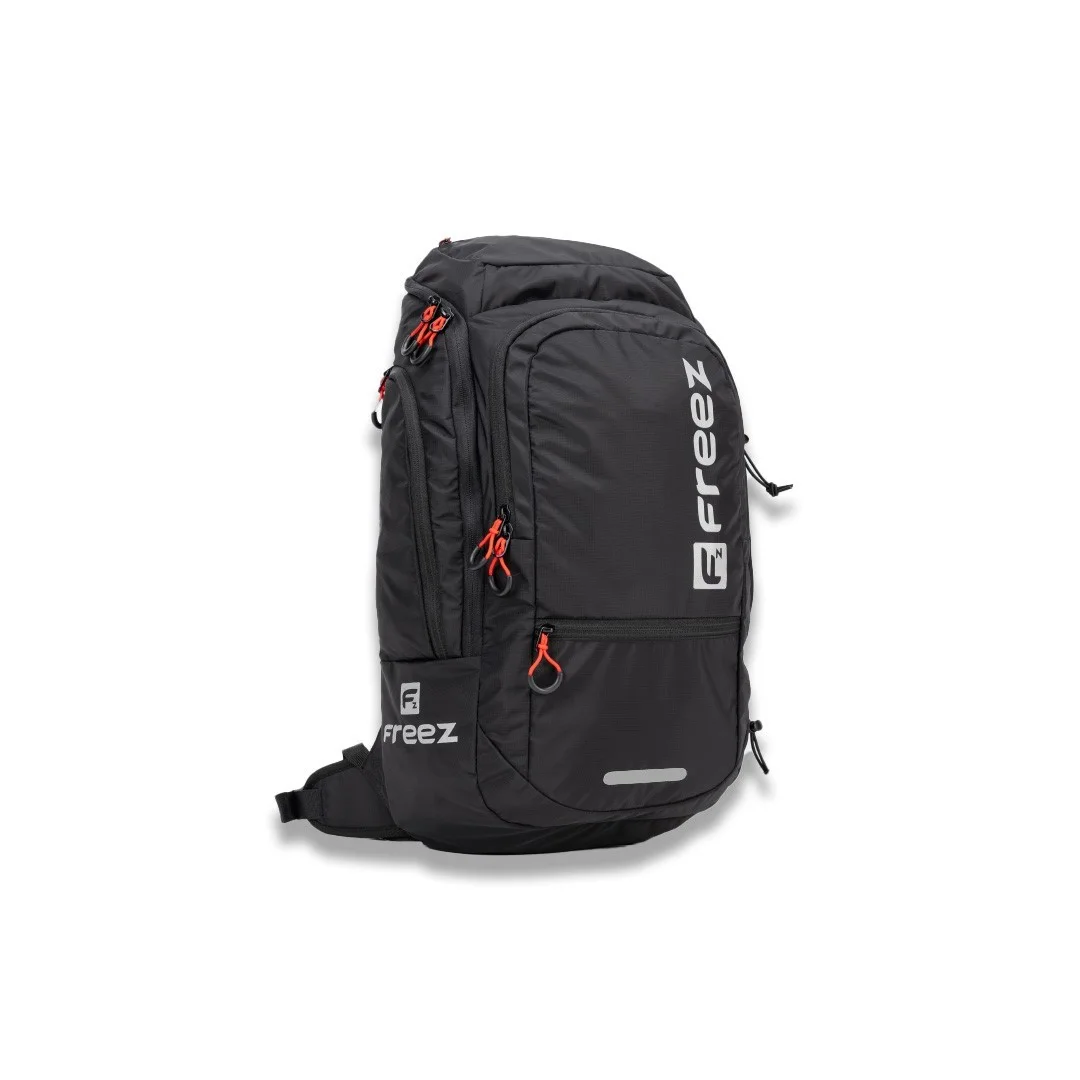
A sports backpack pocket can accept a bulky item yet remain loose after that item comes out. Easy insertion is not enough to approve stretch mesh. The development brief should distinguish extension during loading, shape after unloading and retention of the smallest intended object. Those outcomes depend on the assembled pocket, not just a supplier's description of stretchy fabric.
Start with a side or front pocket intended for a light layer, gloves or a defined accessory. Record the contents and how long they remain inside. Then compare fabric candidates in the same pocket pattern before changing the opening elastic or seam construction. The product photograph illustrates an external-pocket location; it does not identify mesh composition or prove recovery performance.
01
What should the pocket hold after it has been stretched?
Define the smallest and largest intended contents before choosing mesh. The largest item reveals loading effort and local strain. The smallest reveals whether the pocket still provides useful restraint after unloading. A material that works for a loosely folded jacket may be unsuitable for a compact accessory, even when both fit inside.
Write the use sequence as part of the requirement. An item inserted briefly during a shop demonstration presents a different review condition from one left packed between activities. Include the expected duration in the sample plan, without converting that duration into an unsupported claim about service life.
Keep retention distinct from security
An open stretch pocket is not automatically secure storage for valuables. If loss would have serious consequences, consider a closure or another compartment. Increasing fabric tension until every object is difficult to insert can undermine access without providing a reliable security feature.
The backpack capacity brief covers storage-volume definitions. Here, the question is narrower: whether a particular external pocket returns to an acceptable working shape after the intended packing sequence.
02
Ask for comparable stretch evidence
Request the method, specimen direction, loading conditions and recovery interval behind any percentage in a fabric quotation. A single stretch number without those conditions does not describe how two materials compare. Also distinguish extension under load from residual growth after the load has been removed.
ASTM's public D2594-20 description identifies fabric stretch and growth as useful when selecting knitted fabrics expected to stretch and recover. That page is a historical edition, not a current purchasing specification. Ask the testing laboratory to select the applicable current method and edition for the particular textile and purpose.
Do not present a hand stretch at the sampling table as an ASTM test. A laboratory result concerns its stated specimens and conditions; it does not automatically establish the retention of an assembled bag pocket. Keep the report as material-screening evidence and maintain a separate assembly review record.
03
Preserve direction and location in the pattern
Mark the selected fabric direction on both the cutting pattern and the retained swatch. If the fabric behaves differently across its directions, rotating the pocket can change how it accommodates contents. A supplier article number cannot compensate for an undocumented cutting orientation.
Make comparison samples with consistent seam allowances, pocket dimensions and attachment points. Include the top edge treatment because it may limit the opening before the pocket body reaches its useful extension. Label the elastic separately from the mesh so a later substitution does not go unnoticed.
An asymmetric pocket needs location-specific observations. Strain may concentrate beside a curved seam or at an opening corner rather than spreading evenly across the panel. Mark those areas on a photograph and compare them after loading, instead of averaging the whole pocket into a single good-or-bad comment.
04
Compare three states of the same sample
Review the pocket before loading, while holding the agreed contents and after unloading for the agreed recovery interval. Use consistent reference points and a repeatable measurement approach. Do not pull the empty pocket flat differently each time; the measuring action itself can change the apparent result.
- Before loading: record the relaxed opening and pocket shape, including any initial waviness.
- While loaded: note insertion effort, concentrated distortion, seam restriction and the position of the contents.
- After unloading: record residual shape change, edge behaviour and the fit of the smallest intended item.
These are proposed development observations, not a universal test method or a report of JKPD test results. The buyer and development team should agree conditions and acceptance limits before comparing samples. If a numerical requirement matters, define how to measure it and use suitable equipment.
05
Separate fabric growth from assembly problems
A loose opening can come from several parts of the assembly. Compare the mesh body, opening elastic, seam and attachment position independently. If the body returns but the top edge stays long, replacing the entire fabric may not address the part that changed.
Likewise, a pocket can appear to have poor recovery when its attachment seam has shifted or its base has settled into a different position. Inspect the reference points and stitch condition before drawing a material conclusion. Keep a control sample that has not undergone the loading sequence for side-by-side comparison.
If the opening is difficult to use from the start, inspect the assembled geometry before demanding stronger stretch performance. A narrow seam-limited throat can restrict insertion even when the panel stretches readily. The seam-junction review explains how converging layers affect a local assembly. Inspect the relevant joint rather than assuming all seams behave alike.
06
Include the intended exposure, not an invented endurance claim
Decide whether moisture, cleaning or prolonged packed storage belongs in the actual use case. Where it does, specify the condition and sequence with the development team. Compare like-for-like samples and record whether observations occur immediately afterward or following a defined rest period.
Do not prescribe washing merely because the mesh supplier tests washable fabric. Other bag components may require different care. The proposed review should match the eventual product-care instructions and should not create a claim that the complete backpack has passed a test that only a textile swatch underwent.
Also review surface damage separately from shape recovery. A pocket that recovers well can still snag against the intended object. A smooth-looking pocket can still lose useful restraint. Reporting these as different findings makes the next revision more precise and avoids a vague request for better mesh.
07
Release a construction, not just a fabric name
The approval package should connect fabric article and batch, cutting direction, finished pocket dimensions, edge elastic, seam specification and sample identifier. Add the agreed contents, loading sequence, recovery interval and acceptance observations. These details make the approved combination reproducible when production materials arrive.
If a candidate changes, state what changed and repeat the affected comparisons. A different elastic width, coating or cutting direction may deserve review even if the sales description remains the same. Keep the previous sample so the reason for approval remains visible.
For a sports bag development project, send the intended contents and access requirements alongside the reference shape. That gives the sampling team a concrete question to answer: not how far the fabric can stretch in isolation, but whether the finished pocket remains useful after normal loading and unloading.
Discuss your bag development project
ANSON XIE
General Manager & Founder
Quanzhou Junkai Pengda Special Equipment Co., Ltd.
Email: ansonxie@jkpdtime.com
Phone: +86 177 5095 3355
WhatsApp: +86 177 5095 3355
Factory address: Floors 2–4, Building 1, Phase I, Huixin Intelligent Manufacturing Industrial Park, Hui'an County, Quanzhou, Fujian, China