
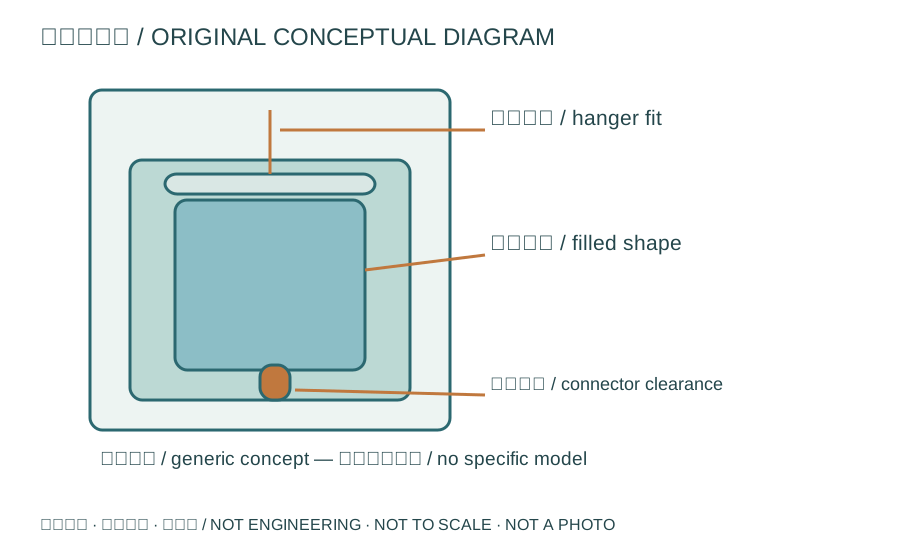
Review a specified reservoir and fill state against sleeve space, hanger geometry and connector clearance before approving compatibility.
01
Specify the reservoir before approving compatibility
A capacity label does not fully define a hydration sleeve. Development also needs a reservoir reference, closure type, fill condition, suspension interface and lower connector arrangement. Those details give the team something concrete to compare with the sample.
This guide addresses the internal sleeve and hanging interface, which are separate from the external hose-routing question. It proposes a general review process. It does not guarantee drinking flow, sealing performance or compatibility with a particular backpack.
02
Treat the hanger as an interface
HydraPak’s official support note describes a plastic clip supplied with its pre-2023 reservoirs. It requires an attachment point inside the pack, such as a sewn loop, and notes that not every pack offers a hanging option. That dated product scope must not be extended to all reservoirs.
A brief should therefore say more than includes a hanging loop. Confirm supplied components, engagement with the loop, operating space above the closure and the intended seated position of the installed reservoir.
03
Review the filled shape
An empty reservoir laid flat and a filled reservoir are different inspection states. Observe width, thickness, the closure edge and the lower shape in the intended use condition. Compare them with the sleeve entrance and back-panel space rather than inferring fit from flat dimensions alone.
The diagram is a generic concept. It does not reproduce a model-specific baffle or connector. It identifies interfaces for review without specifying hanger dimensions, converting dimensions into capacity or representing pressure validation.
Original conceptual diagram; not engineering, not to scale, not a photograph or product/test evidence.
04
Allow access to the closure and connector
Rehearse insertion, hanging, release and removal separately. Check that the closure passes through the sleeve mouth, fingers can reach the hanger and the lower connector is not trapped against the sleeve floor or neighbouring contents. Avoid unapproved folding or modification of reservoir components to achieve installation.
If filling inside the pack is required, review it as a separate use case. Reach, spill handling and closure rechecking need evaluation on the actual sample. The presence of a sleeve does not establish that workflow.
05
Repeat the review with neighbouring contents
Load the agreed equipment into the main compartment. Check for hard-object contact, changes in hanger alignment, pressure on the connector and local interference at sleeve edges. Record the location and packing condition of each issue instead of reporting only that the reservoir fits.
These observations help identify spatial conflicts. They do not replace load-bearing, seam-strength or leakage tests. If such performance forms part of the purchase requirement, agree a separate protocol, sample condition and acceptance criteria.
06
Review removal and cleaning separately
A removable reservoir does not make every sleeve corner accessible for wiping or drying. Review the open mouth, lining corners and hanging area. Follow the selected reservoir manufacturer’s instructions for cleaning and storing the reservoir itself.
Do not describe the surrounding sleeve as a leak-containment vessel without supporting construction and validation. If the project includes a response to leakage, define practical user actions and the separation requirements for neighbouring belongings rather than relying on an unspecified pocket label.
07
Keep the interface revision with the approval
Keep the reviewed combination traceable
Record reservoir model and revision, fill condition, clip configuration, sleeve-mouth and hanger photographs, packing list and removal procedure. If a supplier changes the clip, loop or sleeve material, review whether the previous compatibility record still applies.
Replace a broad capacity claim with compatibility for specified reservoirs under listed conditions. Keep the scope of unreviewed models clear. A defined reference and state make later sample revisions easier to assess and prevent one successful installation from becoming a claim about every reservoir of similar capacity.
Related development guidance: Review the connected construction.
Discuss your bag development project
ANSON XIE
General Manager & Founder
Quanzhou Junkai Pengda Special Equipment Co., Ltd.
Email: ansonxie@jkpdtime.com
Phone: +86 177 5095 3355
WhatsApp: +86 177 5095 3355
Factory address: Floors 2–4, Building 1, Phase I, Huixin Intelligent Manufacturing Industrial Park, Hui'an County, Quanzhou, Fujian, China