
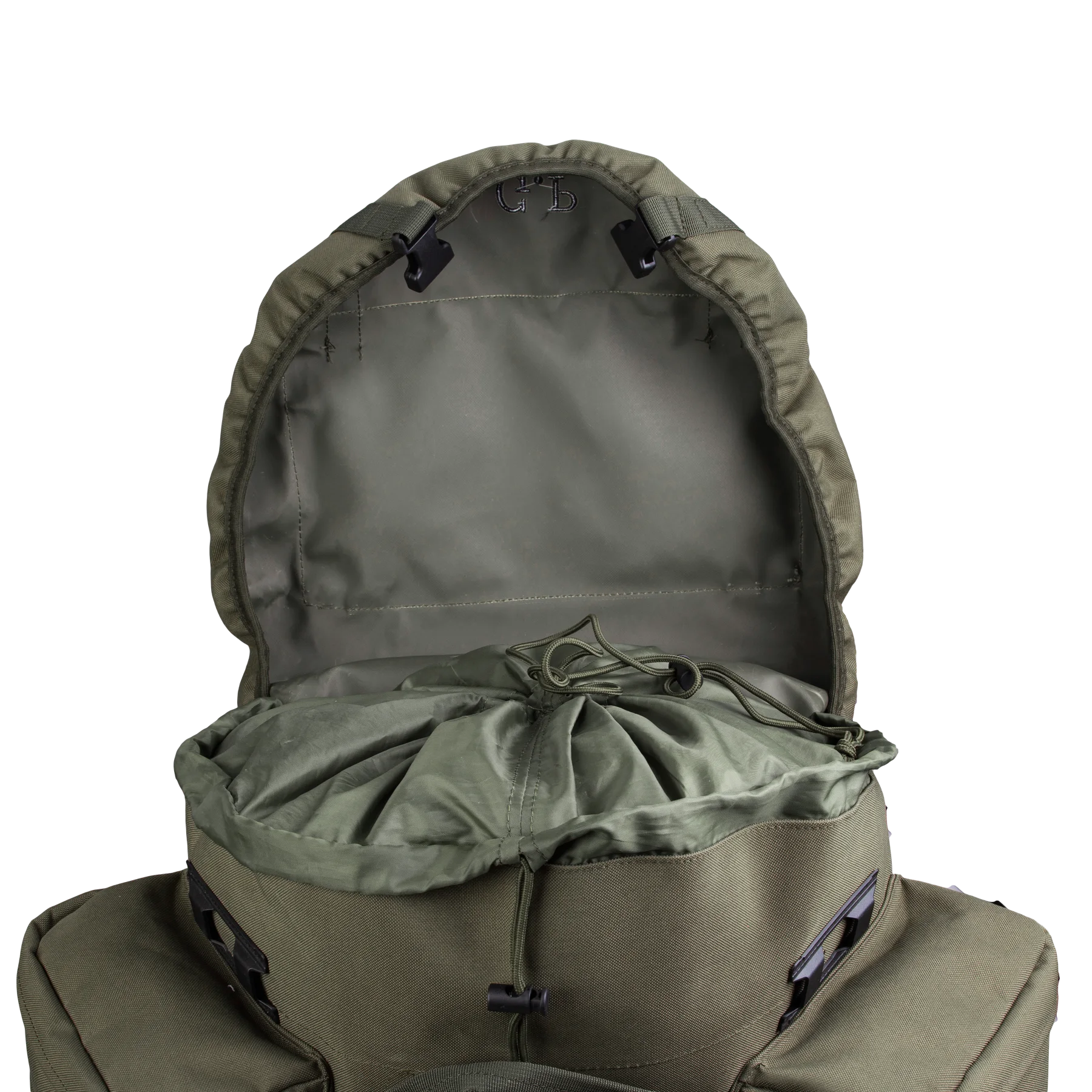
A replacement buckle half can look correct, accept the webbing and make a click without being the approved mate for the part already sewn into a bag. For ordinary tactical-style backpacks and soft equipment bags, record the latch and body as a pair. Treat a replacement proposal as a component change, not as a colour match.
This review concerns bag closures and adjustment hardware only. It does not cover climbing, lifting, restraint, protective equipment or operational military use. The product photograph supplies bag-construction context; it does not identify the buckle manufacturer, establish interchangeability or demonstrate a load rating.
- Identify both halves and their supplier references before approving a replacement.
- Separate mating compatibility from webbing fit and from attachment performance.
- Keep old and new components traceable through sampling, purchasing and service stock.
01
Why is the nominal strap width not enough?
Strap width describes one interface, not every surface that makes a buckle engage. The latch arms, internal body geometry, insertion depth and release action still need to work together. A purchasing description that lists only colour and width leaves the actual mating pair undefined.
Manufacturers may distinguish latch and body part numbers within a product family. For example, ITW Nexus' Evo SR Body Clip page identifies intended Evo SR latch pairings and presents separate latch and body references. This is evidence for that stated family, not permission to mix arbitrary components of a similar size.
Ask the proposed supplier to identify the exact mate and confirm the application. Do not infer compatibility from a catalogue photograph, a shared material name or the fact that two halves can be pushed together. A recognizable click is an observation, not a complete approval record.
02
What should the component list identify?
Give the latch and body separate entries, connected by an assembly identifier. Include manufacturer, family, part reference, size, material and finish as specified for each part. Where a supplier uses revision identifiers, preserve them rather than shortening the record to a generic description such as black buckle.
Record which half is sewn permanently into the bag and which can be removed without opening a seam. This affects both production substitution and service replacement. A new loose half may be convenient to ship, but convenience does not establish that it belongs with the retained sewn-in component.
Keep physical references together
Retain an approved pair and a short sample of its actual webbing construction. Label them so that separation during a review does not erase their relationship. Photographs help identify shape and markings, but cannot replace the parts when evaluating engagement or the route taken by the strap.
03
How can mixed stock enter an assembly?
Look at the points where components change containers or lose their labels. Sampling benches, returned parts, service kits and partially used production bins can bring similar-looking items together. The review should make identity visible at those points rather than relying on a worker to recognize small geometric differences.
Use distinct storage and records for unapproved substitutions. When a supplier sends a revised half, do not place it beside the approved reference without a clear status label. A comparison sample should remain identifiable as a proposal until the required review is complete.
If the project intentionally uses more than one buckle family, document where each belongs. Keep those location codes in the bill of materials and assembly instructions. Standardizing the visible colour may suit the design, but it also increases the importance of clear component identification.
04
What should the mating review observe?
Review insertion, full seating and release as separate actions with the intended pair. Record any uneven engagement, obstruction or unusual movement by location and sample identifier. Compare the proposal with the approved assembly under the same conditions instead of relying on impressions collected at different times.
The team responsible for validation should define the required retention, repeated-operation and environmental checks for the intended use. This article supplies no universal force limit or cycle count. An informal hand pull is not a certified load test, and a successful closure does not validate the attachment seam.
- Identity: are the two supplier references the intended pair?
- Operation: do insertion, seating and release behave as specified?
- Assembly: do the webbing route, fold and surrounding construction permit that operation?
Keep failed or uncertain samples available for investigation. Repeatedly forcing a reluctant combination together can damage it and obscure the original issue. Record the observation before deciding whether it is a mismatched pair, a defective part or interference from the installed construction.
05
Does a matched pair solve the webbing interface?
No. Mating approval and webbing approval answer different questions. A correctly paired buckle can still be unsuitable for a thick folded strap, a coated webbing or a particular adjustment route. Review the final strap material and construction rather than a convenient loose strip from the sample room.
Document threading direction, folded ends, stitching position and clearance around the buckle. Check the installed arrangement in the intended bag positions. If adjacent fabric prevents full seating or makes the release surfaces difficult to reach, investigate that interference before changing the component family.
The plastic hardware material guide addresses material identity and molded-part evidence. Material selection does not prove mating compatibility, just as mating compatibility does not prove the strength of the sewn webbing connection. Keep those approvals separate and link them to the same assembly revision.
06
How should a replacement proposal be handled?
Ask whether the proposal replaces one half or the complete pair. If one half must remain on the bag, the supplier needs its exact identity, not merely a photograph and nominal width. Where that identity cannot be established, keep the proposal pending rather than assuming a nearby catalogue match is equivalent.
Replacing the complete pair may remove one uncertainty, but it introduces others. The new pair still needs review for webbing fit, overall length, adjustment range, hand access and attachment construction. A larger body can move a seam or shorten the usable strap even when the nominal webbing width stays unchanged.
Use the sample revision record to connect the requested change to the affected locations. State which evidence can be retained and which checks must be repeated. Do not allow a purchasing substitution to silently become a new approved standard.
07
What belongs in the service and production record?
Keep the approved pair references, location codes, webbing construction and review results available to both purchasing and after-sales teams. Service stock should preserve the same identification as production stock. A replacement kit described only as a spare buckle can lose the information needed to choose a compatible part.
Define how supplier changes will be reported before releasing an order. If part references, materials or geometry change, require a clear comparison and an updated approval decision. This is a traceability procedure, not a guarantee that a supplier's future parts will remain interchangeable indefinitely.
For a tactical-style soft bag project, send the complete closure assembly and intended replacement scenario with the brief. The useful question is not whether two pieces look alike. It is whether the identified pair, installed with the specified webbing, has the evidence required for that particular bag application.
Discuss your bag development project
ANSON XIE
General Manager & Founder
Quanzhou Junkai Pengda Special Equipment Co., Ltd.
Email: ansonxie@jkpdtime.com
Phone: +86 177 5095 3355
WhatsApp: +86 177 5095 3355
Factory address: Floors 2–4, Building 1, Phase I, Huixin Intelligent Manufacturing Industrial Park, Hui'an County, Quanzhou, Fujian, China