
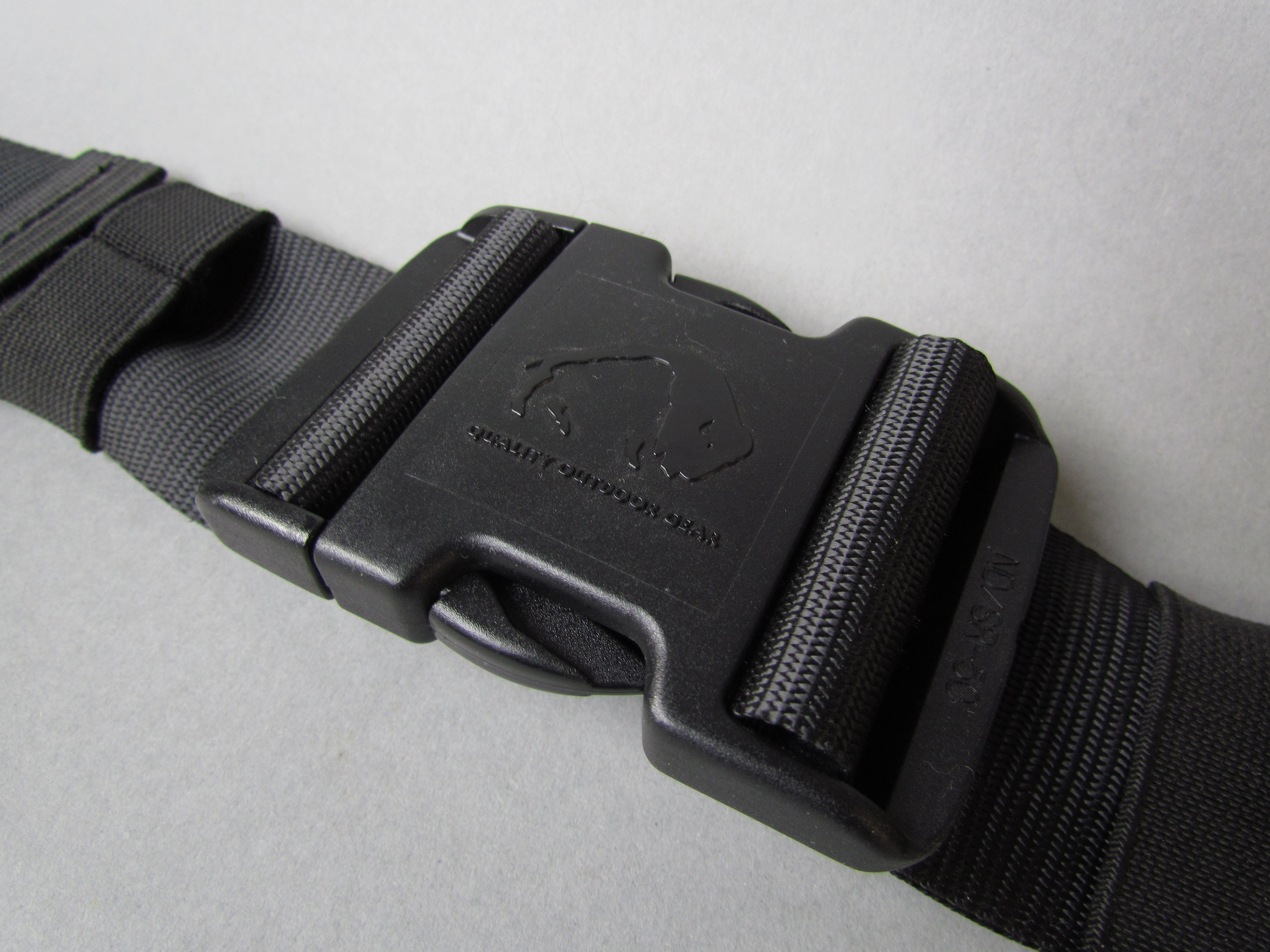
Photo: Frank C. Müller. CC BY-SA 4.0 · Original source. Unmodified for this article. The photograph remains under its stated license; no endorsement, polymer identification or JKPD use is implied.

01
Identify the part before comparing resin names
A black buckle or adjuster cannot be identified as POM or PA from colour, tapping sound or gloss. Begin with the hardware article and revision, then document the resin grade, modification, colour and supplied condition for each constituent part.
Calling everything plastic or nylon leaves an inadequate basis for controlled substitution. Conversely, a shared resin name does not establish equivalent molded-part behaviour. Material data, geometry and manufacturing condition answer different questions. This article proposes a general development and purchasing approach. It does not identify the polymer used in the photographed third-party hardware or claim that JKPD has evaluated the candidate resins.
02
Use the photograph to locate parts, not identify polymers
The third-party photograph above shows a side-release buckle and its webbing connections. It is not a JKPD product photograph. It locates the parts that need separate identification. It does not establish POM, PA, a hardware brand or load performance. Material information absent from a photograph belongs in the supplier record.
Give buckle halves, adjusters and other connectors individual references linked to the bill of materials. If a supplier supplies one material name for an assembly, ask whether it covers every component. Mixed-polymer assemblies are possible. Do not silently transfer a declaration for one item to all the parts visible in a photograph or attached to the same strap.
03
POM and acetal are still incomplete specifications
POM is also called polyoxymethylene or acetal. Selection still requires an identified material system and grade. Delrin’s grade-selection information concerns its acetal homopolymer products and grade choices. Delrin is a brand, not a synonym for every POM supply.
Obtain the current technical data sheet with manufacturer, exact grade, reinforcement or modification and test conditions. “Imported POM” is not a traceable specification. A tensile result on a resin specimen is not a finished-buckle load rating. The application question remains whether the selected grade works in the actual geometry, assembly and use condition.
04
Ask which PA and which specimen condition
PA is a polyamide family. BASF’s Ultramid information lists PA6, PA66 and reinforced or modified variants, illustrating why nylon alone is insufficient. A resin supplier’s portfolio description does not establish the performance of an arbitrary PA buckle.
Ask which grade is proposed and which specimen condition and environment accompany its data. Where a sheet distinguishes dry and conditioned results, read the corresponding columns separately. For the project’s moisture, temperature and outdoor exposure, request applicable grade information or finished-part evaluation. Avoid a universal ranking that assumes PA must always be better or worse than POM regardless of grade and geometry.
05
An assembly can contain different materials
ITW Nexus lists an acetal hook and a Nylon 6/6 retainer for its Interlocking Swivelhook. This is one identified manufacturer example, not the identity of the photographed hardware. It explains why a purchasing record should name materials part by part.
Maintain that detail through assembly approval. Record the intended mating pieces, whether versions may be mixed and which checks follow replacement of one constituent. Whatever the polymer, its name does not eliminate review of engagement, fit, slippage and the actual connection. A documented mixed-material assembly can be intentional; an undocumented substitution remains an open engineering question.
06
Separate resin specimens, molded parts and time under load
The Delrin design guide discusses time-dependent behaviour including creep and stress relaxation. Such guidance helps identify design questions. It does not replace current grade data or turn historical curves into a life guarantee for a bag buckle.
For development specimens, ask the hardware manufacturer about molding-condition control, critical dimensions and batch traceability. Propose engagement, sustained-load or repeated-operation review with the actual webbing, threading and assembly. The project and applicable requirements must establish loads, durations and acceptance criteria. No universal safe value is offered here. The resin video below is supplementary context for the material category.
Related video: DuPont™ Delrin® Outlasts Acetal Copolymers · DuPont Performance Materials
Supplementary viewing only. This external demonstration is not evidence of the pictured component, certification or finished-bag performance; consult current article-specific documentation.
A demonstration is not performance certification. If the player is unavailable, use the original link; internet access is required.
07
Turn abbreviations into verifiable purchasing records
Request the part article and revision, resin manufacturer and grade for each constituent, current data sheets, colour and additive declarations, mating webbing and installation, intended environment and part-level validation requirements. When resin or processing revisions change, ask what is affected and which approvals need repeating.
General bag-development information does not establish suitability for person-supporting equipment, protective systems or other demanding uses. Website copy may explain POM and PA as categories, but a specific product should receive a specific material claim only when the material documents and part records match. Traceable names and specimens evaluated under stated conditions give sourcing decisions a defensible basis.
Related reading: Hardware connection selection.
Share the application, candidate material articles and available records through the JKPD project inquiry page.
Discuss your bag development project
ANSON XIE
General Manager & Founder
Quanzhou Junkai Pengda Special Equipment Co., Ltd.
Email: ansonxie@jkpdtime.com
Phone: +86 177 5095 3355
WhatsApp: +86 177 5095 3355
Factory address: Floors 2–4, Building 1, Phase I, Huixin Intelligent Manufacturing Industrial Park, Hui'an County, Quanzhou, Fujian, China