
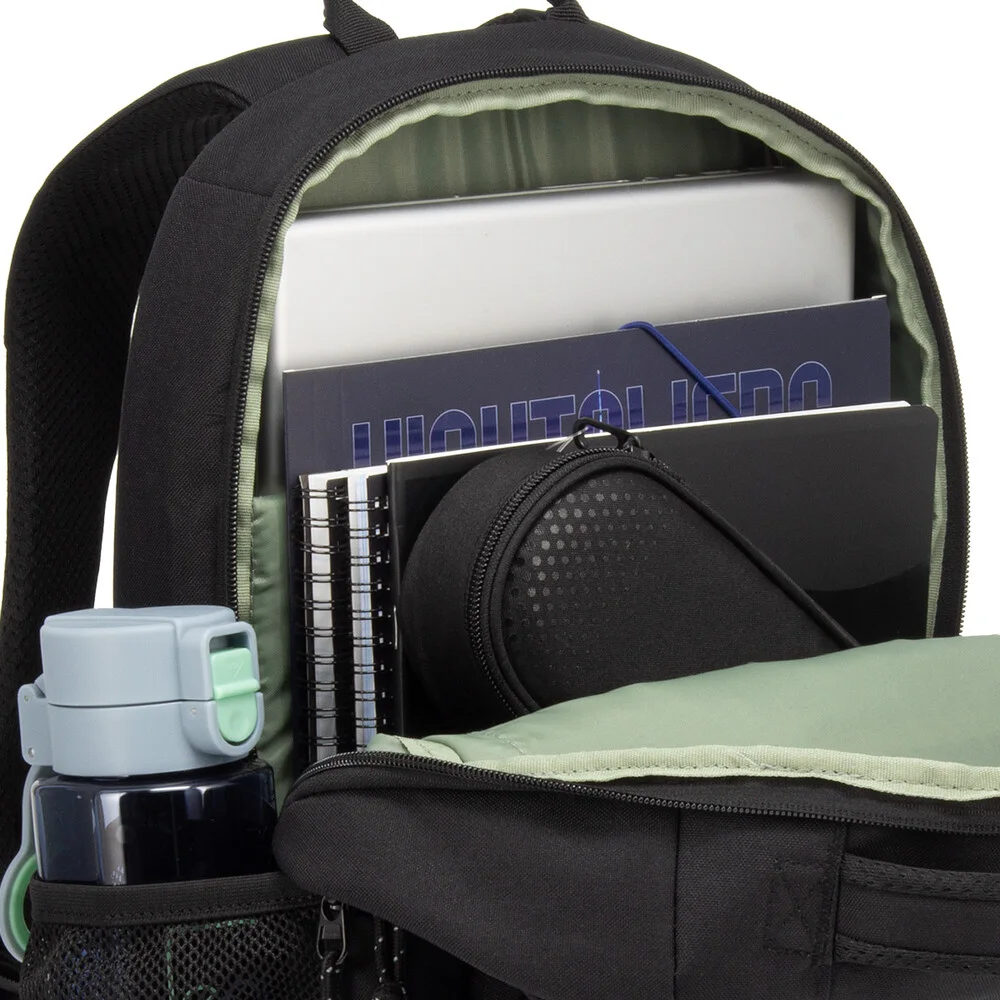
A full bottle pushes outward against a school backpack pocket. A lab report for the pocket mesh may describe what happened when air pressure pushed a specimen outward until it ruptured. Those sound like the same problem. They are not: the laboratory clamps the fabric around a test area; the bottle is supported by a pocket floor, restrained by a rim and pressed against a shaped side panel. What should a buyer do with a good fabric result when the bottle still tips out?
Keep the report with the fabric specification. Give the assembled pocket a separate approval line. The first decision is whether the mesh supplied matches the material you evaluated. The second is whether the pocket made from it does its job with the articles a pupil will carry. One result should never silently close both decisions.
01
Read the two different quantities
ISO 13938-2:2019 describes a pneumatic method for determining the bursting strength and bursting distension of textile fabrics. In plain language, ask how much pressure the specimen resisted and how far it bulged at rupture. Check the units next to the entries. A pressure and a displacement answer different questions. Neither tells you the weight of bottle the finished pocket can carry.
Suppose two suppliers submit similar pressure figures, but one cloth bulges noticeably farther before it breaks. That is reason to investigate how the alternative behaves in the pattern, not reason to rank it higher or lower without a sample. Distension at rupture does not describe how snugly the material holds a small bottle at ordinary use strain. Nor does it tell you whether the fabric springs back after the bottle comes out. For that last question, compare the separate mesh pocket recovery review.
Make a like-for-like comparison
Obtain the report identifier, laboratory, method and edition, test area, specimen description, conditioning information, number of observations and reported variation where available. Ask what the lab did if the construction slipped at the clamp or a result was excluded. A purchasing spreadsheet that retains only the largest figure discards information the next developer may need to decide whether two lots differ. If a report refers to a hydraulic procedure and the approved baseline was pneumatic, ask the lab how the results can be compared before treating them as interchangeable.
02
Match the tested cloth to the cut panel
Lay the report, a swatch and a cut pocket panel side by side. Connect all three to a material code and delivery lot. Does the submitted test describe the stretch mesh, the nonstretch side-panel shell, or a laminate with a backing that was later removed? Record the face, orientation in the pattern, and any dyeing or finishing change that distinguishes the proposed production cloth from the approval swatch.
A useful counterexample is a purchase order that calls both materials “black polyester mesh.” One is an open knit without a lining; the other has a backing and narrower openings. Even if both names and colors match, the report for the backed cloth is not a report for the open construction. Ask for the missing evidence or identify the change as a new sample decision. A shell fabric tensile report is a different document again; do not use it to fill the gap.
03
Give the pocket floor and the rim different jobs
Choose the smallest and largest bottles the brief actually promises to accommodate. Identify them by body shape as well as diameter: a narrow neck does not help if a broad shoulder cannot pass the binding. Put the pack upright with its main compartment filled as intended. Seat the bottle without holding the pocket open from underneath. Look underneath afterward. Is the base resting on the pocket floor, or is it hanging above the floor because the rim catches the shoulder?
Repeat with the main compartment less full. A full pack can push outward and reduce clearance, while an empty side wall can fold inward and let a tall bottle lean away. Observe which part changes shape first. If the rim stays level but the pocket pulls away at its lower corner, increasing elastic tension may make insertion harder without addressing the load at the seam. If the pocket floor stays in place but the narrow bottle rolls under a loose rim, a stronger mesh is unlikely to solve the fit problem.
04
Identify the first change, not just the final tear
Agree on a representative filling, insertion and removal sequence with the buyer, including how the pack is set down. Mark the original rim position on a reference photograph and keep the same bottle and pack filling for comparisons. After the sequence, remove the bottle and look for a displaced binding, stretched mesh opening, broken yarn, missed stitch or cut edge pulling out of the seam. Record the location and the earliest step at which the change was visible. These are proposed sample checks, not ISO test steps or a claim that the pictured school bag passed them.
For example, if a line of mesh openings opens up directly along the seam while the rest returns to shape, inspect how much sound cloth the stitches capture. Compare a revised seam allowance or support strip on the same pocket pattern before replacing the entire fabric. Conversely, if the whole face stays baggy and the seam is undisturbed, compare recovery and pattern allowance first. Change one feature at a time if the purpose of the next sample is to identify the cause.
05
Write an acceptance note someone else can repeat
Keep the agreed lab evidence, material reference, finished pocket dimensions, binding specification and loaded sample photos together. Define what would trigger a new fabric review and what would trigger only a sewn-sample review. A different mesh source deserves a material decision. Moving the pocket floor or changing the binding length deserves a fit decision even if the approved mesh lot is unchanged. Set any numerical acceptance criteria with the buyer and laboratory before testing, not after seeing the results.
The practical sign-off is short: identify the tested cloth, the pack revision, the target bottles and the observed outcome for each. A buyer receiving the next sample should be able to tell whether it needs another material report, a pocket adjustment, or neither. That is a more useful conclusion than a single “strength passed” beside the entire backpack.
Discuss your bag development project
ANSON XIE
General Manager & Founder
Quanzhou Junkai Pengda Special Equipment Co., Ltd.
Email: ansonxie@jkpdtime.com
Phone: +86 177 5095 3355
WhatsApp: +86 177 5095 3355
Factory address: Floors 2–4, Building 1, Phase I, Huixin Intelligent Manufacturing Industrial Park, Hui'an County, Quanzhou, Fujian, China