
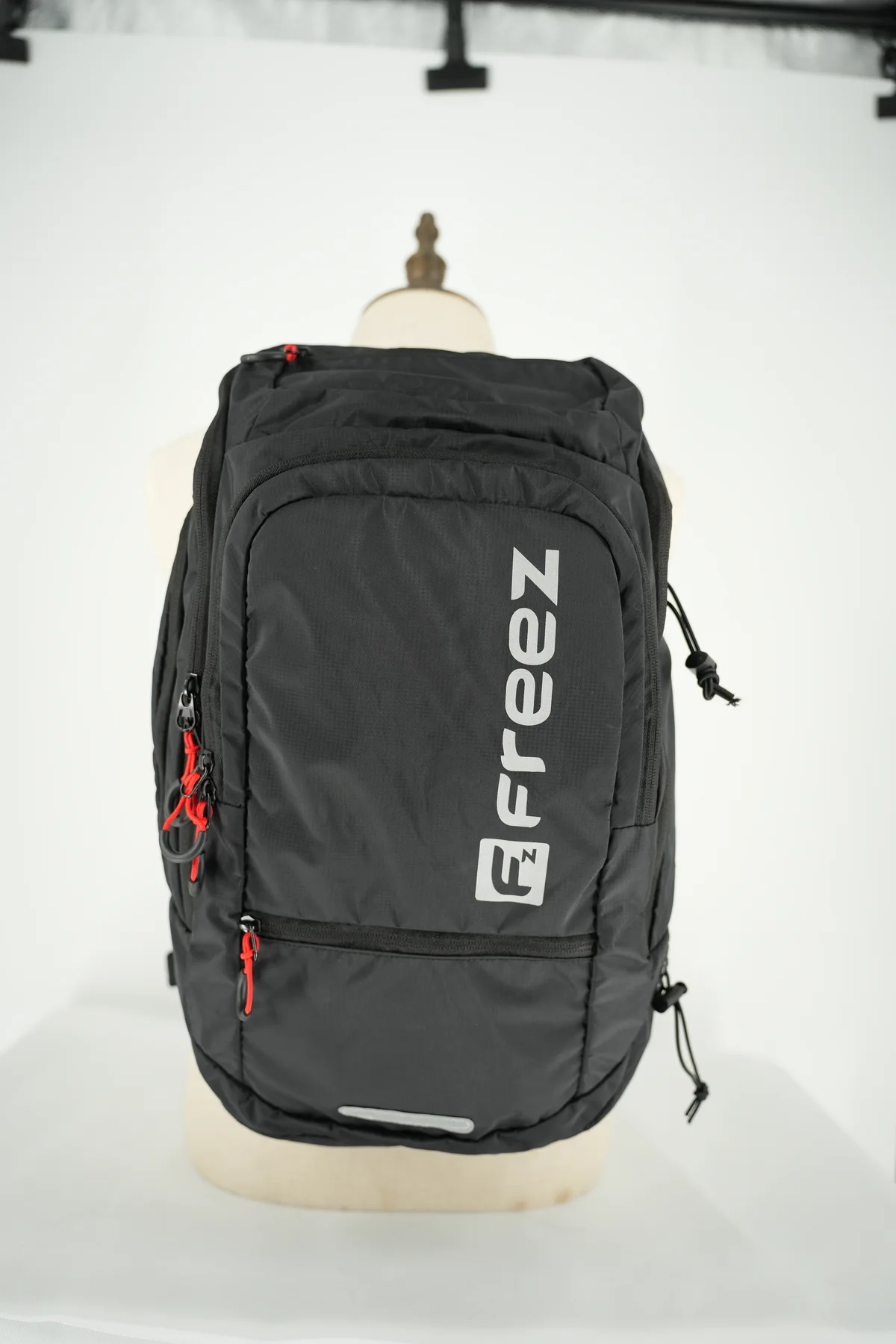
A white screen-printed logo on a sports bag panel can look acceptable at the press and change later. Approving the artwork and ink color is therefore not the same as approving production. Define the ink stack, fabric lot and heating route together, then check whether the recorded process produces the agreed result without damaging the panel.
The product photograph provides sports-backpack context only; it does not identify a printing method, textile composition or tested ink system. This article concerns a proposed direct screen print on a bag panel. It is not a heat-transfer application guide, a report of factory testing or a universal temperature recipe for all bag materials.
01
Name the whole print stack before setting the dryer
Specify the actual shell material, color, finish and backing with the fabric supplier. Obtain written compatibility guidance for the proposed ink system. A garment ink described for polyester is not automatically suitable for a coated bag fabric, even if the face fiber has the same name. If the finish or backing is unknown, resolve that identification before approving a production trial.
List the ink products in print order, including any blocking underbase and each top color. Record permitted additives and their instructions rather than allowing an operator to modify a difficult ink by habit. Link the list to the artwork revision and the supplier's current technical information. A substitution in an unseen lower layer still changes the system being qualified.
Keep artwork positioning as a separate approval. The print placement guide covers finished reference points. Here the question is whether the chosen decoration process can be reproduced on the identified panel, including its surface texture and construction sequence.
02
Separate flashing from final cure
Flashing between printed layers and the final dryer pass are different stages of the process. Document both. A surface that is convenient for the next print operation does not, by itself, prove that the complete ink film has reached the supplier's required cure condition. Ask the printer to show how that condition is verified for the selected system.
Avient's performance-wear guidance discusses low-cure inks, blocking layers and the risk of combining systems with incompatible heat requirements. It recommends measuring ink-film temperature with a probe in its illustrated process. Treat this as a reason to qualify the whole stack and measurement method, not to copy a garment example's settings onto a backpack.
For purchasing, require a process sheet with the flash sequence, final dryer route and relevant control settings. The selected ink supplier should define the applicable cure requirements and suitable verification method. If the material cannot tolerate that route, request a compatible system or another decoration method rather than quietly reducing heat until the fabric looks unchanged.
03
Measure the print's route, not only the display setting
The dryer's display is a machine setting, while the print follows a particular path through the equipment. Ask the printer to identify belt position, panel orientation, loading arrangement and the location being measured. Record the measurement equipment and its verification status. Keep the trace or observation with the trial ID so the evidence can be reviewed later.
Avient's polyester-printing practices recommend pretesting new fabrics and dye lots, avoiding under- and over-curing, and mapping the dryer. Its advice is directed at garment printing. Applying that process-control logic to a bag panel is a development proposal that still needs approval for the particular substrate, ink and equipment.
Include the production configuration
Compare the planned production loading with the arrangement used for the first trial. If a sample passed alone at one belt location, do not describe it as proof for every loading pattern. Have the printer establish which setup is covered and what needs rechecking after a relevant change. The buyer needs a bounded approval, not an undocumented claim that the machine was hot enough.
Record interruptions and restarts in the trial notes. A retained sample should identify the point in the run from which it came. This makes a later difference easier to investigate without assuming that every panel experienced identical conditions.
04
Follow every heating pass in the panel's itinerary
A bag can have several decorated faces, while a cut panel can receive several colors. Draw the actual sequence from first print to release for sewing. Include any repeated dryer pass and subsequent operation that exposes the area to heat. Review those steps with the printer rather than evaluating only the last pass on a process sheet.
For a hypothetical sports backpack with a large front mark and a smaller side mark, establish whether decoration happens on separate cut panels or after assembly. The choice changes access and handling. A printer's flat-panel trial does not represent a finished bag with seams and foam beneath the print, and an assembly trial does not automatically justify printing all panels earlier.
Keep any change in stencil, deposit, layer count or artwork coverage visible in revision control. The objective is not to mandate a particular screen specification in this article. It is to prevent a visually similar logo revision from silently escaping the process that was actually evaluated.
05
Keep appearance, attachment and substrate condition separate
Prepare undecorated material and approved print references from traceable sources. Observe the printed sample at agreed times after processing, not only when it first leaves the dryer. Record discoloration, visible coverage, edge definition, surface cracking and changes to the panel separately. An immediate visual pass cannot settle a concern that the supplier expects to evaluate later.
Use the supplier-agreed checks for the selected ink and intended care instructions. Do not transplant a clothing wash claim onto a bag that has a different cleaning method. An informal fold or rub can identify something to investigate, but it should not be presented as a standardized durability result or an unspecified lifetime guarantee.
When a pale print becomes tinted, send the material and ink identities, process record and retained samples to the suppliers. Do not diagnose every color change as migration from a photograph alone. Similarly, do not solve a suspected heat problem merely by lowering the dryer setting: that may create a different unresolved cure issue.
06
Define the release and the conditions that reopen it
Approve a named material-and-print combination with its process revision, sample IDs and evaluation record. List which fabric colors or lots were reviewed and which were not. State how cooled panels are handled and packed before sewing, with the printer's instructions reflected in the production route. Keep rejected trials clearly separated from the approved appearance reference.
- Identify the complete ink stack and authorized changes.
- Retain the measured process evidence and the production loading arrangement.
- Record observation times and each acceptance decision separately.
- Reassess relevant material, ink, artwork or equipment changes before release.
The sample revision guide helps keep those records attached to the correct bag. Send the intended shell specification, authorized artwork and proposed print sequence through the JKPD inquiry page to define the next sample request. A reproducible cure process is more useful than a bright first print whose production conditions cannot be reconstructed.
Discuss your bag development project
ANSON XIE
General Manager & Founder
Quanzhou Junkai Pengda Special Equipment Co., Ltd.
Email: ansonxie@jkpdtime.com
Phone: +86 177 5095 3355
WhatsApp: +86 177 5095 3355
Factory address: Floors 2–4, Building 1, Phase I, Huixin Intelligent Manufacturing Industrial Park, Hui'an County, Quanzhou, Fujian, China