
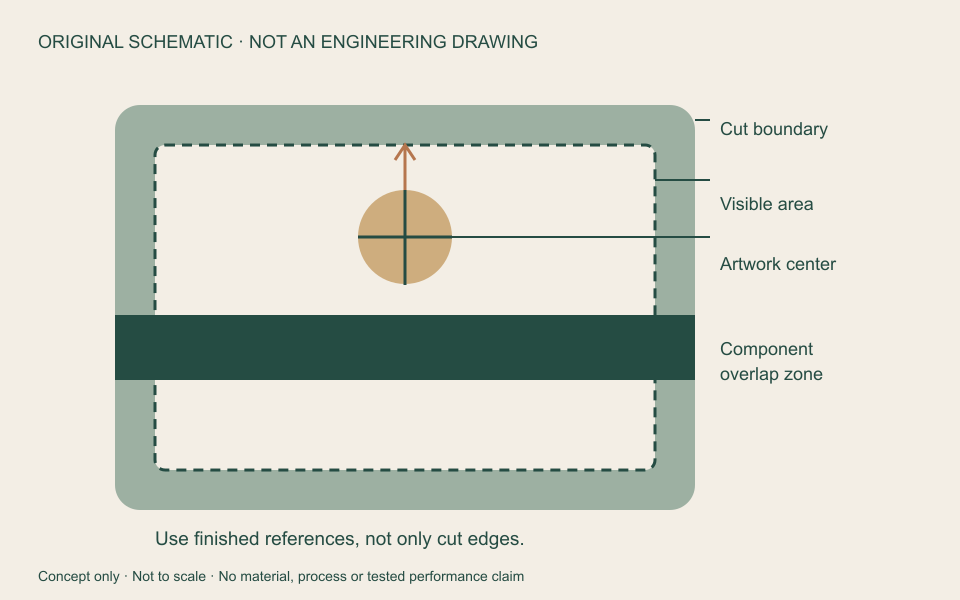
Approve printed artwork against finished reference points, a sample on the actual material and the area visible after sewing. Artwork centered on a screen may not remain centered on the assembled bag. Separate placement, color and process reviews for sports bags, event equipment bags and custom organizers.
01
Identify the production artwork
Retain editable artwork, a preview and a revision ID. Specify target size and orientation. Ask the output and production teams to confirm font handling and whether details suit the proposed process. A screenshot should not become the final production file.
Confirm rights to use brand marks and third-party graphics. Distinguish authorized production artwork from reference imagery so inspiration is not accidentally treated as a manufacturing instruction.
02
Use finished reference points
Choose repeatable references such as a finished seam, opening or defined alignment line. State measurement endpoints and sample condition. Distance to a cut edge is different from distance to the finished seam.
Show artwork boundaries and the finished visible area separately. Mark allowances, folds and obscured areas rather than counting them as visible design space.
03
Check adjacent components
Place pockets, webbing, hardware and openings in the same review view. Assess intended visibility and any unwanted obstruction during normal opening or handling.
Review the assembled bag from the intended presentation angle. A flat panel alone does not establish final placement. For artwork crossing seams, specify alignment expectations and check the finished sample.
04
Confirm color on the actual material
Produce a print sample on the proposed material and identify material, process and artwork revision. Screens and phone photographs help discuss differences; final confirmation should use agreed physical references and viewing conditions.
Review edges, legibility and the visual relationship to neighboring fabric. Appearance does not establish colorfastness, wash resistance or abrasion performance. Agree separate verification for those requirements and reassess print effects after a material substitution.
05
Separate print-sample and finished-bag approval
A print sample supports local appearance decisions; the bag review establishes placement, visibility and component interaction. Record approved and pending items separately rather than treating “artwork OK” as approval of every requirement.
Retain revision files, placement drawings, physical-sample IDs and assembled views. The original schematic uses an abstract symbol, not a brand mark or actual printed product. Share authorized artwork, target placement and material requirements through the JKPD inquiry page to discuss a custom bag sample.
Discuss your bag development project
ANSON XIE
General Manager & Founder
Quanzhou Junkai Pengda Special Equipment Co., Ltd.
Email: ansonxie@jkpdtime.com
Phone: +86 177 5095 3355
WhatsApp: +86 177 5095 3355
Factory address: Floors 2–4, Building 1, Phase I, Huixin Intelligent Manufacturing Industrial Park, Hui'an County, Quanzhou, Fujian, China