
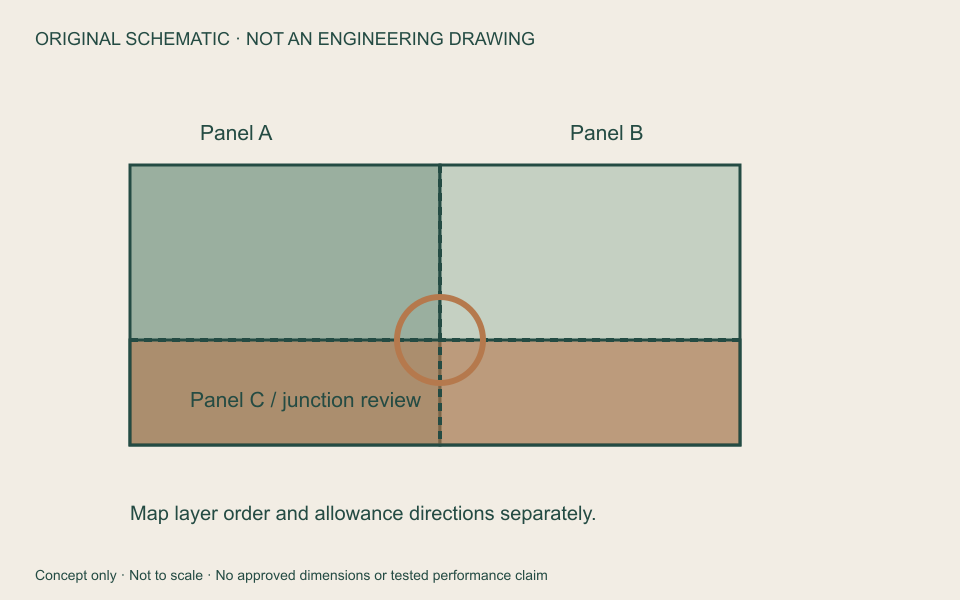
Review seam junctions through allowance direction, layer order and the finished assembly; exterior stitch lines alone leave internal construction undefined.
01
Identify the junction
Mark where side panels, base panels, openings or zipper tape meet. Distinguish the straight seam from the junction and use one ID across drawings, samples and photographs.
Replace “the seam is too thick” with observable details: where it projects, which face is uneven and after which assembly step it changes. Establish the location and state before discussing revisions.
02
Draw layers and allowance directions
Identify the origin, edge and proposed allowance direction of each layer in a local drawing. Annotate hidden layers instead of inferring them from the exterior. Use an accessible junction coupon when needed for joint review.
The diagram explains material relationships near an intersection. It sets no allowance width or cutting method and cannot serve as production instructions.
03
Follow the intended assembly order
Record which seams are completed first, which components follow and when the inside becomes inaccessible. Use the intended material combination and capture key steps. Update the record when adding layers, foam or decoration.
Before trimming, moving stitches or changing allowances, review the effect on other connections. Do not omit a required layer simply to flatten the appearance.
04
Review the finished assembly
After coupon approval, inspect the full sample with related zippers, openings and packing states. Observe operation, internal access and appearance at the junction. Local appearance approval does not establish whole-pack handling.
Use agreed contents and steps to document issues. State when review covers only an open condition; interference after closure needs separate assessment.
05
Keep local and whole-pack approval states
Record junction construction approval and finished operation approval separately, including open issues. Recheck affected regions after material, layer or assembly-order changes.
Retain identified drawings, photographs, layer order and operation records instead of an undefined instruction to match the previous sample. Together they make revisions traceable.
Share material references and sample requirements through the JKPD inquiry page.
Discuss your bag development project
ANSON XIE
General Manager & Founder
Quanzhou Junkai Pengda Special Equipment Co., Ltd.
Email: ansonxie@jkpdtime.com
Phone: +86 177 5095 3355
WhatsApp: +86 177 5095 3355
Factory address: Floors 2–4, Building 1, Phase I, Huixin Intelligent Manufacturing Industrial Park, Hui'an County, Quanzhou, Fujian, China