
A travel-backpack brief needs more than a litre number. It needs a defined bag configuration, a measurement method and a separate check that the intended load can actually pass through the opening. Otherwise, two samples described as the same capacity may solve different packing problems.
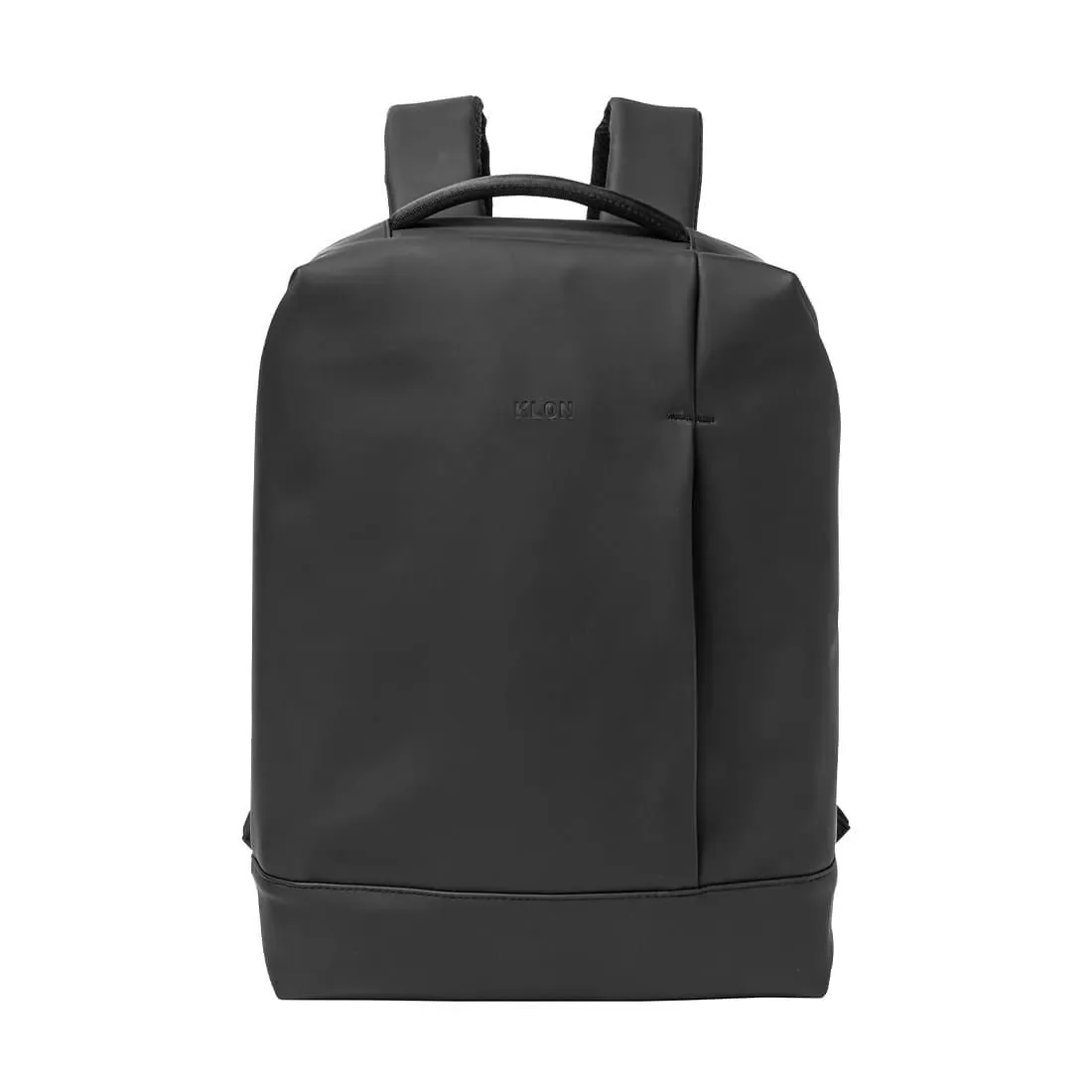
Start with a compact, structured backpack such as the Klon 1 development reference. Its exterior gives a useful starting point for discussing proportions, but a photograph cannot establish internal capacity, expansion features or airline acceptance. The review below is a proposed development workflow, not a test report for that product.
The distinction matters before a pattern is enlarged. More depth may increase storage, but it also changes the carried profile, pocket reach and packing arrangement. First identify whether the complaint concerns measured volume, usable shape or access; these require different corrections.
01
Separate capacity from the external envelope
External height, width and depth describe an envelope around the bag. Multiplying them treats the backpack as a rectangular box. Rounded corners, padding, shaped backs and tapered panels mean that calculation should not become an unqualified internal-capacity claim.
Use two fields in the product brief: external dimensions under a stated condition, and storage capacity under a stated method. Add a third field for the intended packing set if the buyer needs a laptop, garments and travel accessories to fit together. None of these fields replaces the others.
A change inside an unchanged envelope
For example, a development team might propose a deeper laptop sleeve while holding the outside dimensions constant. The sleeve could improve device protection yet occupy space previously available for clothing. This is an illustrative trade-off, not a measured loss: review the revised physical sample before changing a litre claim.
02
Choose a method before comparing suppliers
ASTM F2153-07(2018) addresses backpack capacity and related bags, including travel packs and duffels. Its public scope distinguishes extended and unextended configurations and excludes storage areas not completely enclosed by fabric, such as mesh pockets and bottle holders. It also notes that the method is not practical for packs below four litres.
Ask the laboratory to confirm applicability, the edition used and any deviations. The public scope is not the complete test procedure; it does not justify inventing filling media, handling steps or tolerances. A supplier's informal fill check can be useful for development, but should be named as an internal method rather than presented as ASTM conformity.
Compare reports only after checking that their inclusion rules and sample states match. If one result includes external stretch storage and another does not, a larger reported number does not necessarily mean a larger main compartment. Resolve that difference before choosing a supplier or approving packaging text.
03
Freeze the configuration that the number describes
Document the bag as presented for measurement. Identify the pattern revision, installed dividers, removable organizer, compression settings and closure position. If the design includes an expansion section, treat the closed and expanded states as distinct configurations instead of allowing the operator to select whichever produces the preferred result.
Photographs should show how the sample was prepared, not just its front face. A report that says “expanded” without showing the expansion closure leaves room for disagreement. Record whether removable accessories stay installed and ensure that the commercial description names the configuration buyers will receive.
This is also a reason to separate capacity from transport fit. A capacity statement does not establish compliance with a carrier's size or weight limits. Any travel-fit promise needs its own current requirements and a defined loaded condition; do not infer it from litres alone.
04
Map pockets that compete for the same space
Review the storage layout before adding compartment figures together. An internal organizer sits inside the main cavity; a filled pocket may displace contents on the other side of its wall. Measuring every pocket separately at its fullest shape can describe combinations that the assembled bag cannot accommodate simultaneously.
Create a simple compartment schedule for the development review. Name each space, identify its opening, note whether it projects inward or outward, and flag shared flexible walls. Ask the test provider how the selected method handles those spaces rather than inventing an arithmetic correction after seeing the results.
Then use the schedule to explain the product honestly. A small-accessory pocket can be valuable because it improves organization, even when it does not add independent storage volume. The earlier travel organizer lining review addresses a separate issue: whether that pocket construction remains sound under its intended load.
05
Run a packing review alongside volume measurement
A packing review answers a different question: can the intended items be loaded, retrieved and carried in the agreed arrangement? Use a written item list with actual dimensions and identify rigid cases separately from compressible garments. Keep the same set when comparing pattern revisions.
Record the loading order and any special handling needed. If the packing result requires removing an organizer, bending a rigid item or forcing a zipper around an obstruction, it should not silently count as the normal configuration. Photograph both the arranged contents and the closed bag so that another reviewer can repeat the check.
Pay attention to access as well as fit. A device may occupy a sleeve correctly while remaining difficult to remove when the main compartment is full. That finding points to opening geometry or shared-space allocation, not automatically to insufficient total capacity. Keep it separate from the formal volume result.
06
Investigate a mismatch before changing the pattern
When two reports disagree, first check identity and method. Confirm that the samples share the same revision, lining construction and accessories, then compare preparation and reporting conventions. Do not start by adding depth to a pattern that may already meet the intended brief.
If the difference survives those checks, ask for repeat measurements under the agreed procedure and discuss sample variation with the test provider. Decide the sample quantity and acceptance rule before using the data to approve production. A single convenient result should not become the only basis for a catalogue claim.
For a genuine packing problem, change the feature tied to the evidence. A restricted opening may need a new zipper path; an intrusive pocket may need a different position. Review the consequences for laptop backpack structure and carrying balance before treating extra volume as a universal solution.
07
Release one consistent specification
The approved record should connect the stated capacity to the tested sample, configuration, method and report. Keep external dimensions and the practical packing review beside it, but clearly label them as different evidence. Marketing, packaging and the supplier's specification should all refer to the same approved state.
Reopen this review when changes affect the usable cavity: thicker padding, revised lining, a new divider or an altered opening can make an old packing approval misleading. A colour-only change does not automatically require the same response; assess what physically changed and document the reason for the decision.
For the next development discussion, bring the target load and dimension constraints, not only a requested litre figure. That gives the pattern team a problem they can evaluate and leaves a clear record of what the final capacity claim does, and does not, promise.
Discuss your bag development project
ANSON XIE
General Manager & Founder
Quanzhou Junkai Pengda Special Equipment Co., Ltd.
Email: ansonxie@jkpdtime.com
Phone: +86 177 5095 3355
WhatsApp: +86 177 5095 3355
Factory address: Floors 2–4, Building 1, Phase I, Huixin Intelligent Manufacturing Industrial Park, Hui'an County, Quanzhou, Fujian, China