
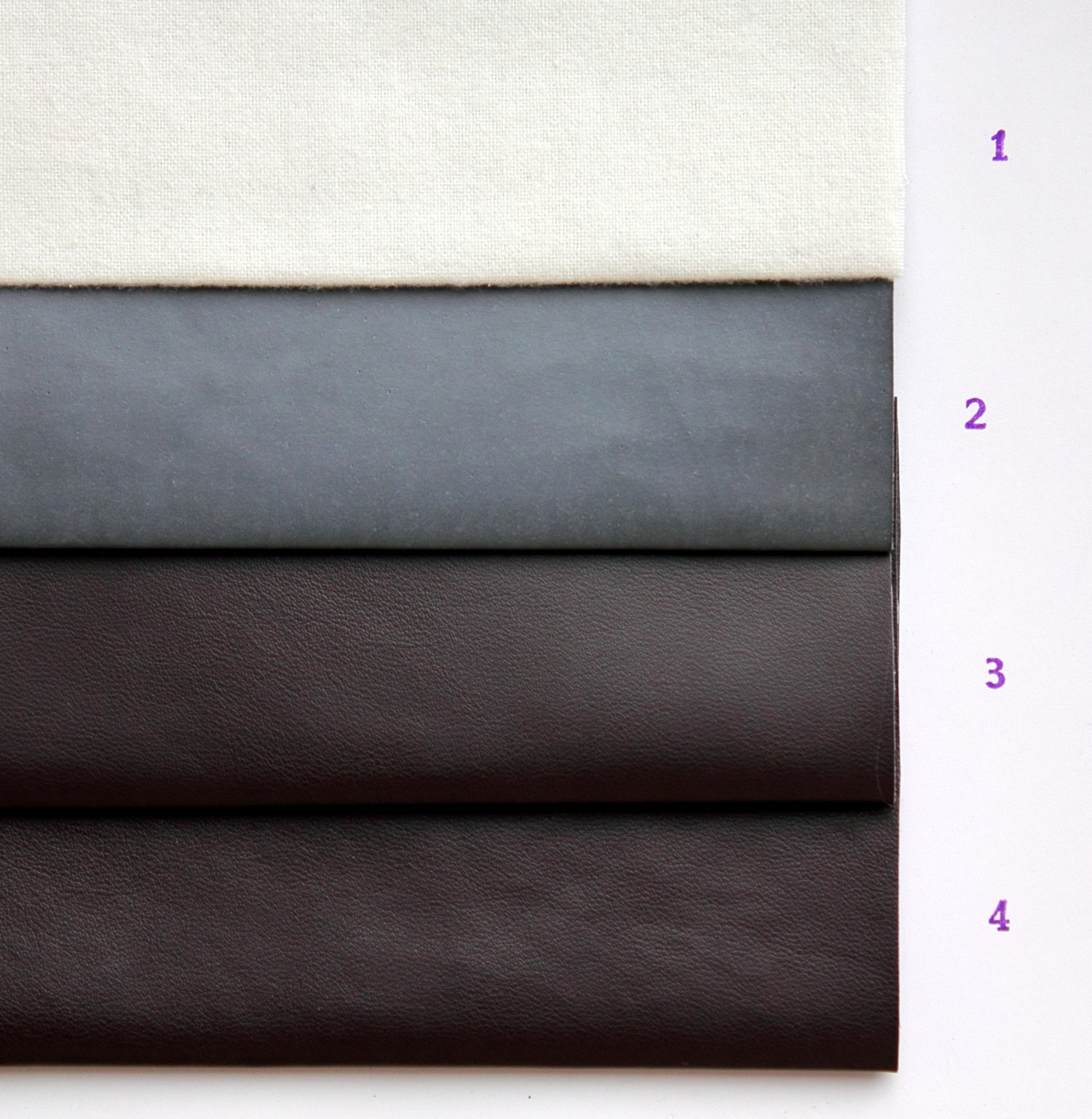
Photo: Holger Casselmann; white-balance correction by A7N8X. CC BY-SA 3.0 · Original source. Unmodified for this article. The photograph remains under its stated license; no endorsement, specific material grade or JKPD use is implied.

01
Begin with a layered material specification
Specify the substrate, body layer, surface layer and any added backing separately when sourcing PU synthetic leather. PU identifies a polyurethane system; it does not establish layer thickness, backing composition, resin category or years of durability.
This guide concerns bag panels, trim and soft-handle materials. Two visually similar swatches may need different folding, sewing or lamination routes. Identify the article and use before comparing grain and handle. Photographs help explain the construction, while supplier declarations establish composition. Keep each layer’s identity linked to the article so a change in backing does not disappear beneath an unchanged colour name.
Consider an inquiry stating a surface of 100% PU. That declaration cannot be rewritten as an entire sheet made of 100% PU. Ask what the percentage describes, how it is calculated and which record supports it, then identify the backing and other layers. A recycled-content statement likewise needs its layer and calculation basis. Neither a waterborne route nor a leather-like appearance supplies that information. This example is a proposed document-reading check, not a description of the photographed material or a claim about any particular supplier’s formulation.
02
Read the real staged sample correctly
The photograph in this section shows real specimens numbered one to four. The source author identifies cotton backing, a wet-coagulated stage, and later coating and finishing stages. The numbers indicate processing stages, not layer-thickness proportions or a magnified cross-section.
This is a historical solvent-based example, not a description of every modern PU synthetic leather or a JKPD process. Use it to structure questions about layers, then obtain the current supplier’s actual route. Do not transfer the photographed example’s solvent or formulation to another article. The visible grain also cannot identify a resin family, emission result or hydrolysis rating.
03
Process names do not identify every layer
Wet coagulation and transfer coating describe processing routes that can appear at different stages or in combination. One concerns forming a base structure; the other can provide a surface film with colour, texture and surface properties. These terms explain the photographed sample’s provenance, not a production recipe.
Covestro’s textured-synthetics information describes waterborne polyurethane dispersions and textile-coating options. PU synthetic leather therefore should not automatically be equated with one historical solvent route. Waterborne alone also does not establish that a whole material has zero emissions, is recyclable or meets a broad environmental claim. Identify the layer, product and evidence behind each statement.
04
Hydrolysis exposure is not a service-life clock
ACT’s hydrolysis explanation relates resistance to composition and manufacturing, and states that test weeks do not directly correlate with years in service. Its context is contract upholstery, so its recommendations are not automatic bag acceptance limits.
Request a report linked to the exact article, with method edition, environmental conditions, exposure period and assessment. Do not rewrite a pass after several weeks as a warranty against peeling for the same number of years. If only raw sheet was tested, record that limit. Sewing, folds, adhesive and contamination after assembly remain separate application questions rather than evidence already supplied by the material report.
05
Preserve alternative explanations for surface damage
ACT also notes that exposure to cleaning or disinfecting chemicals can produce cracking or flaking resembling hydrolysis damage. If a defect appears, record its location, timing and contact history before asking the supplier or laboratory to investigate. A photograph alone cannot establish the failure mechanism.
Proposed development review can separate hydrolysis, flexing, layer attachment and colour transfer. Let the laboratory select suitable methods and identify whether specimens are raw material or processed details. Results from those evaluations are not interchangeable. A hydrolysis pass leaves other durability questions open, and a material change should be assessed against the failures the project actually needs to prevent.
06
Sample the fold and repeated-motion detail
For a bag panel or soft handle, a proposed sample can include the actual fold radius, stack, stitching, adhesive and adjacent textile. Observe whitening, wrinkling, cracking or separation after processing. Obtain needle, stitch and thermal or adhesive guidance from the selected suppliers rather than inferring settings from appearance.
The Covestro video below provides supplementary context for waterborne PU coatings in sports and outdoor applications. It does not identify the photographed specimens as INSQIN material. Its promotional discussion of circularity or environmental benefits is not adopted as a JKPD product fact. Material identity and the scope of any environmental statement still need current documents.
Related video: INSQIN®: Reaching circularity w/ high performance coatings, Sports- & outdoor equipment | Covestro · Covestro
Supplementary viewing only. This external demonstration is not evidence of the pictured component, certification or finished-bag performance; consult current article-specific documentation.
A demonstration is not performance certification. If the player is unavailable, use the original link; internet access is required.
07
Close the inquiry with a layer-by-layer record
Organise the inquiry in three groups: composition and article identity for substrate, coatings and backing; thickness, handle, grain, processing and neighbouring materials; then reports, specimen condition and intended use. Preserve distinctions between typical values, supplier declarations and batch results. Avoid merging them into a single unqualified specification.
If substrate, resin or finish changes, similar appearance is not enough to carry the previous approval forward. Retain original swatch, processed specimen and assembled detail. Those records connect purchasing, sampling and website descriptions to the same version. They also help a supplier explain a substitution in terms of what changes technically rather than only which colour looks closest.
Related reading: Developing care instructions.
Share the application, candidate material articles and available records through the JKPD project inquiry page.
Discuss your bag development project
ANSON XIE
General Manager & Founder
Quanzhou Junkai Pengda Special Equipment Co., Ltd.
Email: ansonxie@jkpdtime.com
Phone: +86 177 5095 3355
WhatsApp: +86 177 5095 3355
Factory address: Floors 2–4, Building 1, Phase I, Huixin Intelligent Manufacturing Industrial Park, Hui'an County, Quanzhou, Fujian, China