
Changing a travel bag from hand carry to shoulder carry involves more than providing two straps. Rotating the bag changes the positions of handles, zippers, unused fittings and loose webbing. Treat the transition as a separate use task in the development brief.
Development priorities: define both carrying orientations; assign a place for unused straps; check twists after connection; review conversion and access with the same contents.
01
Define where each carry mode will be used
Hand carry may cover short transfers, removal from a vehicle or placement on a counter. Shoulder carry may serve a walking section where the user wants both hands available. State the intended situations before deciding which components need detaching and which should remain connected.
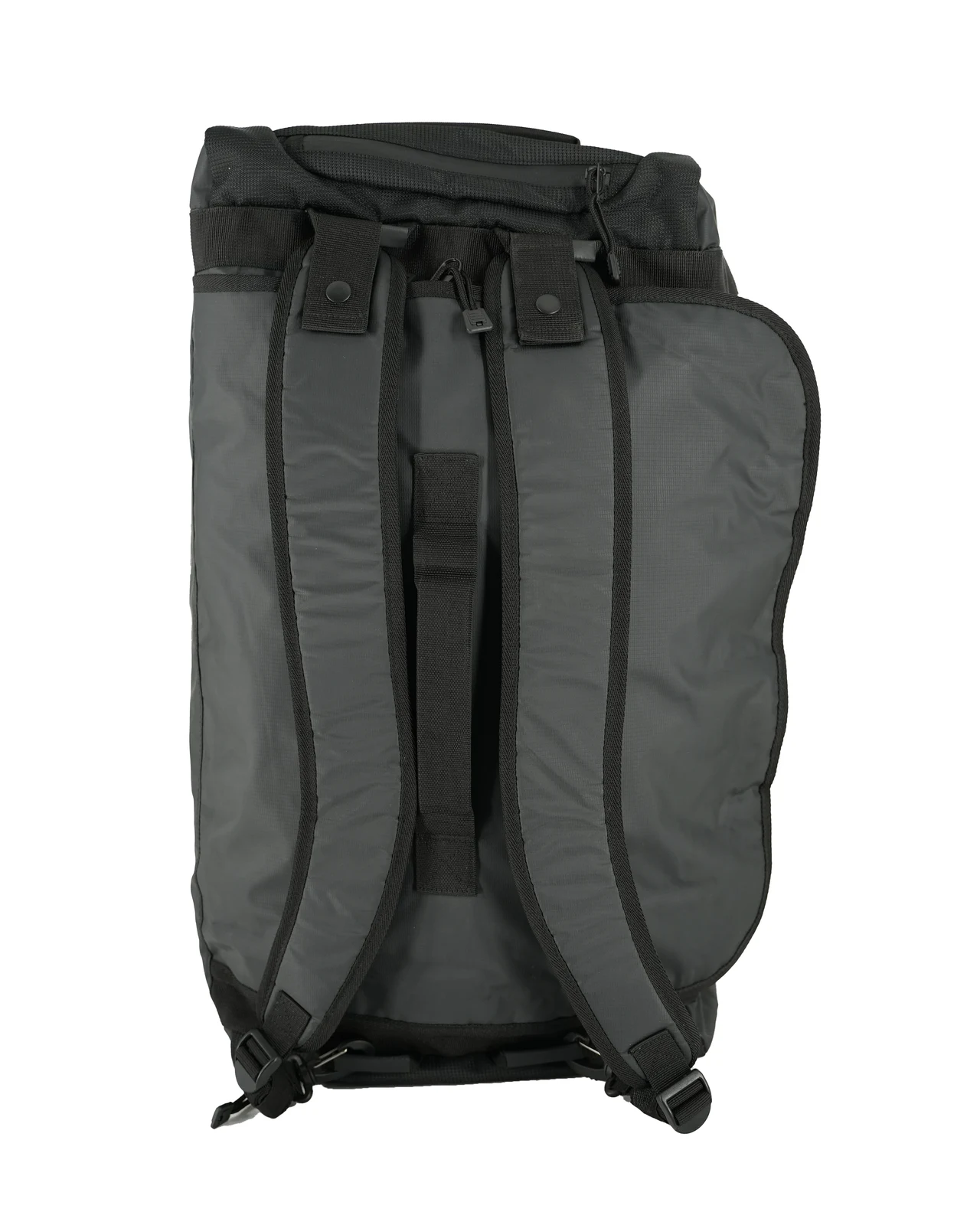
The photograph shows paired shoulder straps, a central handle and lower adjusters. It provides a reference for discussing carrying directions. It does not establish carrying capacity, long-duration comfort or every possible conversion sequence.
Avoid giving a sample a feature merely because the design team can imagine a way to rearrange its straps. Confirm the intended method on the corresponding physical assembly, then use that method consistently in the brief and later product communication.
02
Give unused straps a defined place
If the shoulder straps remain outside during hand carry, inspect whether they touch the placing surface, enter the zipper area or obstruct the handle. If they fold back or stow away, specify the position and retention method. An unshown interior area should not be described as a concealed harness compartment.
For a short transfer, a connected but tidied strap arrangement may be worth comparing. A requirement for complete harness storage needs a corresponding sample that demonstrates insertion and removal. Promotional photography cannot supply construction that has not been developed.
Define the exit condition as well: when the user returns to shoulder carry, the straps should be identifiable and arranged as intended. Record any untwisting or reconnecting step rather than assuming the transition ends when the bag looks neat on a table.
03
Keep connections and openings usable
Where upper straps sit near a zipper, review the positions of closure tabs, straps and sliders. Open the bag, remove a selected item and close it again in both intended orientations. An empty bag lying flat is only one condition.
Where several components sit together, their exact removal sequence requires the matching sample. Number the connection points and identify which component each step operates, especially where a fixed end could be mistaken for a normal release point.
The most useful revision names an interference: a tab covering the slider, a strap crossing the opening or a handle difficult to locate. This tells the sample room what to change without demanding an unrelated redesign of the entire bag.
04
Check direction after fastening
After connection, examine strap twist, hook orientation and left-to-right adjustment. A detail that is unobtrusive in hand carry may sit differently against the wearer during shoulder carry. Keep loaded reference photographs for both states.
A visible hook-and-ring connection does not establish a rated load. Register the fitting reference, webbing and assembly direction together. A substitute component should trigger a review of the assembled connection rather than approval based on a similar silhouette.
05
Consider where contents move after rotation
Contents can settle against different walls in horizontal and vertical orientations. With the bag closed, change its direction, place it down and reopen it. Check whether the planned groups remain identifiable and whether frequently needed items have moved beneath others.
If every transition requires repacking, consider internal restraint or item placement. Before adding pockets, identify the group that actually needs locating. More divisions can also add steps, so they should solve an observed access problem rather than decorate the feature list.
06
Hand over an identifiable approved arrangement
Keep the approved sample identifiable
Keep both carry states, unused-strap positions, connection sequence, packing list and sample version in the approval record. Later photography and instructions should use that confirmed arrangement. A different fastening method introduced for a tidy image can create inconsistent user expectations.
These are proposed development steps, not claims that the illustrated sample has passed them. Find related construction discussions in the JKPD development blog.
Related: Bag hardware selection. See the photographed product reference.
Discuss your bag development project
ANSON XIE
General Manager & Founder
Quanzhou Junkai Pengda Special Equipment Co., Ltd.
Email: ansonxie@jkpdtime.com
Phone: +86 177 5095 3355
WhatsApp: +86 177 5095 3355
Factory address: Floors 2–4, Building 1, Phase I, Huixin Intelligent Manufacturing Industrial Park, Hui'an County, Quanzhou, Fujian, China