
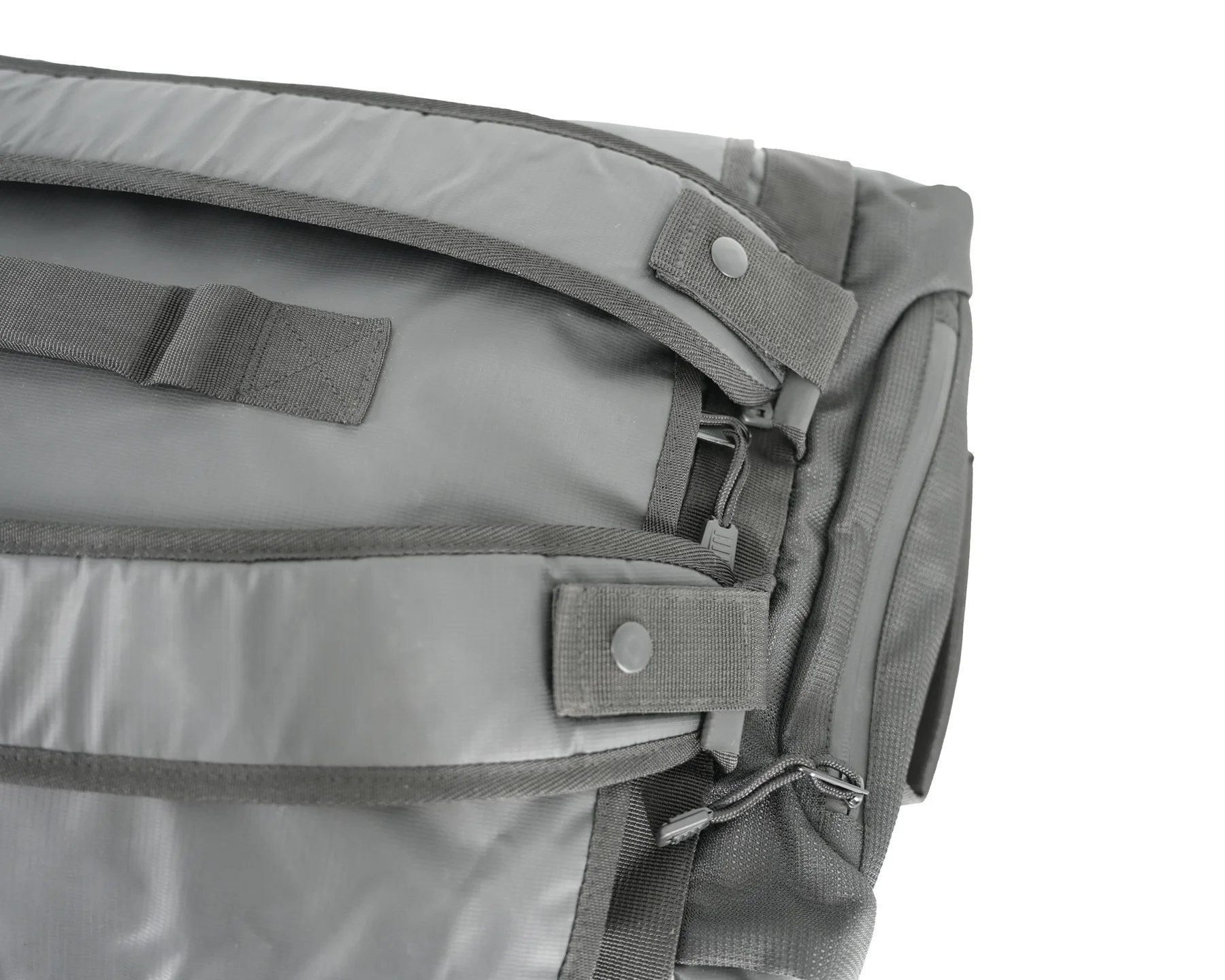
A travel organizer closes easily when empty, but that does not answer how its closed zipper behaves when contents push the two sides apart. For this question, ask for relevant lateral chain strength evidence and review the installed opening separately. Smooth slider movement, a large chain size and a familiar brand name are not substitutes for that evidence.
Start with the specific opening: a main compartment, an expansion section or an organizer pocket. Identify the intended contents and the zipper assembly before choosing a test programme. This guide explains how a buyer can frame the review; it does not assign a safe packing load or claim that the photographed product has passed a strength test.
- Match the report to the actual chain and component combination.
- Distinguish transverse chain loading from pulling a slider along its path.
- Review tape attachment and surrounding fabric as separate parts of the installed opening.
- Do not convert a component test force into a luggage capacity claim.
01
What does lateral chain strength address?
Lateral chain testing concerns resistance across the engaged zipper chain. YKK's explanation of chain lateral pull testing describes loading the chain sideways until failure. Its discussion also treats repeated opening and closing as a separate test, reinforcing that these properties should not share one vague durability label.
The direction matters. Moving a slider along the chain asks whether the assembly operates; pulling the closed sides apart asks a different question. A report headed operating force should not be presented as a transverse strength result merely because both tests involve the same zipper.
The travel zipper operability guide covers opening and closing observations. Use the two reviews together when both functions matter. Keep their evidence and acceptance decisions distinct so that a smooth demonstration cannot hide a missing strength assessment.
02
Trace the result to the supplied assembly
Ask for the supplier's chain reference, type and size, plus the relevant slider, tape and finishing details. Record the tested sample identity and report date. If the report concerns another article in the same range, ask the supplier to explain the relationship and the limits of that coverage.
A name is not a complete specification
Two components can look similar in a photograph yet have different article references. Do not accept a general product family brochure as a test report for an unspecified supplied combination. Equally, do not conclude that a report is irrelevant without giving the supplier an opportunity to establish traceability.
Connect the report to the bill of materials and retained sample. The zipper sample-library workflow provides a way to keep those references together. Record substitutions explicitly; an unchanged bag model name should not conceal a changed fastening system.
03
Read the test basis before comparing numbers
Compare results only after confirming what was tested and how the value is expressed. Ask the testing party for the method, edition, specimen arrangement, conditioning, units and failure description. A peak force without those details is not enough to rank two zipper options reliably.
Have the laboratory choose or confirm the applicable procedure for the assembly. The manufacturer's public explanation establishes the broad direction of testing, not a complete laboratory instruction. Do not improvise clamp dimensions or test speeds from a photograph and then describe the outcome as a recognised standard result.
- Verify the tested article and sample condition.
- Check the method and any declared changes to it.
- Read the result units and the basis on which the result is reported.
- Ask where and how failure occurred, rather than collecting only a pass stamp.
- Agree the acceptance requirement before the samples are tested.
The requirement should come from the intended product and its validation plan. A number copied from another manufacturer's bag may refer to a different arrangement or use case. If the buyer has no established criterion, resolve it with the supplier and qualified testing party before bulk release.
04
Follow the load into the installed opening
The installed zipper connects through its tape, stitches and neighbouring panels. A chain result does not automatically establish the strength of those connections. Review the sewn construction as an assembly, with its own sample identity and agreed evaluation, instead of extending a loose-component report to the whole bag.
For a hypothetical organizer carrying rigid accessories, note where the contents press against the opening. A corner of a packed object can change the local shape without making the entire opening uniformly loaded. Define the contents and orientation so later sample comparisons do not quietly change the loading situation.
Record the failure location precisely
If an agreed assembly evaluation produces damage, distinguish chain separation from tape tearing, stitch damage or failure in the neighbouring fabric. Photograph the location and retain the sample. A note saying zipper failed can send the supplier toward the wrong correction when the affected part is actually the attachment.
Do not conduct an uncontrolled destructive pull merely to produce a dramatic demonstration. Use an agreed programme, suitable equipment and qualified personnel for measured testing. Buyer handling observations can identify concerns, but they are not interchangeable with a controlled strength result.
05
Avoid assigning a packing weight from a test force
A reported chain force is not a luggage weight rating. The relationship between contents and force at an opening depends on the bag's shape, packing arrangement, supports and how it is handled. Those conditions are not supplied by a loose zipper result.
For example, two hypothetical packing lists with the same total mass could distribute their contents differently around an organizer opening. That comparison explains why the packing arrangement needs definition; it does not predict a force or establish an allowed mass. Keep any finished-product load claim tied to its own supporting evaluation.
If the intended contents prevent normal closure, revisit the compartment and packing brief. Do not treat a stronger chain as automatic permission to force an undersized opening shut. The travel opening design review addresses the geometry and access questions that should accompany component selection.
06
Compare corrections without losing the baseline
When a revised sample arrives, identify every changed item: chain, tape attachment, fabric, allowance, opening geometry or packing instruction. Compare it under the same agreed conditions. A second sample with fewer contents does not isolate the effect of a replacement zipper.
Where practical, review one suspected cause at a time. If several changes are necessary, approve the complete revised assembly and record that the individual contribution of each change was not isolated. This prevents a later cost reduction from removing a feature that was part of the approved combination.
Retain the earlier evidence and note which findings the revision resolves. Keep initial strength, repeated operation and installed access as separate lines. Passing one line should not automatically close the others, especially when the revised component changes the way the user opens or closes the bag.
07
What should be released to purchasing?
Issue the exact component references, approved assembly drawing, applicable report references and agreed acceptance criteria. Include the defined packing configuration used for any assembled review. State unresolved items clearly instead of summarising a partial programme as fully tested.
For a new travel bag programme, this separation makes the next decision practical: select a traceable zipper, obtain relevant component evidence, and verify the surrounding construction. The outcome is a documented approval scope, not a universal promise that a larger or smoother zipper makes every packed bag stronger.
Discuss your bag development project
ANSON XIE
General Manager & Founder
Quanzhou Junkai Pengda Special Equipment Co., Ltd.
Email: ansonxie@jkpdtime.com
Phone: +86 177 5095 3355
WhatsApp: +86 177 5095 3355
Factory address: Floors 2–4, Building 1, Phase I, Huixin Intelligent Manufacturing Industrial Park, Hui'an County, Quanzhou, Fujian, China