
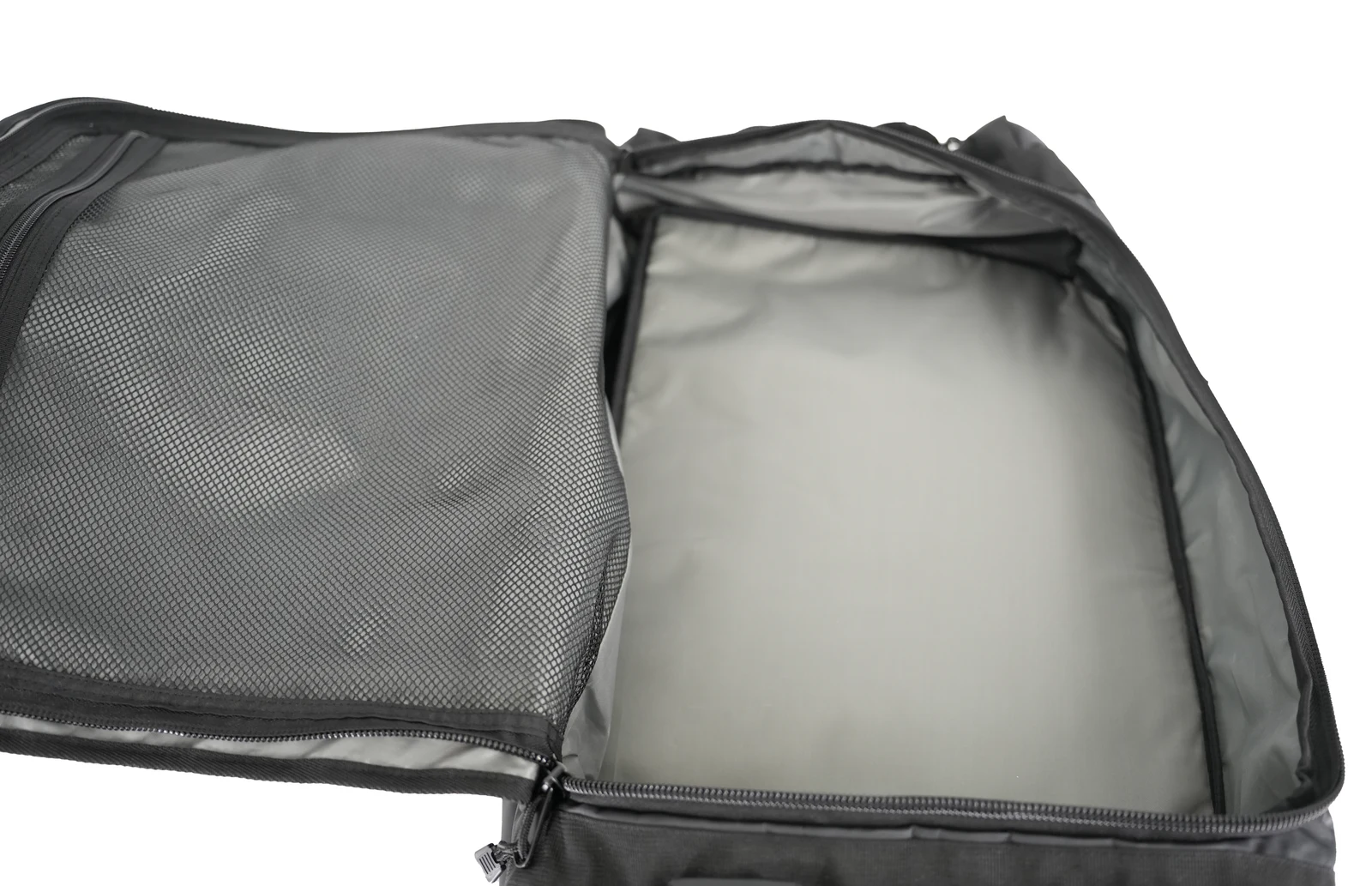
A travel bag mesh divider can keep a selected group of items in a defined area while allowing part of the contents to remain visible. Develop the divider around folded garment thickness, closure and access sequence. Adding another mesh layer does not automatically create more usable storage.
Development priorities: define the contents of each layer; allow for packed depth; keep garments away from the zipper path; specify visibility and liquid separation as different tasks.
01
What should the divider separate?
An outfit, frequently used items or one traveller’s belongings can each form a useful group. Give the divided area a clear job, such as keeping arrival clothing separate from less urgent items, rather than assigning a small pocket to every object.
For a brand brief, name the intended user and the moment of access. A compartment arranged for unpacking at a hotel may need a different opening from one intended for a quick stop. This makes the number of divisions a consequence of use rather than the starting specification.
02
Allow packed depth as well as flat area
Specify the divider’s flat outline and the usable depth behind it separately. A thin shirt, a folded knit garment and an irregular pouch can occupy similar areas but form different packed shapes. Build the sample around the intended list and folding method.
The interior photograph shows a mesh divider, surrounding zipper and light-coloured lining. It records visible layers, not fiber composition, stretch performance or maximum loading. Check whether the divider lies over the contents naturally and whether objects push its edges upward before attempting closure.
If the divider and main compartment share space, define a condition with both areas packed. A demonstration with one side full and the other empty can overlook interference. Photograph the combined arrangement and keep the item list with the sample record.
03
Keep the closure path clear
Leave enough room to move garment corners away from the zipper teeth and slider path before closing. Review binding, lining allowances and corners in the sewn assembly. A wide opening on a drawing does not establish convenient handling at every turn.
Ask a reviewer to pack, close, reopen and remove only one selected garment. Note whether other items must first be removed. If access repeatedly disturbs the whole stack, consider changing the opening direction or grouping before adding more pockets.
A useful revision identifies the specific obstruction: a garment edge entering the closure path, a bulging corner or a divider that cannot settle. “Make it easier to use” gives a sample room much less guidance than a photograph of that condition.
04
Separate visibility from liquid isolation
Visible openings in mesh are not evidence of waterproof separation. If damp items need to stay apart from dry clothing, define the container, closure and seam requirements separately. The phrase “wet/dry section” should follow an agreed construction and verification approach rather than appear as a label on any divider.
A separate end pocket may provide another storage position. A proposed shoe or toiletry application needs the actual objects and an interior sample review. An exterior silhouette alone does not confirm suitability.
05
Match mesh to the surrounding assembly
Compare visibility, flexibility, deformation and edge treatment separately. A lighter mesh can change handling and shape as well as weight. Neither a photograph nor the generic word “mesh” establishes abrasion or carrying performance.
Ask for an identifiable material reference and a sewn sample combining mesh, binding, zipper and lining. When the mesh changes, review packed depth again rather than comparing only swatch price. Keep the intended content arrangement constant so that a different folding method is not confused with a material improvement.
06
Keep a repeatable approval record
Keep the approved sample identifiable
Save empty, simultaneously packed, closed and partial-access views with the item list and folding method. These become comparison references when a fabric or pocket changes. Record the sample version so later approvals refer to the same assembly.
The retained photograph comes from the company product library. This article provides development suggestions rather than test results. Continue with the JKPD development blog for related bag construction topics.
Related: Removable organizer insert review. See the photographed product reference.
Discuss your bag development project
ANSON XIE
General Manager & Founder
Quanzhou Junkai Pengda Special Equipment Co., Ltd.
Email: ansonxie@jkpdtime.com
Phone: +86 177 5095 3355
WhatsApp: +86 177 5095 3355
Factory address: Floors 2–4, Building 1, Phase I, Huixin Intelligent Manufacturing Industrial Park, Hui'an County, Quanzhou, Fujian, China