
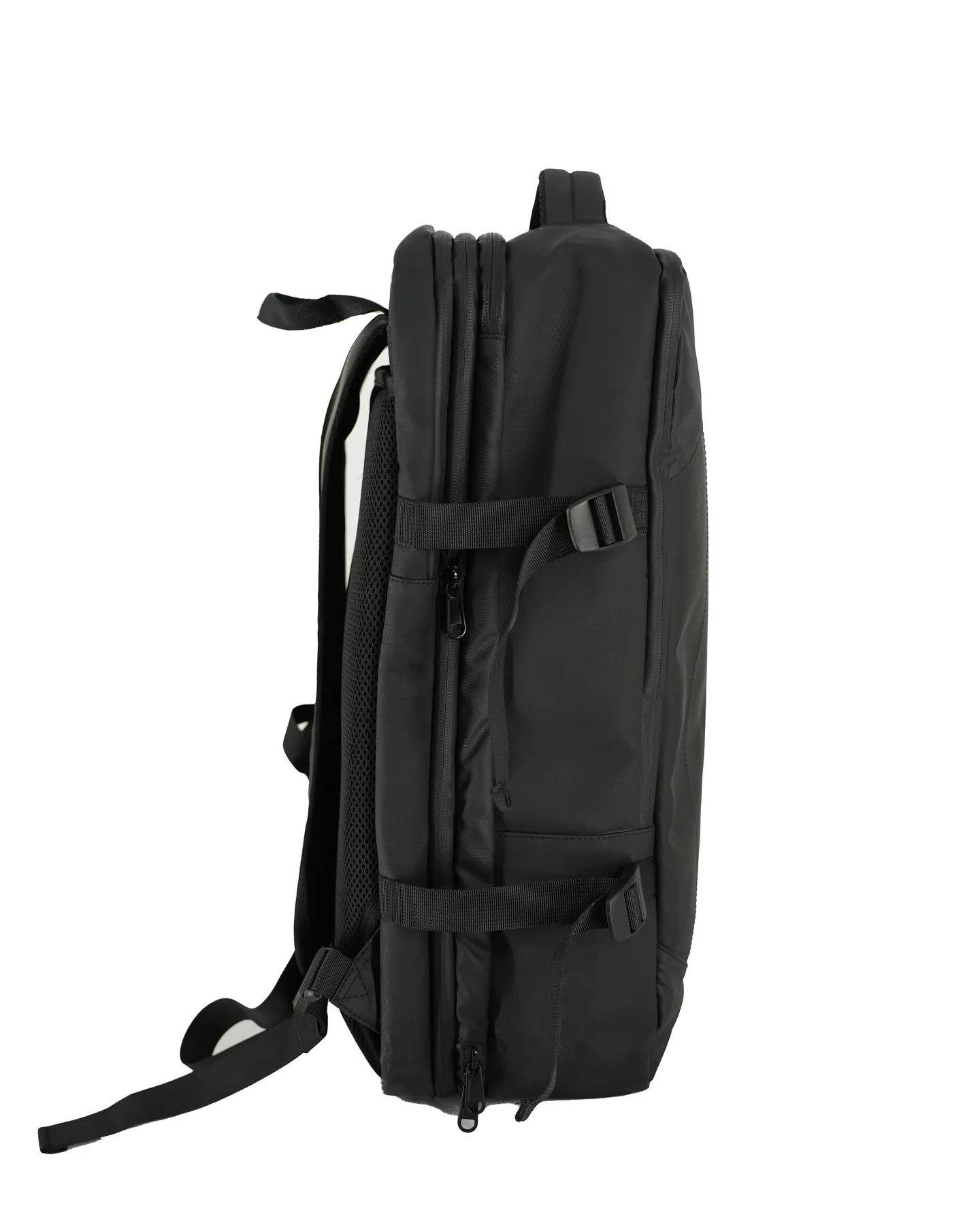
A travel backpack can match its drawing when empty and exceed the intended size once the front pocket holds a charger. Approve the outside envelope in a defined packing state, not just the flat panel dimensions. The development brief should say which projections count, how the bag rests and what the user may adjust before measurement.
This is a sample-development review, not an airline approval or a promise of cabin acceptance. The photograph provides a backpack profile reference; it does not establish the pictured bag's dimensions or suitability for any flight.
- Define the target baggage category and the applicable airline policy before freezing the pattern.
- Separate usable storage volume from the three external dimensions of the packed product.
- Retain the packing list, strap positions and measurement method with the approved sample.
01
Which baggage requirement is the design targeting?
Name the intended market and baggage category before requesting a cabin-size backpack. An overhead cabin bag and a personal item intended to fit beneath a seat are different briefs. A label such as travel size leaves the pattern maker without a measurable boundary and gives purchasing no clear basis for comparing samples.
IATA's passenger baggage guidance states that allowances vary by airline, cabin class and aircraft type. Its general reference is not a universal product certification. Record the policy source and review date, then ask the buyer to confirm the target envelope for the actual sales claim.
For a specific example, ITA Airways' hand-luggage page lists 55 × 40 × 23 cm and 8 kg for its main carry-on allowance, including handles, side pockets and wheels. These figures were checked on 24 October 2026 and are an example only; policies and flight conditions can change.
Keep the claim narrower than the evidence
Do not turn one carrier's dimensions into an approved-for-all-airlines statement. The design team can document a measured sample against a named requirement. That record cannot guarantee what happens at every boarding gate, particularly when a customer packs differently from the agreed sample condition.
02
What belongs inside the measurement envelope?
Draw the three measurement directions on a photograph of the finished bag. Include the protruding parts required by the chosen policy, rather than measuring only the seam-to-seam shell. Handles, filled pockets, padded back panels and projecting hardware can extend beyond the flat pattern's apparent outline.
Specify whether the bag stands upright, lies on its back or rests in another defined orientation. Soft panels settle differently under their own weight. Use the same support and orientation for every comparison, and document whether straps are secured in their intended travel position or left loose.
The backpack capacity brief addresses storage-volume definitions. Litres do not replace this review: two bags with similar usable volume can have different proportions, and a deep front pocket may increase the maximum depth without changing the main compartment's width.
03
How should the sample be packed?
Use a written packing list and a repeatable placement plan. Identify the size and shape of the dummy contents, not only their total mass. A firm rectangular object and a compressible clothing bundle can push the same shell into different profiles even when the scale shows a similar reading.
Include the pockets that customers are expected to use. Measuring a loaded main compartment with every external pocket empty can hide the very bulge that the design needs to control. If a water bottle or accessory sits outside the bag, state whether that configuration is within the product's intended baggage claim.
Keep valuable electronics out of development handling checks. Suitable dummy objects can reproduce the agreed geometry without exposing a customer's equipment. Photograph the placement before closing the bag so another reviewer can rebuild the condition instead of relying on a description such as normally packed.
04
What does a repeatable dimension check look like?
Measure the outermost points in each agreed direction using a method that does not unintentionally flatten the bag. Record the measuring equipment and contact approach. A tape following the curved surface measures a different path from the straight distance between two reference planes, so do not mix those results.
Where a sizing fixture is part of the brief, record its internal dimensions and the permitted insertion action. Merely forcing a soft sample into a box does not establish that it meets the intended customer experience. Note whether closure, insertion or removal requires unusual compression or rearranging the contents.
- Record the bag revision, packing arrangement and adjustment state before measurement.
- Locate the maximum projection rather than assuming it is at the centre of the panel.
- Repeat the observation after removing and replacing the contents using the same instructions.
These are proposed development controls, not a standardized laboratory method or a report of completed JKPD testing. Agree acceptance criteria and measurement uncertainty with the team responsible for verification before treating a small difference as a pass or failure.
05
Which design changes alter the packed profile?
Review front-pocket depth, gusset shape and stiffener location when the maximum dimension is larger than expected. Find the part that projects first. Reducing every panel by the same amount may sacrifice useful storage while leaving a protruding handle or pocket unchanged.
Expansion features deserve separate states in the specification. Record the closed and expanded configurations, their intended uses and any limits on the baggage claim. Do not show the expanded capacity in marketing while supporting the cabin-size statement only with an unexpanded, lightly packed sample.
Compression straps may alter the shape, but the compression-strap layout review is a separate design task. Here, define the actual adjustment state and check whether the customer can reproduce it without blocking access or putting excessive pressure on the intended contents.
06
How much room should the drawing leave?
Do not set the nominal drawing exactly at a maximum limit and assume every production unit will remain below it. Ask the pattern and quality teams to account for material thickness, seam construction, packing variation and measurement variation. There is no universal allowance that can be copied into every soft-bag project.
Compare several representative samples when the design is close to its boundary. Record the range and investigate its causes rather than reporting only the smallest result. A change in padding, lining bulk or seam allowance may alter the outside envelope even when the main pattern pieces retain their names.
Keep weight acceptance separate from dimensional acceptance. Passing a dimensional check does not establish a packed mass, and neither result alone proves flight acceptance. The buyer should approve the wording used on the product page against the actual scope of the retained evidence.
07
What should procurement retain after approval?
Keep the finished sample, pattern revision, packing list, placement photographs, measurement directions and results together. Add the named target requirement, source date and permitted adjustment state. This package makes a later size dispute more useful than a comparison between two marketing photographs.
Repeat the affected checks when a pocket, handle, padding stack or expansion construction changes. For a travel bag development brief, provide the intended packed envelope alongside the storage requirements. A measurable boundary and a realistic packing plan give the sampling team a practical design problem to solve.
Discuss your bag development project
ANSON XIE
General Manager & Founder
Quanzhou Junkai Pengda Special Equipment Co., Ltd.
Email: ansonxie@jkpdtime.com
Phone: +86 177 5095 3355
WhatsApp: +86 177 5095 3355
Factory address: Floors 2–4, Building 1, Phase I, Huixin Intelligent Manufacturing Industrial Park, Hui'an County, Quanzhou, Fujian, China