
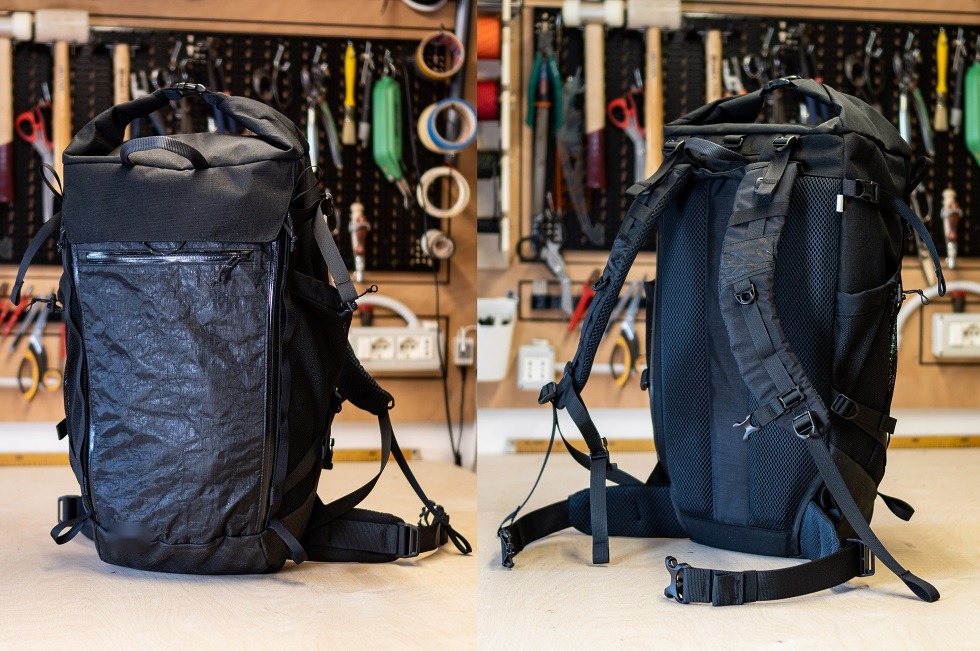
A custom roll-top pack can use different materials for the body, floor and lining. A translucent laminate on the shell serves a different purpose from a reinforced bottom or a bright interior.
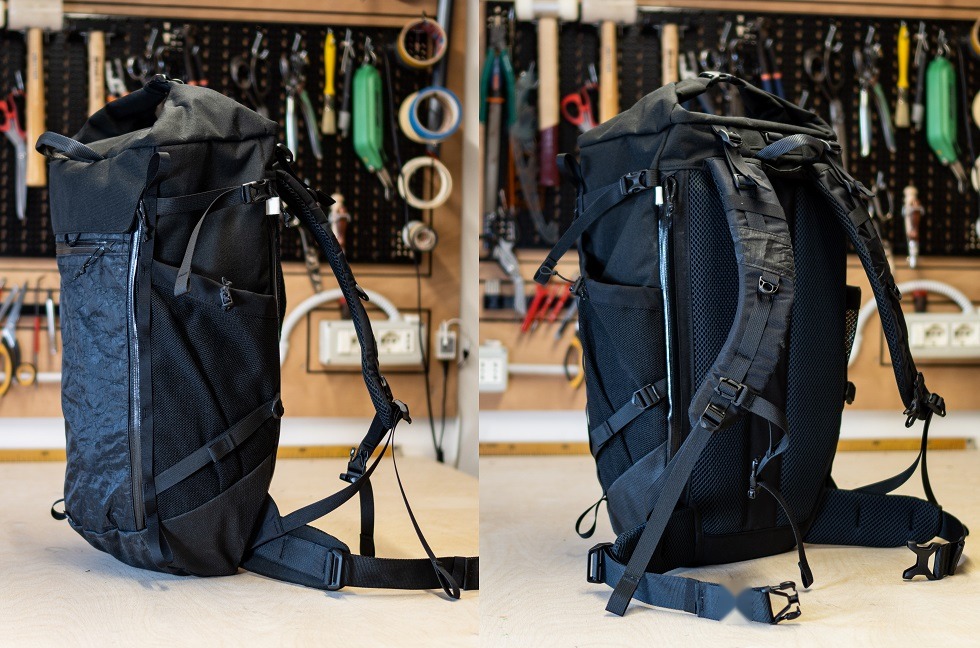
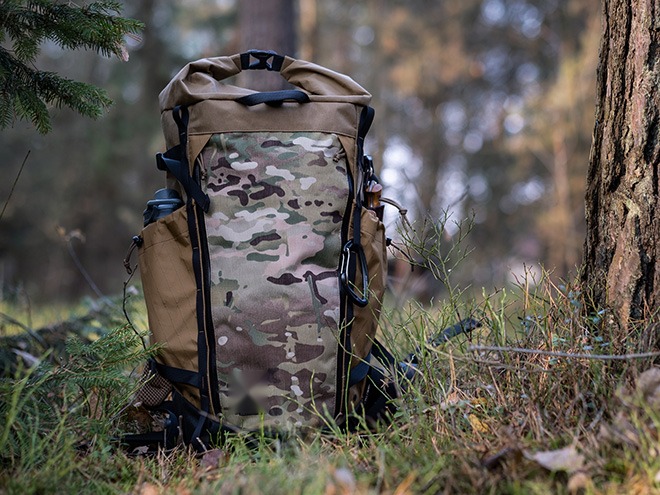
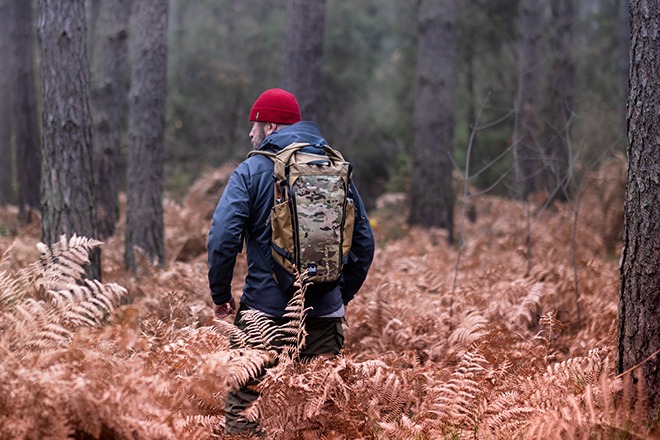
The photos show different build variants. The black and camouflage packs are reference examples for access, fit and storage; they should not be read as proof that one photographed pack contains every material discussed here.
01
At a glance
| Feature | Reference build features |
|---|---|
| Volume | About 30 L standard, expandable to about 38 L or more by unrolling the top |
| Frame | Internal aluminium frame |
| Main fabric (example build) | Translucent green-grey UHMWPE composite laminate, 0.75 oz/yd² (25 gsm) |
| Bottom (example build) | Aramid fibre |
| Lining (example build) | Purple nylon |
| Harness (example build) | Vest-style shoulder straps |
02
Choose the construction by zone
Start with the use of each zone. A thin body saves weight but the floor meets hard surfaces. A bright lining helps reveal small contents and a heavier front panel may be appropriate where equipment rubs.
03
Functions and features
Roll-top closure and serious expansion
An extended roll-top adds room as the load changes. Take capacity dimensions with the opening rolled to its intended closed position; an unrolled collar is not the same as usable volume.
The roll-top also keeps the pack slim when it is not full: side compression straps pull the body in, so the same pack looks compact on a light day and tall on a heavy one.
Access from three directions
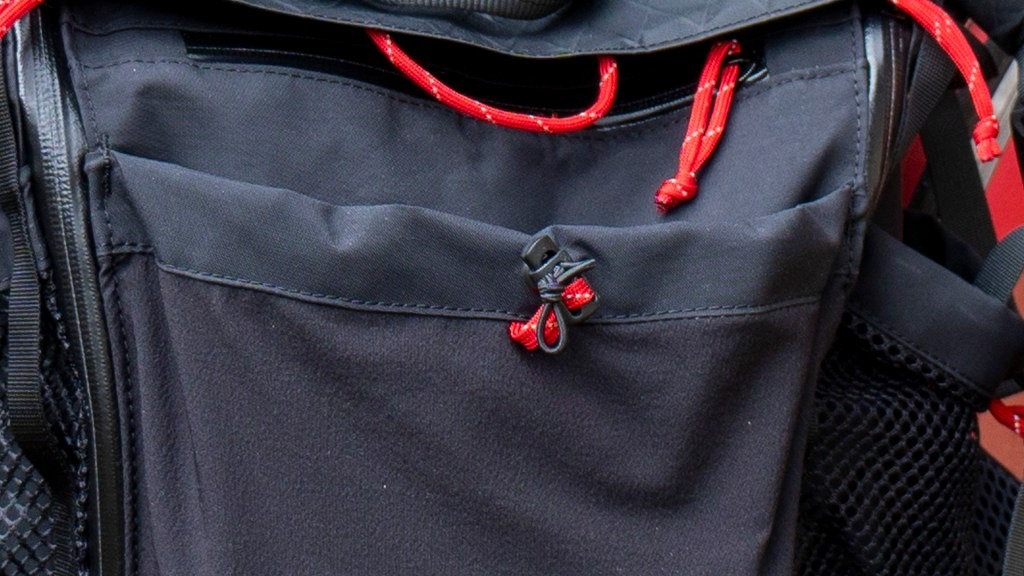
A roll-top on its own is a poor way to reach things at the bottom of a pack, so this model is designed around multiple entries. The example build has a diagonal water-resistant zip across the front, opening into the main compartment, with a stretch-mesh pocket and a bungee cord in front of it and a daisy chain running down the face.
Other builds of the same model show the range of what is possible. One has a full front panel that opens on a zip, secured at the top by a strip of hook-and-loop fastener, with a second zip on the opposite side giving access to any part of the main compartment. Another has two front zips, so the face can be peeled down from either side. A rear zip gives direct access to a padded sleeve that fits a 15-inch laptop, so the computer can slide in and out without opening the pack at all.
Inside, the organisation is deliberately simple: a hydration sleeve, loops for clipping in pouches and gear, and a few pockets.
Vest-style shoulder straps and an aluminium frame
The example build uses vest-style shoulder straps — wide, close-fitting straps that wrap the torso more like a running vest than a conventional hiking pack — with their lower ends attached to the pack body by bungee cord. That attachment is the one detail the original owner flagged as an open question: whether the elastic connection would let the pack sway on the move. It is a fair question, and it has no published answer yet.
An internal aluminium frame gives the body structure. Check how it connects to the shoulder straps and whether the chosen waist arrangement transfers or simply stabilises the load.
One reference layout uses a simple removable webbing waist strap. Check removal and refitting with the bag packed and make sure the side attachments remain accessible.
Pockets, lashings and small details
The example layouts use large side pockets and external attachment points. Measure an actual bottle and check access with the side straps occupied.
04
Fabric and material combinations
A thin translucent laminate lets light through and behaves differently from the heavier materials used at wear points.
Check the selected material's stiffness, seam handling and resistance to local damage. Visibility through the shell does not establish its weight or waterproof performance.
- Main body example: translucent UHMWPE composite laminate.
- Floor example: aramid reinforcement at a high-wear contact zone.
- Front panel (other builds): laminated fabric or polyurethane-coated heavy nylon, sometimes in a contrasting colour or camouflage print.
- Lining: chosen for visibility, not just looks. The example build uses purple nylon; other builds use a white luminous nylon or a red polyurethane-coated nylon ripstop. A bright lining turns the inside of a dark pack from a black hole into something you can actually search.
- Pockets: stretch mesh for the bottle pockets, with bungee cinches.
- Frame: internal aluminium frame, with a removable foam back panel on some builds.
- Hardware: water-resistant zips and buckles from specialist suppliers, rather than generic parts.
Shell material, zip and seams form separate paths for water. Verify the finished design rather than treating a shell or closure specification as a waterproof bag claim.
05
Who is it for?
- Hikers who want to define the storage and contact zones for a particular load.
- Fast-and-light mountain users, who value a tall, slim roll-top that expands from a day-pack volume to a weekend volume.
- Walkers who carry climbing or winter gear, who will use the daisy chains, ice-tool loops and side compression straps.
- Commuters and travellers who want one pack for everything, since the same model is used as a daily carry, a travel pack and a mountain pack, depending on the build.
06
Pain points it solves
- A brief that needs different materials or openings in different zones.
- Dark interiors you cannot search. A vivid lining — purple, white or red — makes the contents visible at a glance.
- Roll-tops that hide everything. Front and side zips, plus a rear laptop entry, give access to the main compartment without unrolling the top.
- Wear at the floor. Compare a reinforced bottom with the actual contact and packing load.
- One-size-fits-all harness fit. A bespoke fit removes the usual compromise on torso length and strap shape.
07
Design strengths
- Thin translucent shell fabric, with separate reinforcement where needed.
- An aramid floor option for the contact zone.
- A roll-top that changes its closed height with the load.
- Three-way access: roll-top, front zips and a rear sleeve entry.
- Bright, high-visibility lining in purple, white or red, chosen by the owner.
- Mountain-ready lashing: daisy chains, ice-tool loops, side compression and big bottle pockets with drain holes.
08
Limitations to keep in mind
- Thin laminate deserves a close wear check where it folds or contacts hard equipment.
- Vest straps on bungee are unproven. The example build attaches the bottom of its vest-style straps to the body with elastic cord, and whether that lets the pack sway is still an open question.
- Strap foam thickness and coverage need checking with the intended load.
- The waist strap can be fiddly. On one build it is hard to remove and refit; on another, the side compression webbing is tied into loops inside the bottle pockets, where the knot can obstruct a bottle.
- Mesh pockets snag. Stretch mesh saves weight and drains well but can catch on branches and rock.
- A small black fitting at the base of the example build has no documented purpose.
09
What the design teaches
Keep the shell, floor and lining decisions independent in the brief, and list which photos show each idea.
The second lesson is about the lining: a bright interior is the difference between finding something in seconds and digging through a dark sack, and letting the customer pick the colour shows how much of a pack's quality sits in decisions a spec sheet never lists.
The third lesson is about the frame: an internal aluminium frame, a mesh back panel with a spine channel and working load lifters let a pack under a kilogram carry 14 kg comfortably. Weight is saved in the fabric, not in the carrying system — and that is the right way round.
10
Prototype brief
Useful inputs for a custom roll-top prototype include:
- Target volume and expansion range, and the recommended maximum load.
- Fabric by zone: UHMWPE laminate weights for the body, aramid or heavy nylon for the bottom, and the lining colour and weight.
- Frame design: material and shape, how it sits in the back panel, and how the load lifters connect to it.
- Closure and access: roll-top length, and the split between top, front and side entries.
- Pocket layout: side pocket size for large bottles, front mesh pocket, and internal organisation.
- Harness: vest-style or conventional straps, and how the strap bottoms attach to the body.
Related guide: An Ultralight Frame Pack with a Removable Belt and Full-Length Front Zip
Discuss your bag development project
ANSON XIE
General Manager & Founder
Quanzhou Junkai Pengda Special Equipment Co., Ltd.
Email: ansonxie@jkpdtime.com
Phone: +86 177 5095 3355
WhatsApp: +86 177 5095 3355
Factory address: Floors 2–4, Building 1, Phase I, Huixin Intelligent Manufacturing Industrial Park, Hui'an County, Quanzhou, Fujian, China