
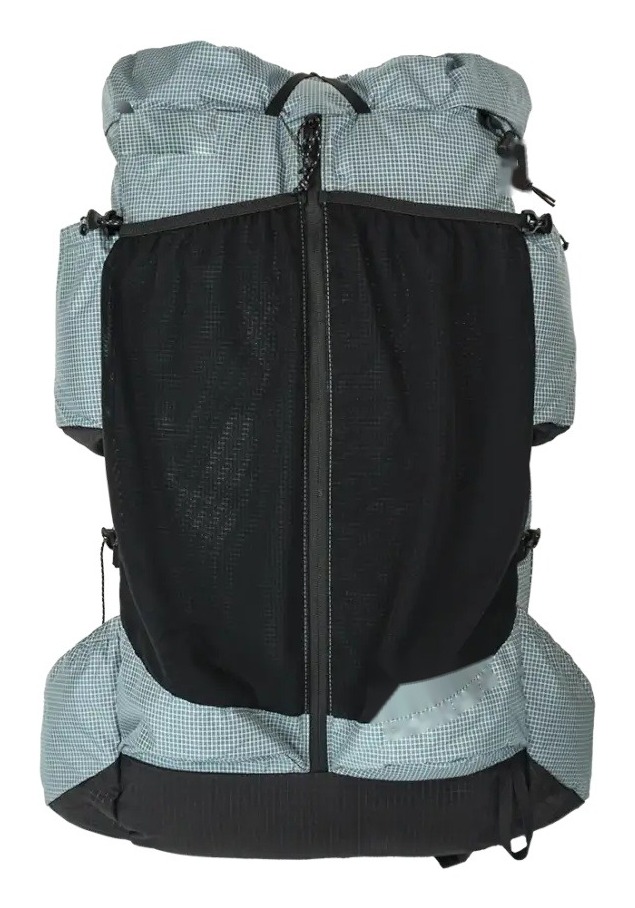
Frameless packs save structure, but shoulders may carry more of the load after a resupply or on a long dry stretch. An internal frame is another option when the gear cannot be made smaller or lighter.
This reference pack comes in 45- and 60-litre layouts, with an aluminium frame, a padded back, load lifters and a wide hip belt.
The body uses a nylon and UHMWPE ripstop grid. The belt and foam back pad can be removed. It is a reference example, not a JKPD product.
01
At a glance
| Feature | 45 L version | 60 L version |
|---|---|---|
| Weight | 865 g | 895 g |
| Dimensions | 60 × 28 × 16 cm | 60 × 28 × 19 cm |
| Nominal volume split | 35 L main compartment + 10 L pockets, plus about 10 L extra in the roll-top | 50 L main compartment + 10 L pockets, plus about 10 L extra in the roll-top |
| Frame | 24-inch (about 61 cm) aluminium frame | Same |
| Hip belt sizes | S up to 80 cm, M 81–91 cm, L 92 cm and over | Same |
| Main fabric | 100D high-tenacity nylon with a 200D UHMWPE ripstop grid | Same |
| High-wear fabric | 210D high-tenacity nylon with a 400D UHMWPE ripstop grid | Same |
| Colours | 2 | 2 |
02
Why this pack matters: a frame without the weight penalty
A frameless ultralight pack relies on the gear inside — usually a folded sleeping pad — to give the pack its shape, and on the shoulders to carry most of the weight. That works for a light base weight. It stops working when the load gets heavy, because without a frame there is nothing to transfer the weight to the hip belt, so it ends up on the shoulders.
This pack keeps the frame. A 24-inch aluminium frame inside the back panel transfers the load to the hips, and the load lifters anchor to the frame so they can pull the top of the pack in towards the body. The trick is that everything else has been trimmed: a light fabric, a roll-top instead of a zipped lid, mesh pockets instead of fabric ones. The result is a framed pack that weighs about the same as many frameless ones.
03
Functions and features
A 24-inch aluminium frame
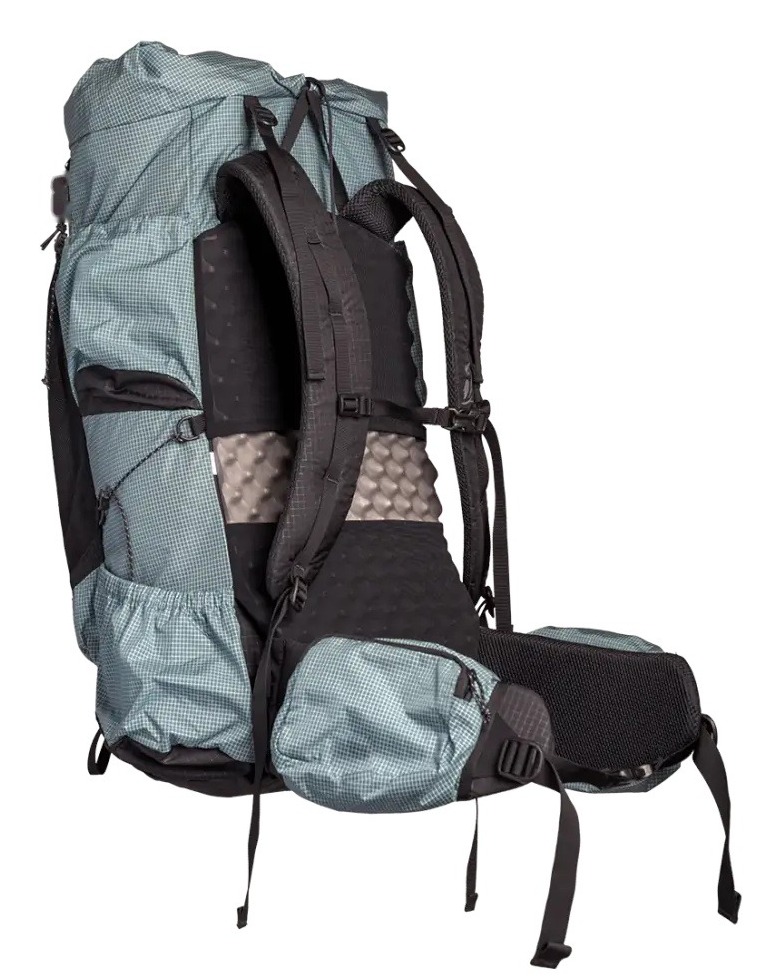
The frame is the core of the pack. It runs inside the back panel and gives the pack its shape whether it is full or nearly empty. The frame can technically be removed, but this is not recommended: getting it back in is difficult. In practice it is best treated as a permanent part of the pack.
The removable belt is a separate interface from the frame. Check that it stays positioned when the sample is loaded, and document the connection before assigning a carry rating.
A modular build: removable hip belt and back pad
The pack is modular. The hip belt can be removed, so on a light day or a short side trip the pack can be stripped down. The foam back pad can also be taken out and used as a sit pad at camp or on breaks — one item doing two jobs, which is the essence of ultralight packing.
Separate torso length and belt size when reviewing fit. Check whether the selected belt wraps the hips without running out of adjustment.
Roll-top closure and a full-length front zip
The main compartment closes with a roll-top. Its extension gives room for a fuller load; mark how many rolls are needed to close it securely in the normal carry state.
The drawback of a roll-top pack is usually access: to reach something in the middle, everything above it has to come out. This pack solves that with one long vertical zip running down the front, behind the mesh pocket. Opening it gives access to the main compartment without unrolling the top.
External pockets: built for long trails
External storage is where this pack stands out:
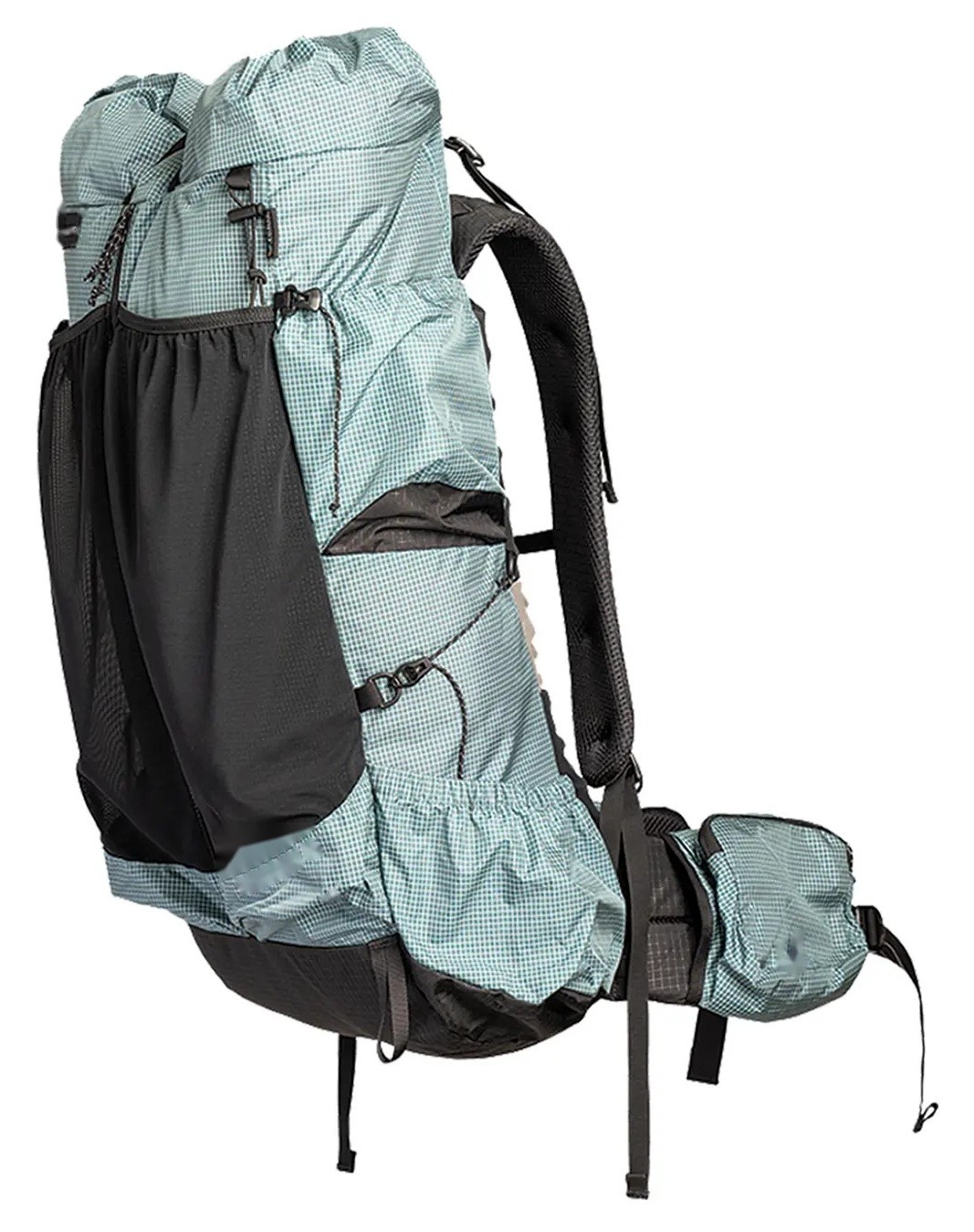
- Two large side mesh pockets, each big enough for a 2.5-litre bottle — essential for dry stretches where large water capacity is needed.
- Two extra storage spaces above the side pockets, so the sides of the pack have an upper and a lower pocket each.
- A large stretch-mesh front pocket, for a wet tent fly, a rain jacket or anything that needs to dry or be reached quickly.
- Large hip-belt pockets, one with a key clip inside.
Together these let a hiker keep water, snacks, a map, a phone and rain gear outside the main compartment, so the roll-top only has to be opened at camp.
Load lifters, hardware and the small details
Load lifters connect the top of the shoulder straps to the frame. Because the frame is rigid, tightening them actually pulls the load in towards the hiker's shoulders, which is something a frameless pack cannot do.
Check zip and buckle operation with the bag both lightly loaded and full. With lighter shell fabric, confirm the reinforcement wherever a fastener puts load into the panel.
04
Fabric and material combinations
The fabric is the pack's other main story.
- Main body: high-tenacity nylon with a visible UHMWPE ripstop grid. The base cloth and grid serve different roles; assess the finished material and seam, not just the fibre name.
- High-wear areas: 210-denier high-tenacity nylon with a 400-denier UHMWPE ripstop grid, about twice the weight, used on the base and other areas that are set down on rock and dragged over the ground.
- Water resistance: a shell fabric test does not establish finished-bag water resistance. Check seams and closures separately and use a liner for sensitive gear when needed.
- Pockets: stretch mesh for the front and side pockets, keeping weight down and letting wet items drain.
- Back pad: removable foam, doubling as a sit pad.
- Frame: aluminium, 24 inches long.
A nylon base reinforced with a UHMWPE grid offers a different hand and structure from a full laminate. Check tear resistance, flexibility and seam performance on the exact material before selecting it.
05
Who is it for?
- Long-distance and thru-hikers who want a pack under one kilogram that can still carry a heavy resupply or a big water load.
- Hikers moving from a conventional pack to ultralight, who want to cut weight without giving up a frame and a real hip belt.
- Hikers in dry regions, where carrying several litres of water is unavoidable and large side pockets matter.
- Hikers with an unusual fit, who benefit from choosing torso length and hip-belt size separately.
- Weekend backpackers who like modular gear, stripping the hip belt for light days and using the back pad as a seat.
06
Pain points it solves
- Loads carried largely on the shoulders. The aluminium frame and load lifters give the harness structure for transferring load toward a properly fitted belt.
- Heavy framed packs. A lighter fabric and simpler closure help limit the weight of this frame design.
- Roll-top packs that are hard to get into. A full-length vertical front zip opens the main compartment without unrolling.
- Not enough water capacity. Each side pocket takes a 2.5-litre bottle.
- Gear that has only one use. The removable foam back pad doubles as a sit pad.
- One-size-fits-nobody harnesses. Three hip-belt sizes, combinable with different torso lengths.
07
Design strengths
- An aluminium frame in a design that reduces shell and closure weight.
- Nylon and UHMWPE ripstop grid, with a heavier fabric on high-wear areas.
- Modular design: removable hip belt and removable foam back pad.
- Roll-top plus front zip, combining adjustable volume with easy access.
- Generous external storage: two large side pockets, two upper side pockets, a big mesh front pocket and large hip-belt pockets with a key clip.
08
Limitations to keep in mind
- Belt connection. Check how the removable attachment behaves under the intended load before assigning a comfort target.
- Frame removal not practical. The frame can be taken out, but getting it back in is difficult.
- Do not assume the finished pack is waterproof. The front zip, sewn seams and roll-top all need separate checks.
- Mesh pockets are less durable than fabric. Stretch mesh saves weight and drains well but can snag on branches and rock.
09
What the design teaches
The most useful lesson in this pack is the way it chooses where to spend weight. The fabric is thin, but reinforced exactly where packs wear out. The closure is a simple roll-top, but a front zip is added so access does not suffer. The frame stays, because without it the pack cannot carry a real load. Everything else is trimmed. That is the logic of a good ultralight pack: not removing everything, but keeping what carries weight and cutting what does not.
The modular parts carry the same idea further. A removable hip belt and a back pad that becomes a seat give a single pack more than one role, which is what long-distance hikers value most.
The design question is how much structure to keep when reducing weight. Check whether the frame and removable belt carry as intended before changing either one.
10
Prototype brief
Useful inputs for an ultralight framed pack prototype include:
- Target weight, capacity and recommended maximum load.
- Frame design: frame length and material, and how the hip belt and load lifters connect to it.
- Modularity: whether the hip belt, back pad or frame should be removable, and how they attach.
- Fabric by zone: nylon and UHMWPE-grid ripstop weights for the body and the high-wear areas, and the water-resistance target.
- Closure and access: roll-top, front zip, or both.
- Pocket layout: side pocket size for large bottles, upper side pockets, front mesh pocket and hip-belt pockets.
- Sizing: torso lengths and hip-belt sizes, and whether they should be combinable.
Related guide: Hiking Pack U-Zips: Reach the Middle of the Load
Discuss your bag development project
ANSON XIE
General Manager & Founder
Quanzhou Junkai Pengda Special Equipment Co., Ltd.
Email: ansonxie@jkpdtime.com
Phone: +86 177 5095 3355
WhatsApp: +86 177 5095 3355
Factory address: Floors 2–4, Building 1, Phase I, Huixin Intelligent Manufacturing Industrial Park, Hui'an County, Quanzhou, Fujian, China