
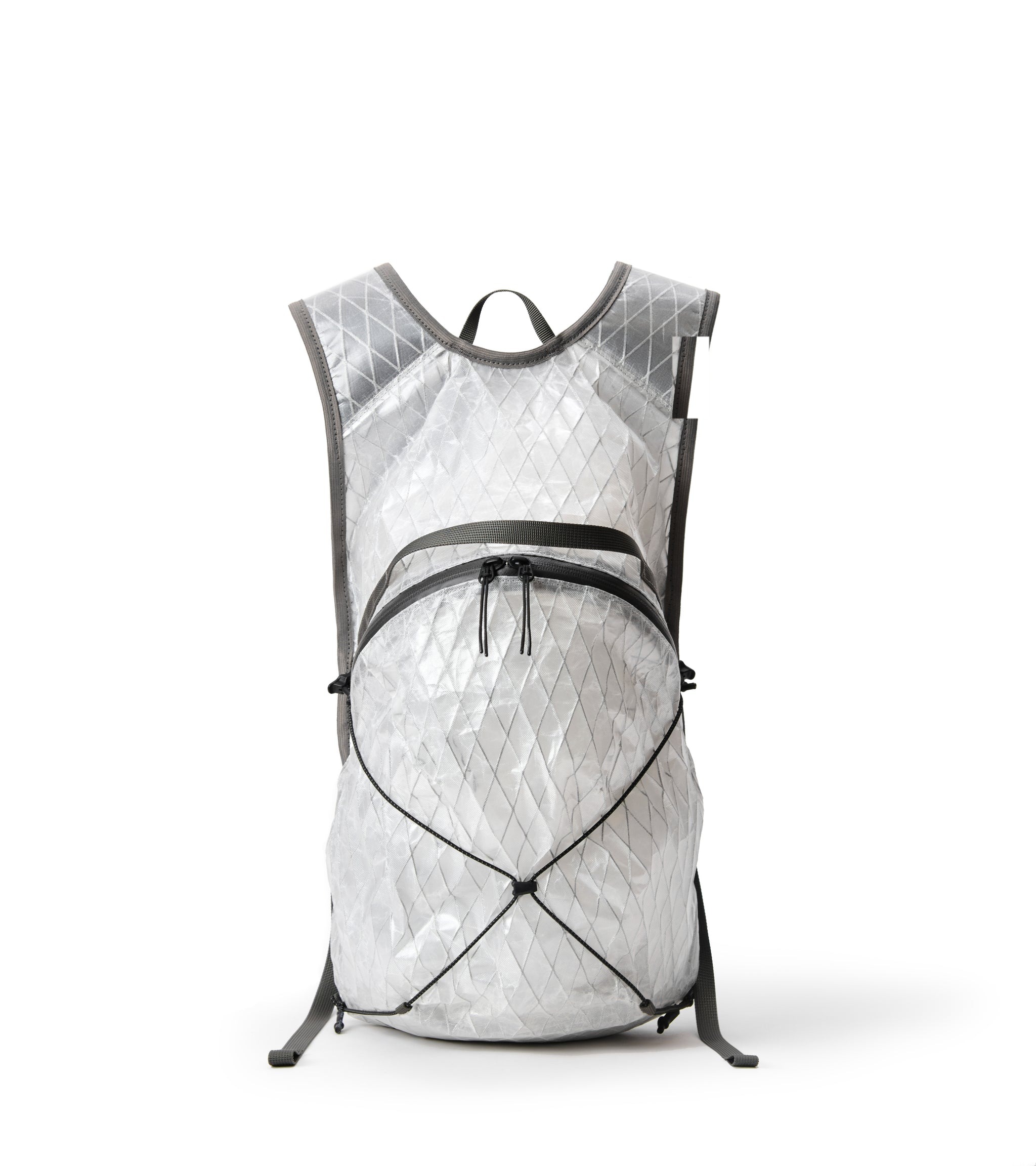
A translucent pack wall can reveal the outline of contents and the reinforcement grid without opening the bag. Its value is not just visual: it changes how a user checks where a layer or food bag ended up.
The supplied images illustrate comparable translucent pack and laminate constructions. They do not establish the dimensions, weight or performance of one finished pack.
01
At a glance
| Feature | Reference layout |
|---|---|
| Main fabric | Translucent UHMWPE laminate; grade to verify |
| Front pocket | Stretch mesh, wave-edged, with daisy-chain cord both sides |
| Shoulder straps | Widened grey mesh, with a stretch strap pocket |
| Sternum strap | Seven height positions, no whistle |
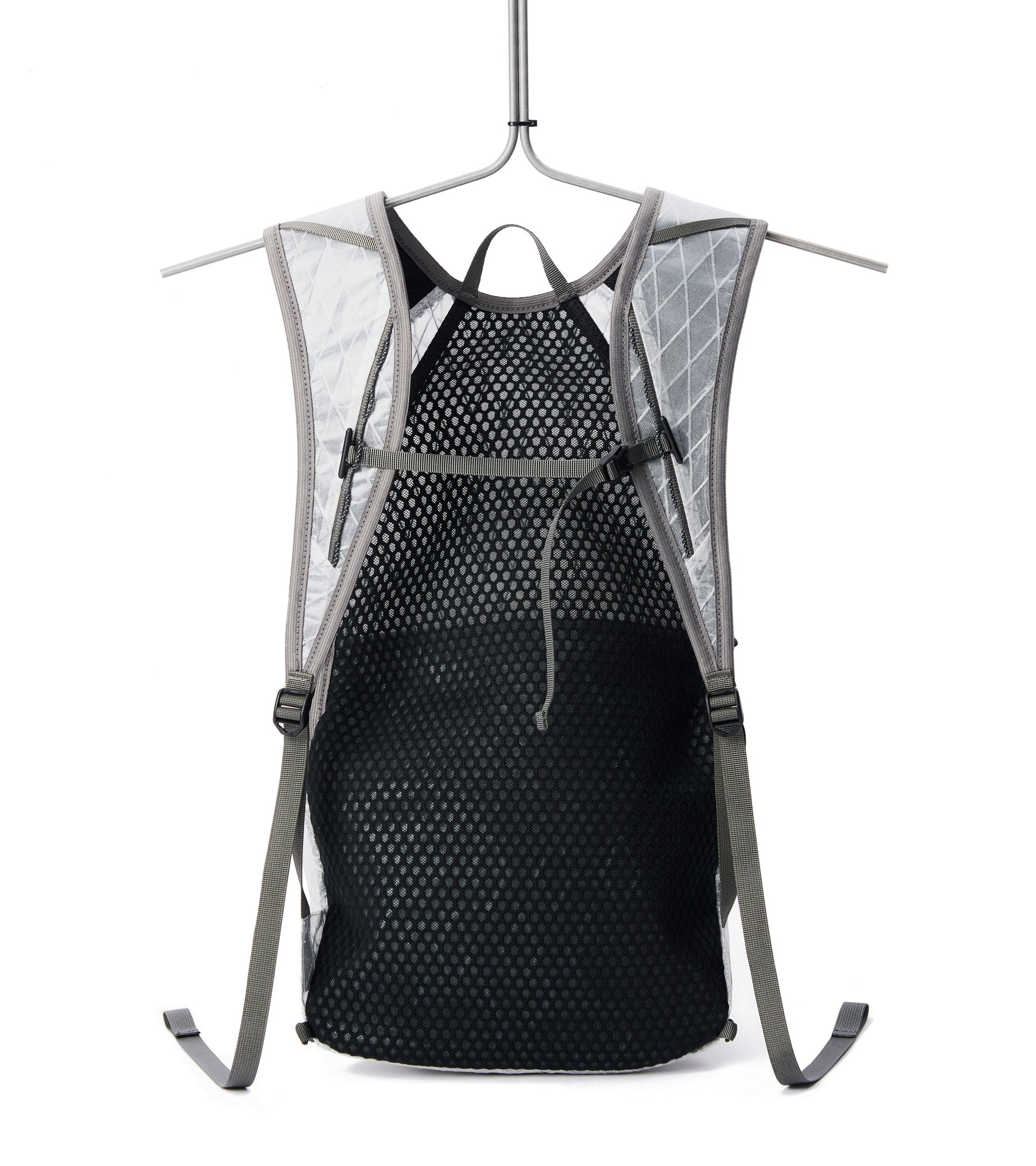
| Back panel | Translucent, showing the padding inside |
02
Why this pack matters: transparency as a feature, not a gimmick
Transparency lets a user see where a layer or food bag has shifted. Check which items can actually be recognised against a loaded bag and whether the contents should be visible from outside.
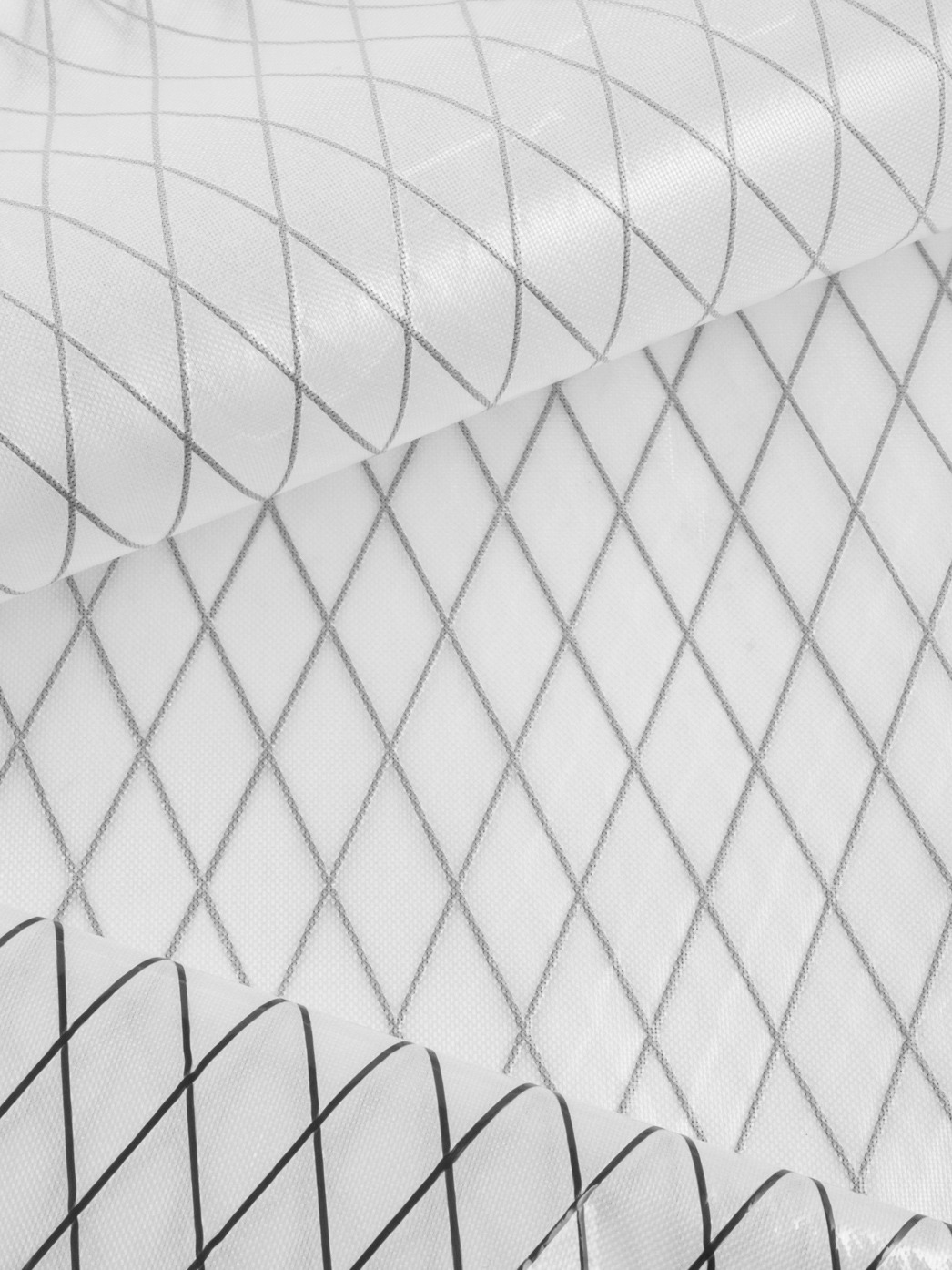
A lightweight laminate can combine a woven UHMWPE face, a visible reinforcement grid and a film backing. Compare the separate jobs of the face, the grid and the backing in the actual sample.
03
Functions and features
The front pocket and the daisy chains
A stretch-mesh front pocket with a wave-shaped edge offers access to layers. A lower centre can give the hand a clearer path; when the main bag is full, check whether it still leaves room to reach inside.
Daisy-chain cord down both sides allows attachment points to be moved. If a pad is held against the front, check that the cord and straps do not block the pocket.
An elastic webbing loop at the top of the front pocket gives light items an anchor. Check the reinforcement and stitch placement where the loop pulls into the thin laminate.
Shoulder straps, back panel and the sternum strap
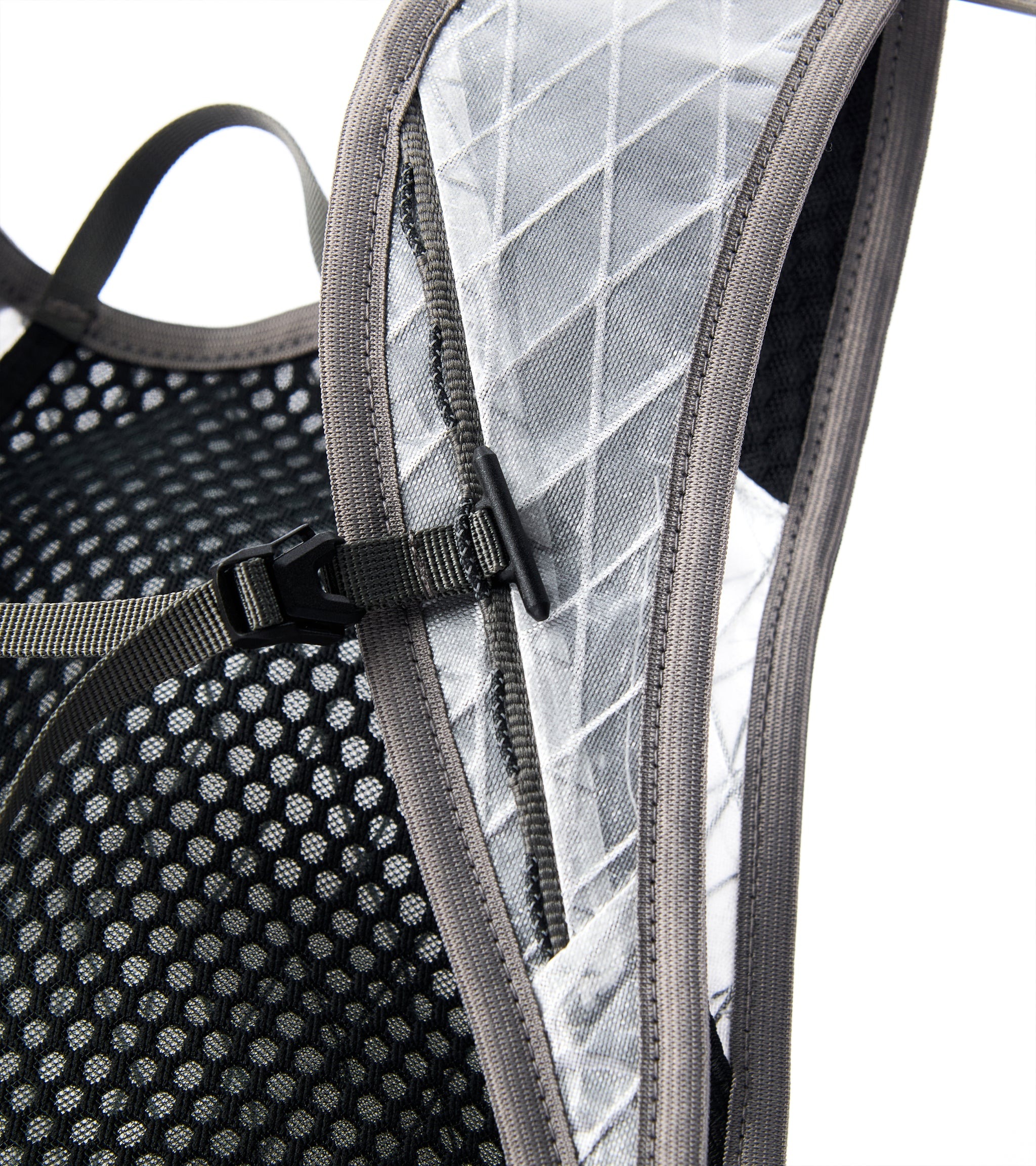
Widened, mesh-covered straps distribute contact over a wider area. A shoulder pocket adds reachable storage, and several sternum strap positions let the fit be adjusted. Confirm placement on the size set with loaded pockets.
A translucent back panel can show padding through the face. Side loops provide places to secure longer items; check that they stay clear of the shoulder and pocket openings.
The threads inside the laminate
The visible grid contributes to the appearance of the laminate. The fibre and orientation cannot be identified reliably from colour or a photograph alone; confirm the layers on the material specification.
04
Fabric and material combinations
The fabric deserves a careful description, because it is the whole point of the pack.
- Main body: a translucent laminate with a woven face, reinforcement grid and film backing; confirm the selected grade and mass per unit area.
- Water resistance: verify fabric, needle holes, seams and closure separately; a material specification is not a rating for the finished pack.
- Front pocket: stretch mesh, chosen for give and for drainage rather than for strength.
- Straps and back panel: mesh-covered padding and stitching at load points. Assess what extra layers are needed under strap anchors and daisy chains.
- Hardware: cord locks in orange, webbing loops and buckles from specialist suppliers, kept small and light throughout.
Openings and unsealed seams can admit water even when the face is highly water resistant. Confirm seam construction and water protection with the finished bag.
05
Who is it for?
- Hikers who make or modify their own gear, and want to see what a minimal laminate pack looks like when it is built well.
- Hikers with a light, settled kit, who do not need a frame or a hip belt and carry their load on their shoulders.
- Hikers who value being able to see their kit, and pack and repack often enough for that to matter.
- Hikers willing to check abrasion and carrying comfort before choosing a lighter laminate.
06
Pain points it solves
- A pack body that hides its contents. The translucent wall shows what is packed and where, without opening the pack.
- A front pocket that is hard to use one-handed. The wave-cut edge and the stretch mesh let things in and out without a fight.
- A sternum strap hard to position. Several height choices make it easier to find a suitable line across the chest.
07
Design strengths
- A translucent body that shows the contents and the reinforcement grid at the same time.
- A surface and seam construction that can be assessed separately for rain protection.
- Bar-tacked stitching and adjustable attachment points.
08
Limitations to keep in mind
- Delamination is a risk to check at folded edges and seams. Use the selected laminate's care instructions rather than applying one washing rule to all films.
- Verify abrasion in the finished seam and base areas, including contact with rough surfaces. Do not translate a material abrasion number directly to service life.
- A frameless layout puts the load on the shoulder straps unless other support is added. Check comfort at the intended packed weight.
09
What the design teaches
The most useful lesson in this pack is that transparency changes how a hiker packs. When the contents are visible, the pack is no longer a black box: a forgotten item is seen, a badly balanced load is seen, a wet layer is seen. The material's appearance is not decoration. It is information, and it is available without opening anything.
A frameless, lidless pack directs more of the load through the shell and strap anchors. Select the laminate together with its reinforcement and stitch layout.
Measure the completed bag before making claims about weight or volume. Check abrasion at the base and look for separation where the laminate folds or meets a seam.
10
Prototype brief
A translucent laminate pack is a demanding brief, because the fabric is the structure, and every seam and attachment point is visible through it. Useful inputs include:
- Target weight and capacity, and how they will be verified — measured, not claimed.
- Fabric by zone: laminate weight and construction for the body, mesh for the pockets, and the water-resistance target — including whether seams should be taped.
- Reinforcement: which high-load points get an extra layer, and how the stitching is specified for a laminate rather than a woven fabric.
- Closure and access: roll-top or drawcord volume, front pocket construction, and pole and accessory attachment.
- Carry system: strap width and padding, sternum-strap adjustment range, and whether a frame or hip belt is needed for the target load.
- Testing: abrasion, seam strength and delamination testing, and how the results will be reported.
Related guide: Two-Way Roll-Top Packs: What Changes When the Bottom Expands?
Discuss your bag development project
ANSON XIE
General Manager & Founder
Quanzhou Junkai Pengda Special Equipment Co., Ltd.
Email: ansonxie@jkpdtime.com
Phone: +86 177 5095 3355
WhatsApp: +86 177 5095 3355
Factory address: Floors 2–4, Building 1, Phase I, Huixin Intelligent Manufacturing Industrial Park, Hui'an County, Quanzhou, Fujian, China