
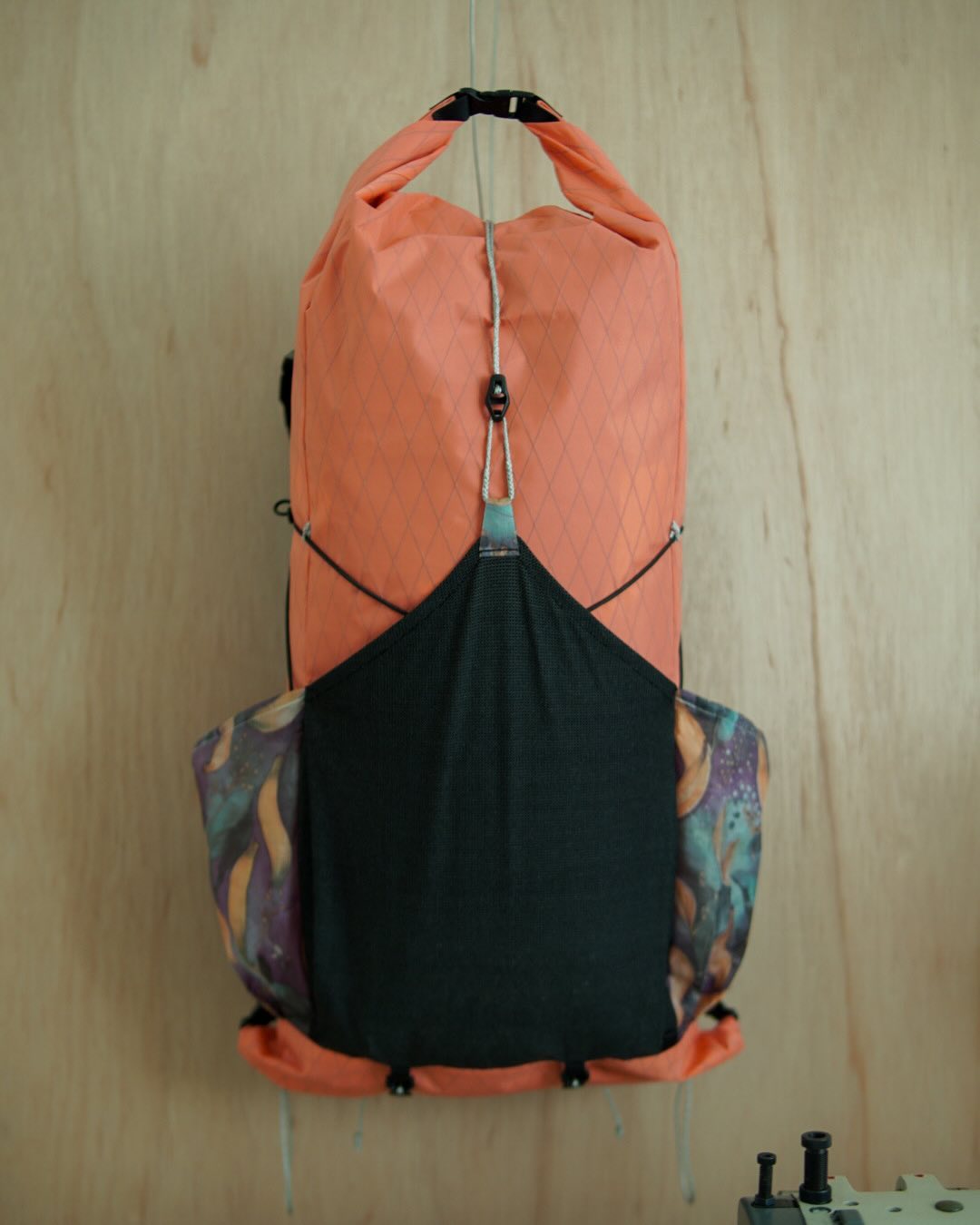
Look at this pack from the front and it seems ordinary: a salmon-orange roll-top with a black mesh front pocket, hanging on a pale wooden wall. Look closer and the familiar shape starts to behave strangely. The roll-top at the top is only half the story. The bottom of the pack rolls too. Open the bottom roll and the pack grows — the same bag, several litres bigger, without a lid, a zip or an extension collar.
This reference example contrasts the upper roll, which gives access, with a lower roll that changes the body length. The question is what the second opening does to the load path when the pack is full. This is a design example, not a JKPD product.
01
At a glance
| Feature | Reference design |
|---|---|
| Type | Lightweight hiking pack with a two-way roll closure |
| Capacity | About 25–30 L in its standard form, with the bottom roll adding several litres more |
| Opening | Roll-top at the top, roll closure at the bottom |
| Front pocket | Large black mesh pocket |
| Side pockets | Printed fabric pockets, each holding 2 × 500 ml bottles |
| Back | Padded shoulder straps with daisy-chain edging, sternum strap, compression straps |
| Colourways | Salmon-orange and olive-green examples shown |
02
The idea: a roll-top that works at both ends
Every roll-top pack works the same way. Fill the bag, fold the top over a few times, clip the buckle, and the opening is sealed. Roll it down further and the pack gets shorter; leave it up and the pack gets taller. The volume changes, but only from the top.
This pack adds a second roll at the bottom. The base of the pack is a separate roll of the same diamond-pattern fabric, held by black webbing, a grey cord loop and a black cord lock. Unrolled, it extends the body downwards and adds several litres of capacity. Rolled up, it disappears into the base of the pack and the silhouette returns to a normal roll-top.
The result is a pack with two ways to change size. Need a little more room for a bulky layer or extra food? Open the bottom roll instead of over-stuffing the top. Travelling light? Roll the bottom closed and the pack is compact again. It is a simple idea, and it is surprising that so few packs use it.
03
Functions and features
The top roll-top
The upper roll closes with a buckle. A vertical cord with cord locks cinches the front of the pack; a printed webbing tab marks where the cord meets the mesh pocket.
The bottom roll
The bottom closure is the pack's signature. A close-up shows the mechanism clearly: an olive-grey roll of the same diamond-pattern fabric, black webbing, a grey cord loop and a black cord lock. It is the same language as the top closure, repeated at the other end of the bag. The bottom of the pack is orange, matching the body, so the roll reads as part of the pack rather than an add-on.
Two checks are still needed in expanded mode: whether the effective back length shifts, and whether the extra load hangs away from the lower back. Repeat against the compact setup with the same load.
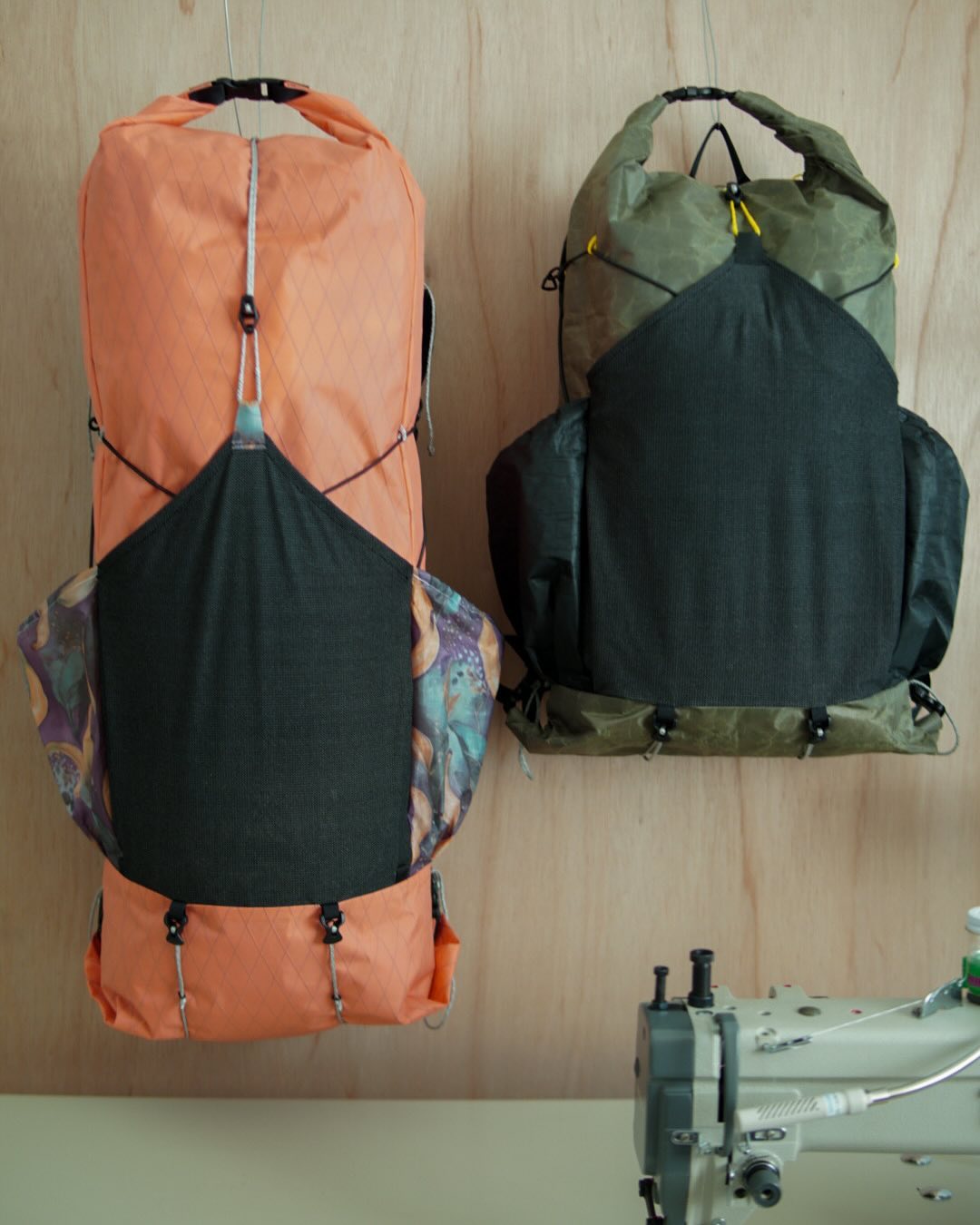
Pockets and storage
- Front mesh pocket. A large black mesh pocket covers the lower front of the pack. It is the catch-all: a wet layer, a map, a pair of gloves, anything that needs to be reached quickly and does not mind the weather.
- Printed side pockets. Each is sized for two 500 ml bottles in this example. Check reach, retention and whether the pocket is still usable once the front mesh is full.
- Diagonal compression cord. A black cord runs diagonally across the front of the pack, over the mesh pocket, to hold a jacket or a sit pad in place.
There is no lid, no zipped front pocket and no hip-belt pocket. The storage is deliberately minimal: one big mesh pocket, two side pockets, and the main compartment. Everything else is left to the roll-tops.
The back panel
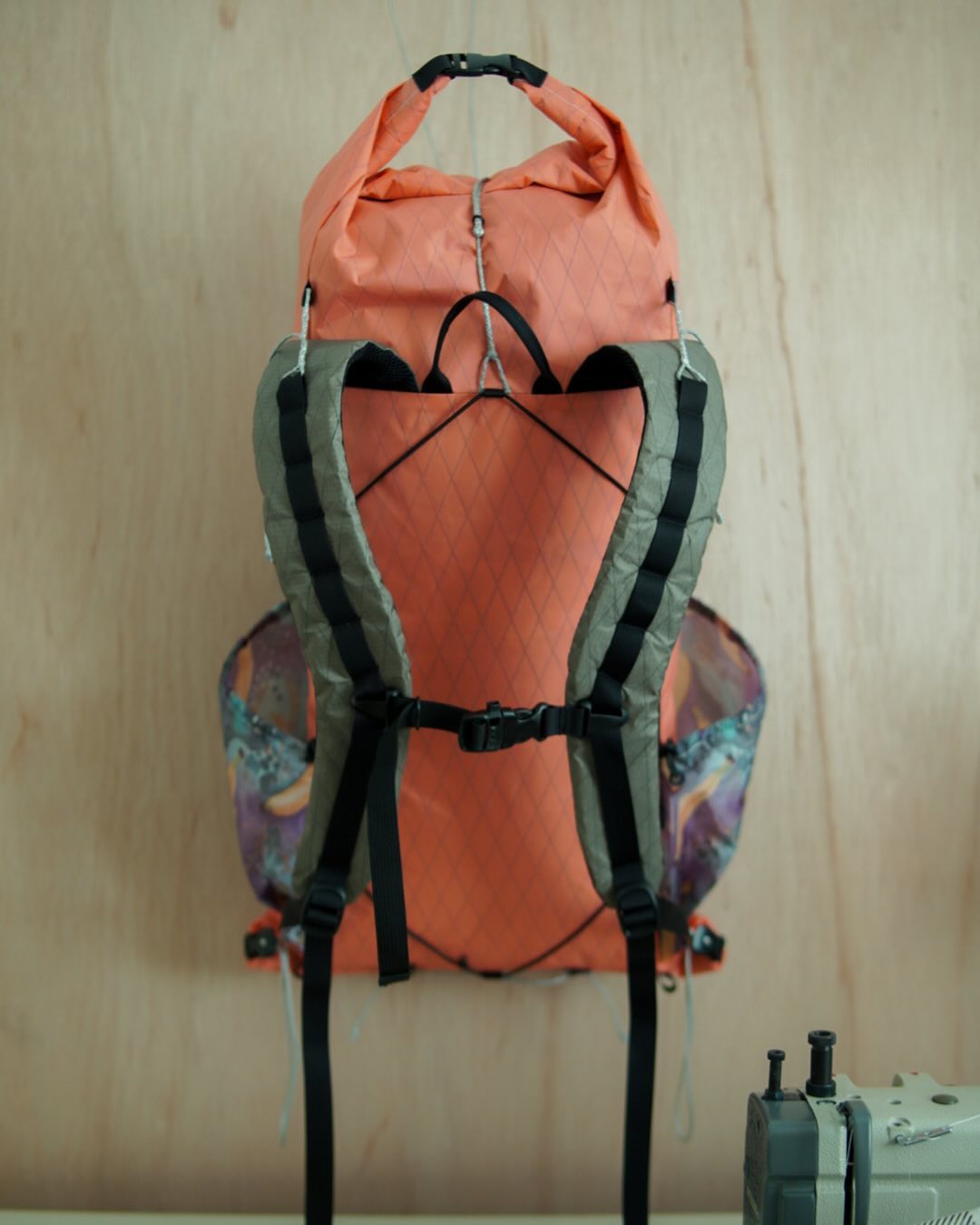
The back of the pack is straightforward and workmanlike. The shoulder straps are padded, in a grey-green fabric with black daisy-chain webbing along the edges — the daisy chain gives clip-on points for small accessories. A sternum strap connects the two shoulder straps, and black compression straps run across the back of the pack. There is no frame, no moulded back panel and no hip belt. The carry system is the straps and the shape of the bag, nothing more. That is consistent with the pack's weight-first philosophy: every part that does not carry the load is left out.
Finishing the lower closure and seams
An extra roll adds seams where the pack rests. Check how the closure sits when the pack is set down, where the folds concentrate abrasion and whether the buckles lie flat or form pressure points.
04
Materials and construction
No fabric specification was ever published for this pack, so the honest description is what the photos show:
- Body fabric: a diamond-pattern ripstop fabric, in salmon-orange or olive-green. The diamond grid is visible across the whole body and is the pack's most distinctive visual feature.
- Front pocket: black mesh, fine and close-woven, sewn onto the front of the body.
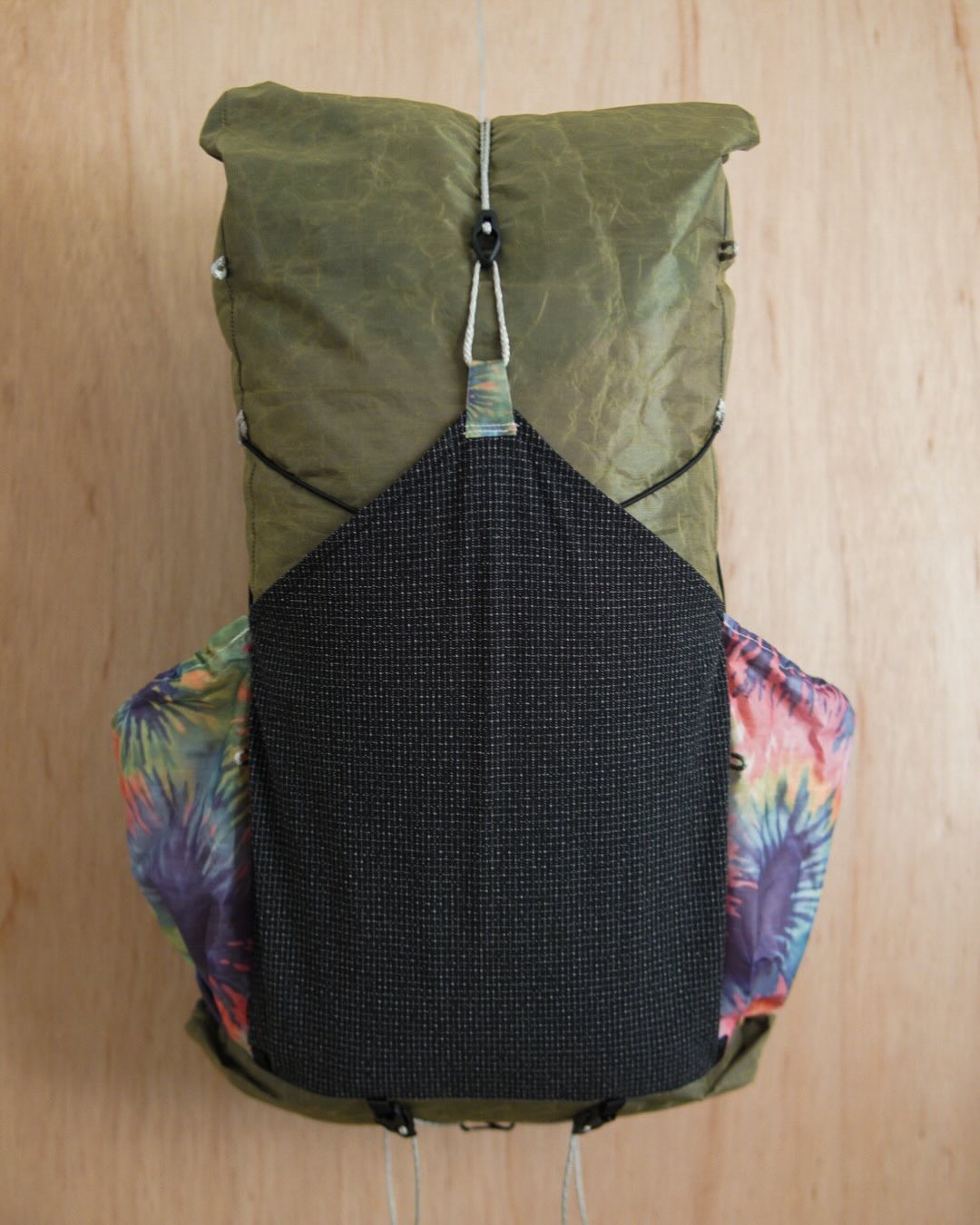
- Side pockets: printed fabric with a banana-leaf pattern in purple, teal and orange on one side and a brighter tie-dye leaf print on the other.
- Straps and webbing: black webbing for the roll-top buckle and the compression straps, grey braided cord with black plastic cord locks for the front drawcord.
- Back: grey-green padded shoulder straps with black daisy-chain edging, a sternum strap and black compression straps.
- Bottom: the same diamond-pattern fabric as the body, in orange on the orange pack, with black webbing and a grey cord loop for the bottom roll.
Different body colours can share the same pocket and trim layout. Check the pattern alignment across left and right side pockets where the print is one of the visible features.
05
Who is it for?
- Lightweight hikers who want a pack that can grow for a longer trip and shrink for a day out, without carrying two packs.
- Pack designers and MYOG enthusiasts experimenting with alternative expansion layouts.
- Hikers who like colour. The orange body and the printed side pockets are a deliberate break from the usual black and grey.
- Anyone who packs inconsistently. The bottom roll forgives a packing list that changes from trip to trip: open it when you need room, close it when you do not.
06
Pain points it solves
- A pack that is the wrong size. The bottom roll adds capacity without a separate extension collar or a bigger pack.
- Over-stuffed roll-tops. Instead of forcing the top roll to hold more than it should, the extra volume goes to the bottom, where it does not fight the closure.
- Boring lightweight packs. The printed side pockets and the diamond fabric make a small pack visually distinctive.
- Bottles that do not fit. Two 500 ml bottles per side pocket is more than most packs this size offer.
07
Design strengths
- Two-way roll closure. The only pack in this series with a roll at both ends, and the idea is easy to understand at a glance.
- Strong colour identity. Salmon-orange and olive-green, with printed side pockets that make the pack recognisable.
- Minimal, honest feature set. Nothing on the pack is decorative; every strap and pocket has a job.
- Flexible capacity. About 25–30 litres as standard, with several litres more available from the bottom roll.
08
Limitations to keep in mind
- Check expanded carry on a weighted sample. The extra volume changes the depth and position of the load without moving the shoulder attachments.
- No frame and no hip belt. The carry system is shoulder straps alone, which limits the comfortable load.
- No weather protection is specified. The roll-tops seal the openings, but there is no published waterproof rating and no rain cover.
09
What the bottom roll teaches
The most transferable idea in this pack is not the print or the colour. It is the second roll. Pack designers usually treat capacity as a fixed number with a little stretch at the top. This pack treats capacity as a range, with a second closure at the bottom that opens up several litres when they are needed and disappears when they are not.
A top extension puts extra volume above the load, while this lower roll adds it below. Neither is automatically more stable. Check balance at both settings and make sure the expanded base clears the hips and ground.
Document the compact and extended shapes side by side, with the same contents. Check the lower roll for abrasion, closure retention and clearance when the wearer takes a long step.
10
Development checklist
Specify both closure states before sampling a two-way roll-top. The brief should cover:
- Capacity in both states: closed and with the bottom roll open, and how the back length should behave in each.
- Whether the pack needs a frame or a hip belt, and what load it must carry when expanded.
- Fabric choice for the body and the roll sections, including whether the same fabric should be used at both ends.
- Pocket plan: mesh or printed fabric, and how many bottles each side pocket must hold.
- Colour and print plan, including whether the side pockets should carry a print while the body stays plain.
- Closure hardware: buckles, cord locks and webbing, and how the bottom roll should be secured when closed.
Related guide: Choosing a Day-Hiking Pack: Capacity, Carry Systems and Hip Belts
Discuss your bag development project
ANSON XIE
General Manager & Founder
Quanzhou Junkai Pengda Special Equipment Co., Ltd.
Email: ansonxie@jkpdtime.com
Phone: +86 177 5095 3355
WhatsApp: +86 177 5095 3355
Factory address: Floors 2–4, Building 1, Phase I, Huixin Intelligent Manufacturing Industrial Park, Hui'an County, Quanzhou, Fujian, China