
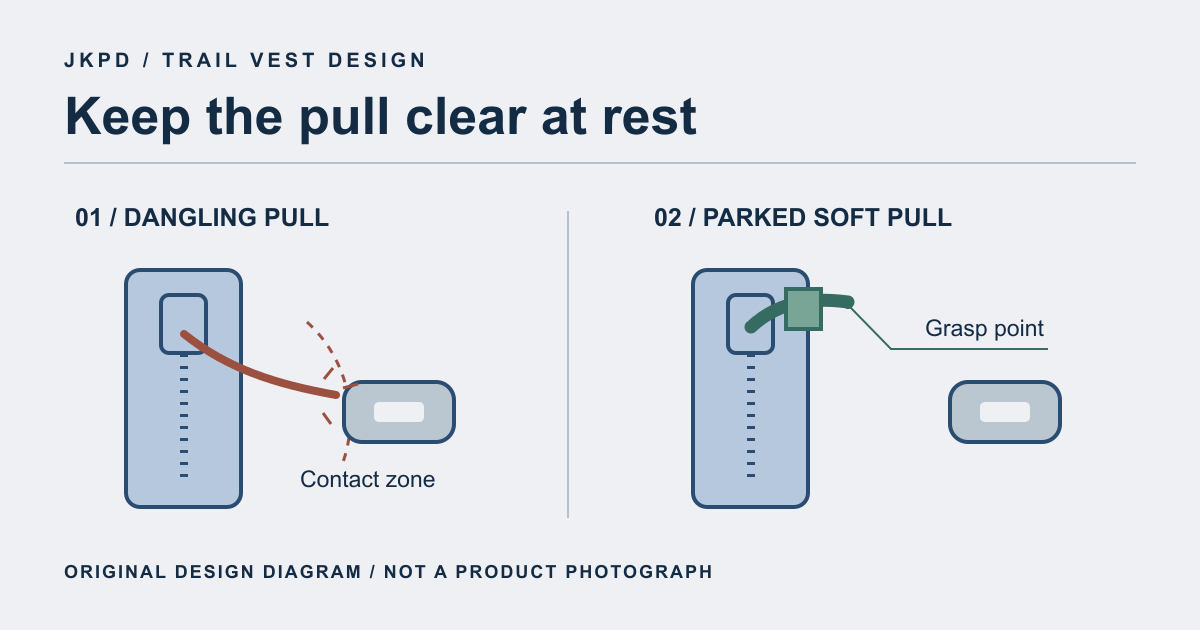
A zipper can close correctly and still make a repetitive click on a trail vest. The slider might be staying put while its pull hits a buckle or bottle cap. That is a different problem from a slider creeping open, and it calls for a different fix. A pull that is too short to find is not a successful fix either.
Compare the location, shape and resting position of the pull before changing the complete zipper. The aim is a closure you can find, open and close deliberately, with less contact between hard parts when the vest moves.
Key takeaways
- Identify which parts touch before shortening the pull or specifying a locking slider.
- Treat the pull’s resting position and the shape of its grasp point as separate choices.
- Check deliberate operation and closure with the vest worn, dry and damp.
01
Is the pull tapping or is the slider moving?
Mark the slider’s closed position on the sample with a removable witness mark. Check that the teeth or coil are properly engaged, and watch the slider as the vest moves under its intended load. If the slider stays at the mark but a click repeats, look for contact with an adjacent hard part. If the slider travels, investigate closure retention separately.
Start at a safe stop with the contents in their normal places. Lightly move the pull through its free travel and see what it can reach. Park it temporarily using a removable loop that does not restrict the slider. Compare the sound on the same short walk. If the tapping continues, look at loose buckle ends, a cap or any nearby hardware instead of chasing the zipper.
The result should describe the failure clearly. “Pull end touches the flask cap with the pocket filled” is more useful to a pattern maker than “zip noisy.” Do not claim a sound reduction from this check unless the comparison was actually run.
02
Shorten the swing without losing the grasp
A shorter soft pull often has less opportunity to strike adjacent hardware, but its grasp point needs to stand far enough off the fabric for the wearer to find it. Trimming a loop can solve one contact and still leave the runner digging for the tab when a pocket is pushed flat.
Compare three ways to change the contact
- Short cord loop: compare a flattened loop with one that holds a small open shape. Check the knot or end fitting against neighbouring parts as well as the cord itself.
- Textile pull tab: use a soft, textured end that has enough area to pinch. Test it while damp so the chosen texture does not depend on an ideal dry grip.
- Change the resting position: retain the current tab but move the closed end or add a shallow parking loop. Check that the change does not shorten the usable pocket opening.
For comparison, change one thing at a time. A longer tab in a better resting position may be easier to use than the shortest one that fits, particularly if the pocket lip folds over the slider.
03
A zipper garage should offer a deliberate exit
A soft fabric hood or loop can keep the pull near the closed end. Decide whether it is meant to cover the slider body, keep the pull away from a hard neighbour, or both. Those are different jobs. Locking the pull behind a deep fold can reduce its travel and make it hard to extract without looking.
Close the zipper normally, then release your hand. Is the pull parked by the normal motion, or does it need an extra tuck? If the latter, decide whether that step is acceptable for the pocket’s frequency of use. Leave enough space to catch the end and pull in the operating direction without tugging the hood into the teeth.
Check the finished thickness at the top stop. Binding, zipper tape and a folded hood can add several layers in a small area. Inspect a worn vest with the pocket filled so you can see whether the slider arrives at the end stop without forcing the new stack of materials aside.
04
Match any locking action to the finished pull
A locking slider can help address unintended travel, while a soft pull or a parking feature addresses contact. These functions are independent. Automatic and pull-position mechanisms do not engage in exactly the same way, so determine how the selected part is meant to engage using the supplier’s specification.
Assemble the intended pull and park it as the runner will. Check that any retaining loop does not hold the pull in the release position. Then see whether normal pocket access releases the mechanism without pulling hard enough to distort the fabric. A different cord or tab can change the direction of force on the same slider.
Use the zipper slider selection guide to separate the slider, chain and pull specifications. On a running vest, add the positions of adjacent buckles, flasks and adjustment cords to that specification. The approved part should be evaluated on the sewn assembly, not only on a loose length of zipper.
05
Compare use with full pockets, wet hands and layers
Ask wearers to find the tab, open the pocket, retrieve a small item and close it again at a stop. Use the same filled pocket on each sample. Repeat with a damp hand and with the gloves specified in the brief. Check for a second grip, a tab lost beneath fabric, or an opening left partly closed.
Use a short, repeatable walking or easy jogging route to compare contact after reclosure. Check it again with the load partly depleted, since a full flask can hold hardware away from the zipper and an empty one may allow parts to swing together. The flask and chest strap clearance guide covers that neighbouring space from the hydration side.
Record a contact you can identify, movement of the slider from its witness mark and whether the item was returned with the pocket fully closed. Treat sound, retention and deliberate operation as three results. Do not substitute a brief quiet trial for an endurance or durability assessment.
06
Put the resting position on the tech pack
Show the tab at rest and when grasped, with the zipper closed on a loaded vest. Identify the pull material, attachment method, usable grip length and the clearance to the closest hard neighbour. Where the pull parks under a loop, call out how the leave-behind opening is maintained when the body fabric stretches.
Approve the option that quiets the contact you actually observed without making it harder to find or close the pocket. Keep the failed conditions in the sample record. If the closure, flask position or neighbouring trim changes, repeat the loaded check rather than carrying over the original approval.
Discuss your bag development project
ANSON XIE
General Manager & Founder
Quanzhou Junkai Pengda Special Equipment Co., Ltd.
Email: ansonxie@jkpdtime.com
Phone: +86 177 5095 3355
WhatsApp: +86 177 5095 3355
Factory address: Floors 2–4, Building 1, Phase I, Huixin Intelligent Manufacturing Industrial Park, Hui'an County, Quanzhou, Fujian, China