
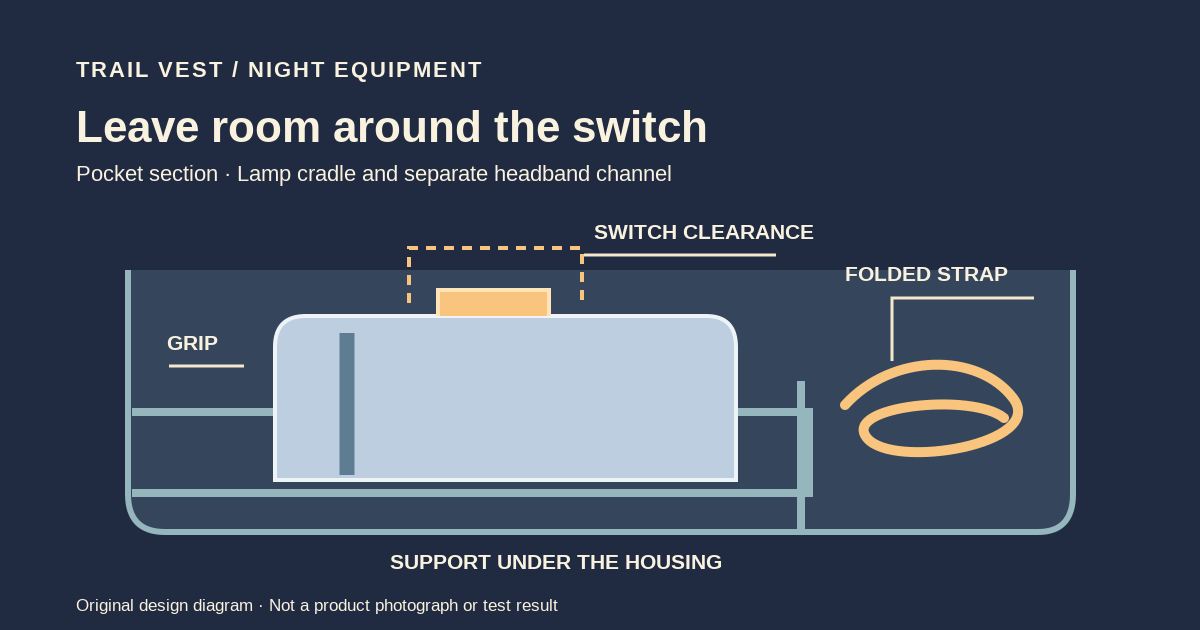
A headlamp can fit neatly in a trail vest and still be badly packed. The flask beside it can lean against a power switch. A zipper might brush the control every time the pocket closes. The headband can hang out of the opening and pull the lamp sideways as the runner retrieves it. A pocket that addresses these problems gives the lamp a repeatable orientation, space around its controls and a place to gather the strap away from the rim.
Treat this as a fit and handling problem rather than a promise to prevent accidental activation. Some lamps have a storage lock; use it according to the instructions for the exact model, and check that the runner can undo it with the gloves they are likely to wear. Pocket geometry reduces unintentional contact; it does not replace the lock or the check that the lamp works before departure.
01
Draw the loaded pocket around the actual switches
Start with the lamp the pocket needs to carry, assembled with its battery and headband. Mark the switches, hinge sweep, lens and any battery connector. Try the lamp in the relaxed vest and repeat with the vest adjusted around full flasks, a phone and the layers a runner typically carries. In a thin vest, the pocket and the gear on both sides of it can shift enough that a lamp resting on its broad face at the bench ends up with a button against a seam when worn.
Judge the contact at insertion and withdrawal as well as when the lamp is resting. A low zipper bridge can sweep across a raised top button, for example, even if the housing ends up facing away from it. On the tech drawing, note the part of the lamp housing that may bear against a lining or neighboring item, and mark the controls as a keep-clear zone. If the pocket must take several lamp sizes, locate the highest switch and any controls that move with a tilting housing. A textile divider controls orientation; it is not a rigid shield unless the construction has been designed and checked for that purpose.
02
Separate the part you grasp from the band you gather
A snug lower cradle can locate the housing while leaving its two ends exposed as grip points. Put a soft strap keeper off to one side so the user lifts the housing without having to pull the entire headband against a zip stop. The keeper can be an open fabric fold or a separate shallow channel. Avoid snag points along its exit line; soft loops around the lamp strap are less useful if the user must extract a buckle backwards through one.
Build the sample so it can be packed consistently in low light. The pocket’s opening and intended grip should feel different from the nearest hydration or food opening. A smooth internal side and a raised mouth edge can provide a tactile distinction without a second piece of hardware. If the lamp cannot be inserted without hitting the button, enlarge or redirect the entry. Do not just make the entire pocket deeper: it can become harder to see how the headband is folded or to pick up the lamp with gloves.
03
Choose the load path for a closed pocket
Compare two simple arrangements. One turns the switch toward a reserved volume backed by a divider, with the rigid housing edges supported below it. That approach holds a known lamp in a defined position but can be too model-specific. A small removable case gives a wider range of shapes some separation from surrounding gear, at the cost of another closure and more bulk. Test the case when the vest is tight; an insert that works empty may crowd the hand or push a corner toward the ribs with a full load.
Check on both shoulders if the vest uses identical pockets. A left-handed reach may rotate the lamp through a different route, and a compressible flask next to it can change shape as water is consumed. Also try the opening when a rain shell covers the front panel. These checks are distinct from the general race kit access audit, which establishes that the equipment fits and can be reached; here the concern is what touches the switch and how the housing and strap clear the opening.
04
Run separate clearance and operating checks
Use a charged, known-working lamp to verify lock and unlock at the start and finish. For a pressure check without intentionally operating a working lamp inside the pocket, use an inert fit block with the same housing and button envelope, or a switched-off lamp with a removable contact indicator as allowed by its instructions. Check a vest on the bench, then worn while walking, bending, and reinstalling adjacent gear. Inspect the result between stages so you can tell whether the trouble started when the zipper moved or after the pocket was compressed. Keep the contact test separate from the lamp’s functional test.
| Sample check | Record before approving the pocket |
|---|---|
| Clearance at rest | State what contacts the housing, where the switch faces and what keeps neighboring gear out of that space. |
| Flask replacement | Look for contact while removing and reinserting a full flask as well as pressure from the flask once seated. |
| Retrieval in gloves | Check that the user finds a secure grasp without tugging the band, touching the switch or emptying the pocket. |
| Return to use | Confirm the lamp can be removed, the strap unfolded and the device unlocked and operated outside the pocket. |
Repeated samples should include a partially open zip, a lamp deliberately dropped into the pocket the wrong way and a folded headband placed across the opening. These are not intended packing modes. They show whether the pattern makes an error easy to detect before the runner closes the pocket. Record any redundant handling and decide whether the fix belongs in the opening, the guide for the headband or the housing seat.
05
Give the buyer a clear acceptance condition
Supply the lamp envelope, allowed orientations, pocket opening dimensions, closure position and a drawing of the keep-clear zone. Add the adjacent loads, layer setup, and a short account of how a gloved user verifies the pocket is closed and the headband is clear. If an event requires a second functioning lamp or spare power, check its real location and do not assume that a single pocket fits both. Use the current requirements for the specific course. A sample that holds a lamp securely without making the controls or headband harder to use is worth approving; a tighter pocket that merely hides the lamp is not.
Discuss your bag development project
ANSON XIE
General Manager & Founder
Quanzhou Junkai Pengda Special Equipment Co., Ltd.
Email: ansonxie@jkpdtime.com
Phone: +86 177 5095 3355
WhatsApp: +86 177 5095 3355
Factory address: Floors 2–4, Building 1, Phase I, Huixin Intelligent Manufacturing Industrial Park, Hui'an County, Quanzhou, Fujian, China