
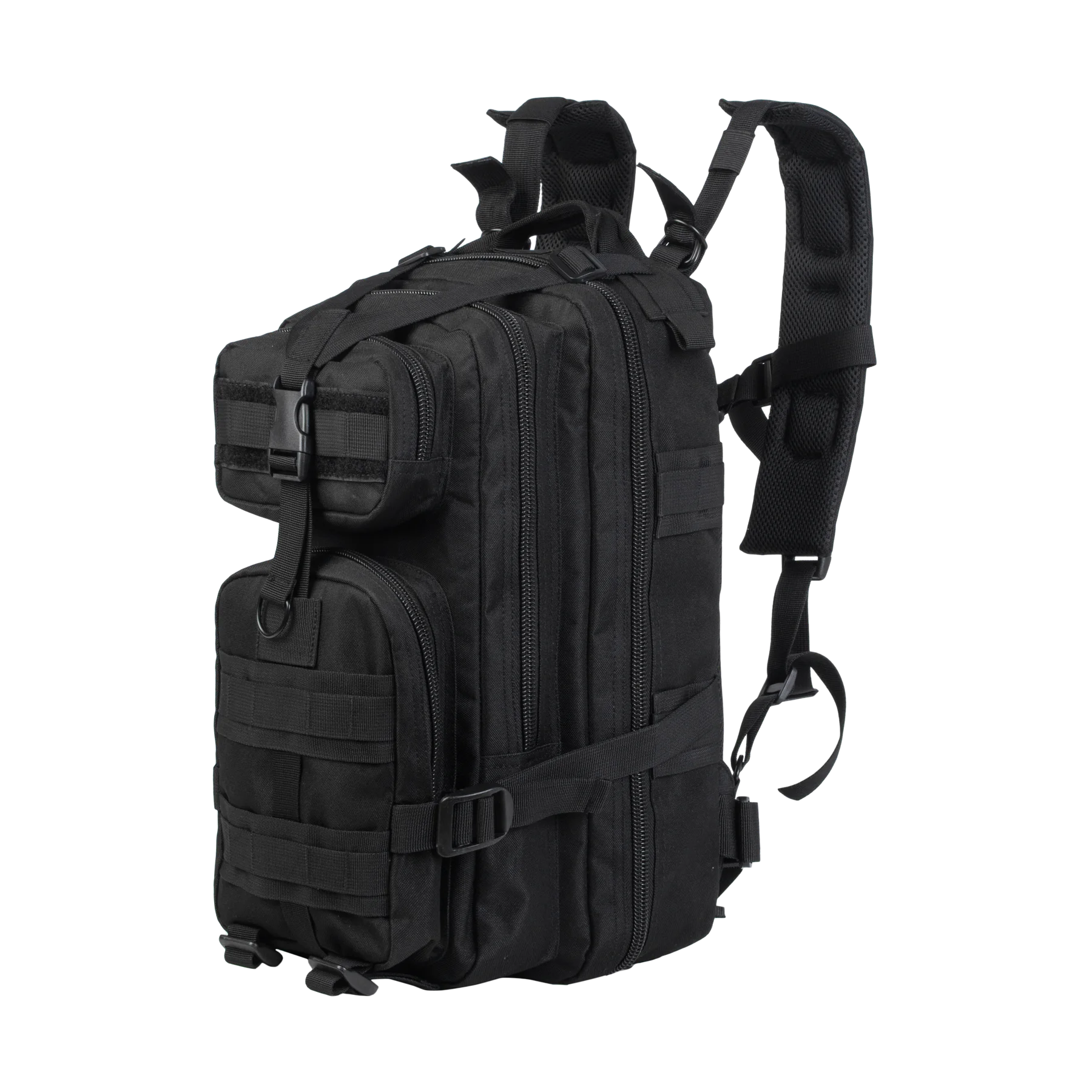
For a soft utility pouch on a tactical-style backpack, a hook-and-loop closure has two competing jobs: stay engaged during ordinary carrying and open deliberately when the user pulls the flap. A single statement that the fastener is strong does not describe both jobs. Ask for peel and shear evidence separately, then check the sewn pouch in its packed configuration.
This article concerns ordinary bag storage and product development, not protective equipment or operational use. The product photograph provides backpack context only; it does not show a tested closure or establish a load rating. The workflow below is proposed buyer practice, not a claim that JKPD has performed the described tests.
01
Draw the force direction before requesting a test
Start with a simple drawing of the closed flap, its overlap and the intended pull tab. Mark the user's opening direction. Then mark how packed contents might press against the flap or how an exposed edge might be lifted during normal handling. These are different actions even when they involve the same pair of tapes.
Peel progressively separates the engaged surfaces from an edge. Shear concerns loading along the engaged interface. A closure can therefore be easy to start opening from one edge yet resist a different loading direction. Do not translate a result from one configuration into an unsupported rating for another.
The drawing is also a useful way to catch a design contradiction. If a pull tab is intended to make opening easy, hiding it underneath another pocket may defeat that purpose. If an edge is unintentionally exposed, stronger tape may not address why the flap is being lifted. Resolve the geometry before asking the supplier to increase an unspecified strength.
02
Order two identifiable kinds of evidence
ASTM D5170 identifies a T-method peel test for hook-and-loop touch fasteners using a constant-rate-of-extension testing machine. ASTM D5169 identifies a dynamic shear method for this fastener type. The latter catalogue page links to a later active edition; confirm the required edition with the laboratory rather than commissioning from an old saved reference.
These public descriptions establish why the methods must not be conflated. They do not supply a complete laboratory procedure or a bag-specific acceptance limit. Have the laboratory confirm the full method, preparation and reporting basis. The buyer should define the product question and requirement, not improvise an imitation standard test at a sample desk.
Label every result with its method and edition. If a supplier uses an internal procedure instead, retain its description and identify the result as internal. It may still help development, but it should not be represented as an ASTM result without the appropriate supporting evidence.
03
Keep the mating pair and engagement identifiable
Record the hook component and loop component separately: supplier codes, construction, width, colour where relevant, and batch or sample reference. One approved half does not identify the complete pair. A visually similar replacement loop should not inherit the previous pair's results without review.
Ask the report to identify the engaged configuration and preparation. Keep a drawing or specimen reference that makes the tested arrangement understandable. Compare like with like; changing the overlap, material pair and preparation together makes it difficult to explain why the result moved.
On the sewn pouch, nominal tape dimensions are not necessarily the area engaged after packing. A curved flap or displaced contents can leave part of the pair apart. Record that condition during sample review rather than treating the full rectangle on the pattern as automatically functional. This is a construction observation, not a substitute for the laboratory's specified specimen preparation.
04
Read the reporting basis before comparing suppliers
Do not compare bare numbers copied into a quotation. Confirm the unit, specimen dimensions, result definition and any normalization used. A total force and a value expressed relative to specimen dimensions are not interchangeable labels. Ask the lab to explain its reporting basis before converting or ranking results.
Keep individual observations and reported summaries together. If one report gives a particular summary and another uses a different one, request clarification rather than choosing whichever looks larger. Include deviations and invalid tests in the technical file so a later reviewer can understand what was actually accepted.
Define opening and retention requirements separately
The desired opening behaviour may impose a different constraint from retention. Define the intended user action and discuss a suitable acceptance approach with the supplier and laboratory. This article gives no universal minimum, maximum or safe load: those would require a product-specific specification and evidence that are not available from a photograph.
05
Evaluate the sewn assembly without calling it a standard test
After reviewing component evidence, load the sample pouch with the intended ordinary contents or a documented equivalent. Close it by the intended action and examine whether the flap lies where the drawing expects. Check access to the pull tab, the engagement boundary and any unwanted lifting at the edge.
Open and close it in the intended handling sequence. Record whether users must hold the pouch body with another hand, whether the tape pulls on its backing, and whether the opening action distorts an adjacent pocket. These observations help refine the design but are not numerical peel or shear measurements unless a defined measurement procedure is actually used.
Examine what moved when something failed. Separation of the hook-and-loop interface is different from tape stitching pulling out or the pouch fabric tearing. A stronger fastener may shift the failure elsewhere. Keep the component result and assembly observation as separate evidence lines so the corrective action addresses the actual weak point.
06
Specify the condition of any repeat evaluation
New fasteners and fasteners after repeated operation should not share an unlabeled result. If the product brief requires a durability evaluation, agree the operation sequence, conditioning and examination points before starting. Record the condition at which each result was obtained rather than adding the word durable to a new-material result.
Likewise, do not mix clean specimens with contaminated ones in a comparison without documenting the difference. Any proposed contamination or cleaning evaluation should reflect an identified product question. It is not automatically part of the cited peel or shear method, and it should not be described as such unless the laboratory confirms the applicable procedure.
07
Approve the pair, the construction and the change rule
The release record should identify the fastener pair, component evidence, sewn sample revision and the separate opening and retention decisions. Attach photographs of the approved closed arrangement and the intended opening action. A purchasing description that says only hook-and-loop tape leaves too much room for an unnoticed substitution.
Reopen the review when the mating component, overlap, flap stiffness, stitching or pull-tab position changes. Decide which evidence remains relevant and which part needs confirmation. For the wider construction checklist, see hook-and-loop closures for tactical bags. The additional discipline here is to keep force direction, reported result and actual pouch behaviour connected without pretending they are the same test.
Discuss your bag development project
ANSON XIE
General Manager & Founder
Quanzhou Junkai Pengda Special Equipment Co., Ltd.
Email: ansonxie@jkpdtime.com
Phone: +86 177 5095 3355
WhatsApp: +86 177 5095 3355
Factory address: Floors 2–4, Building 1, Phase I, Huixin Intelligent Manufacturing Industrial Park, Hui'an County, Quanzhou, Fujian, China