
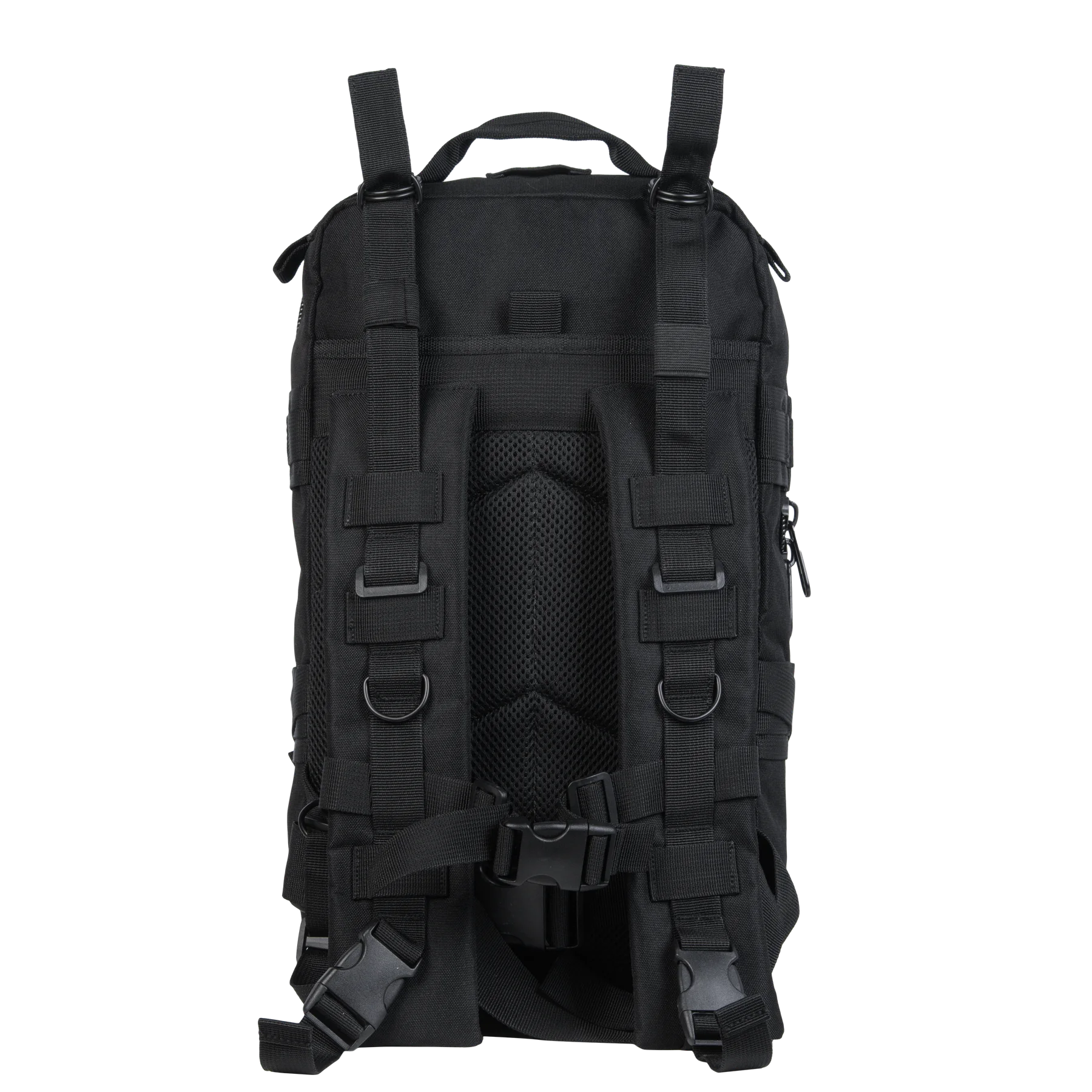
A webbing tail can look neatly cut on the inspection table and still be awkward to thread through its adjuster. The edge may spread, curl or form a hard ridge. For a tactical-style utility bag, approve the finished end in its actual assembly, not merely the absence of loose threads. This is a bag-construction review, not a load rating or an instruction for protective equipment.
The practical sequence is to identify the webbing, classify the end, compare finishing options and check the selected result against the matching hardware. Keep the accepted edge as a physical reference. A photograph helps locate a defect, but it cannot convey how a ridge feels or how the tail passes through a slot.
01
What job does this webbing end perform?
Separate exposed adjustment tails from ends enclosed inside a seam. An exposed tail may need repeated threading, folding and handling. A buried end instead needs a defined position within the sewn construction. Giving both ends the same vague instruction, such as “seal neatly,” leaves important decisions unresolved.
Mark every cut end on the assembly drawing. Record whether it remains exposed, folds back, receives a stitched return or disappears into a seam allowance. Include the orientation of the webbing face and the intended direction through any buckle. These details let the sample room assess the finished edge in context.
Do not mistake an enlarged edge for an engineered stopper. If preventing withdrawal is necessary, specify and evaluate the complete retaining arrangement. Neither a visible fused bead nor a photograph of a folded tail demonstrates the required retention. The cut-edge review also does not replace a separate assessment of the attachment seam.
02
Confirm material identity before selecting the process
Material identity matters because not every strap responds to heat in the same way. Sailrite's hotknife guidance distinguishes thermoplastic synthetic materials from natural fibers and identifies synthetic webbing as a suitable application. It also warns that blends need evaluation. That guidance is a starting point for process selection, not approval of a particular bag component.
Ask the supplier to identify the webbing construction, fiber content, finish and lot. A purchasing description that says only “black webbing” is insufficient for controlling substitutions. If the material changes after sampling, repeat the edge review even when its width and color appear unchanged.
Keep process development with trained personnel following the equipment manufacturer's operating and safety instructions. Do not put a universal temperature or dwell time into the bag specification based on an unrelated material. The factory should establish settings for the identified material and equipment, then demonstrate that the resulting end meets the agreed sample requirements.
03
Evaluate the edge beyond fraying
Inspect the full width of the end and both corners. Record loose yarns, uneven cut lines, local narrowing, curled edges and conspicuous hard ridges separately. Combining everything under a single cosmetic score makes it difficult to tell whether a revision solves the actual problem.
Compare several pieces from the proposed process rather than selecting only the most attractive one. Place them beside the approved reference in the same orientation. A close photograph with a scale can preserve the appearance, while a labeled physical piece preserves the handling reference.
A useful acceptance description
Describe the intended result in observable terms: the tail can enter the specified adjuster without tools, its corners do not catch during the agreed threading sequence, and its edge matches the approved handling reference. Agree the inspection method and any dimensional limits with the supplier. These are proposed project criteria, not universal industry thresholds.
Avoid accepting a broad melted zone simply because no yarns are loose. Ask whether the resulting thickness and stiffness are appropriate for the surrounding assembly. Conversely, a visually small ridge is not automatically a defect if it meets the documented handling and fit requirements. The decision belongs to the complete component specification.
04
Check passage through the actual hardware
Use the exact adjuster reference and webbing orientation intended for production. Thread the finished tail through the full path, including any return through a second slot. A single pass through an empty opening can miss the tighter condition created when another webbing layer already occupies the hardware.
Observe where resistance occurs. A corner may catch at entry, a ridge may stop at a narrow section, or a stiff end may resist the required turn. Record the location before changing the cutting process. A hardware mismatch or an unnecessarily tight threading path may require a different correction.
For a folded end, review the folded assembly rather than only the cut strip. Include the seam and the local stack of layers. Related questions about component compatibility belong in the matched buckle halves review; passing this cut-end check does not establish buckle strength or release performance.
05
Review the end where the user encounters it
After threading, install the strap on the packed sample and follow the intended adjustment sequence. Identify where the free end rests against clothing, lining or adjacent components. The purpose is to locate contact and handling issues, not to infer comfort from the appearance of a loose strip.
If the end catches another surface, separate the possible causes. Excess tail length, storage position and edge finish are different variables. Changing all three at once makes the next sample harder to evaluate. Begin with a documented observation and keep the rest of the arrangement unchanged when comparing alternatives.
For a buried end, inspect the sewn sample to confirm its position and whether the local finish creates unwanted bulk. Do not use neat edge appearance as evidence that the seam has adequate strength. Structural acceptance needs its own agreed method, loading conditions and result record.
06
Carry the reference into production inspection
The approval package should identify the webbing lot, hardware reference, cutting or finishing process revision and assembly drawing. Include representative finished ends and the sewn sample where relevant. Label them so a later reviewer can distinguish the approved construction from a trial alternative.
- Record the exposed or enclosed location of each end.
- Keep appearance and handling criteria separate from strength requirements.
- Check threading with the complete layer arrangement.
- Revisit the approval after a material, process or hardware substitution.
During incoming or in-process checks, compare production pieces against that reference using the same method. If a difference appears, isolate the affected material or process condition before accepting a cosmetic correction. Reheating or trimming a finished part should not become an undocumented routine that changes its dimensions.
The outcome is a reproducible edge specification: identifiable material, controlled finishing, suitable geometry and a verified passage through the intended assembly. The JKPD tactical product category provides bag-format references, but photographs do not certify any of these checks. Resolve the cut end on the actual sample before treating its appearance as approval.
Discuss your bag development project
ANSON XIE
General Manager & Founder
Quanzhou Junkai Pengda Special Equipment Co., Ltd.
Email: ansonxie@jkpdtime.com
Phone: +86 177 5095 3355
WhatsApp: +86 177 5095 3355
Factory address: Floors 2–4, Building 1, Phase I, Huixin Intelligent Manufacturing Industrial Park, Hui'an County, Quanzhou, Fujian, China