
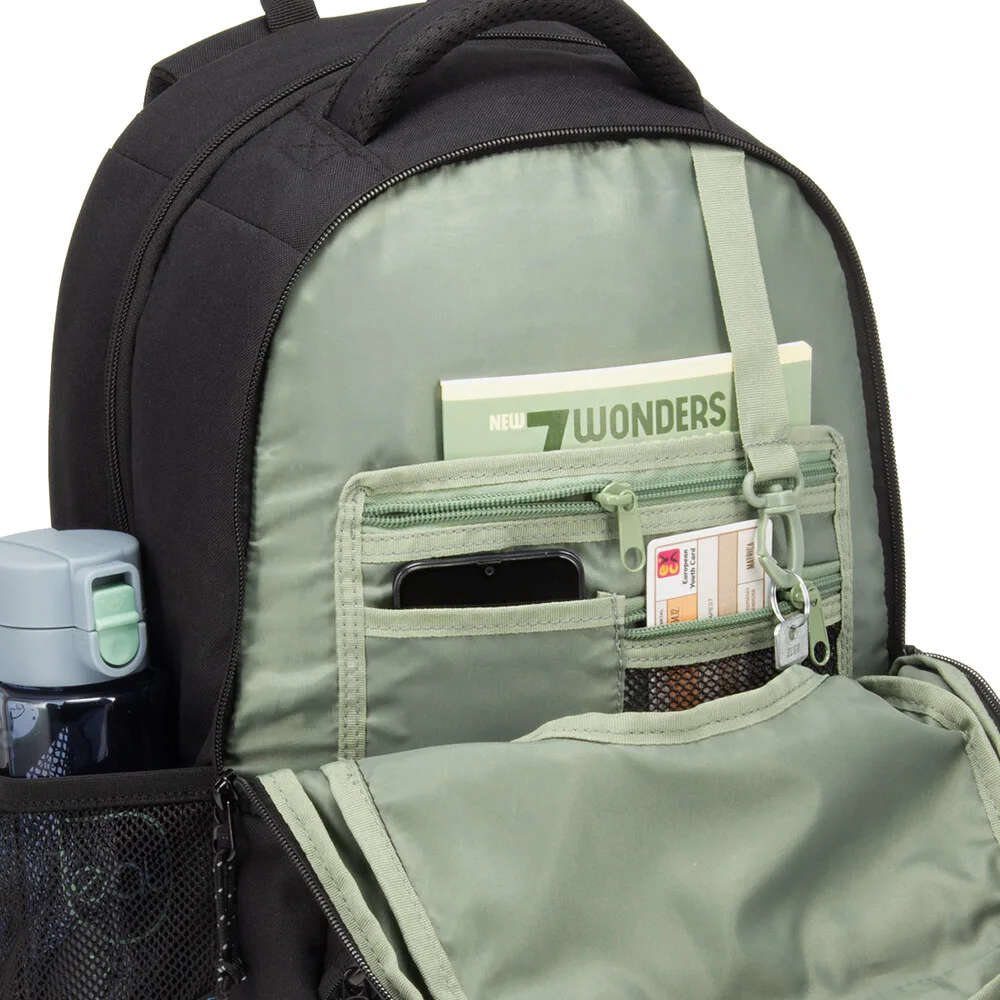
A bottle that slides into an empty student backpack may become difficult to insert once books occupy the main compartment. Approve the side pocket with the intended packing load, bottle and lid, not from flat pocket width alone. The useful space belongs to an assembly whose shape changes when nearby compartments are filled.
This review starts with a school backpack that carries a separate water bottle beside books and stationery. It addresses access and interference, not hydration advice or a claim that one bottle shape fits every student. Keep bottle compatibility specific and testable rather than describing the pocket simply as universal.
01
Which bottle is the pocket intended to accept?
Specify a physical bottle reference, including its lid, handle and any protective sleeve. Volume alone does not define the outside envelope that must pass through the pocket opening. A straight cylinder, a tapered body and a protruding lid can share a nominal capacity while presenting different contact points.
CamelBak Japan's Eddy+ Kids product page lists capacity separately from three external dimensions and describes a carry handle. It is a useful example of why the complete assembly matters. It is not a recommendation, a claim of JKPD compatibility or an identification of the bottle shown in this article's photograph.
Build a small compatibility set
If the brief requires several bottle types, retain each reference and record its identifier. Choose meaningful differences in body width, height and lid profile rather than several colours of the same model. Agree which are required to fit and which are only exploratory comparisons.
Keep the bottle closed during the access review. A protruding spout or handle should be in the intended carrying position. If users must rotate the bottle into one particular orientation, decide whether that is acceptable and document it instead of hiding the restriction in the sample approval.
02
Define the school load before changing the pocket
List the books, folders, lunch container and other representative contents used to fill the main compartment. Record their arrangement as well as their dimensions. A large rigid folder against the side wall can affect local space differently from soft clothing, even when the total packed volume looks similar.
Start with the expected daily load and a separately defined upper-use configuration. Do not stuff the bag arbitrarily until the bottle fails, then treat that result as a defect. Equally, do not approve only an almost-empty bag when the intended use includes a full set of books.
The empty-backpack weight budget concerns the mass of the product itself. This access review concerns how a defined load changes pocket geometry. Keep those approval records separate so a lighter sample is not assumed to provide better bottle clearance.
03
Inspect the opening and the pocket body separately
The opening can pass the bottle while the lower pocket remains too shallow or crowded. Conversely, the body may have enough room but the opening elastic or folded edge may obstruct the lid. Check where contact occurs during the entire insertion path rather than recording only whether the bottle eventually fits.
Mark the seated position on a sample photograph. Note how much of the bottle remains exposed and whether the user can grasp the body without pulling on a delicate cap component. A deep pocket may improve enclosure yet make removal harder; a shallower one may improve access but require another retention solution.
Look inside the pocket for seams and folded allowances that reduce useful room. Check both sides of the backpack if both carry pockets. Similar external dimensions do not establish identical clearance when internal structures or adjacent compartments differ.
04
Repeat access with the main compartment closed
Load the agreed contents, close the main compartment and place the bag in the intended handling position. Then repeat bottle insertion and removal. Leaving the main zipper open can allow panels to spread and conceal the restriction that appears in normal carrying use.
Use a short review sequence that the next developer can reproduce:
- Empty bag: establish the baseline insertion path and seated position.
- Daily load: repeat with the main compartment and adjacent pockets closed.
- Upper-use load: check the separately agreed fuller configuration.
- Bottle removed: inspect whether books, lining or pocket edges shifted during the action.
Record whether the bag needs a supporting hand and whether the user must move another item first. One-handed access should be a requirement only where the project has defined it. Do not assume that an adult sample reviewer represents the grip and reach of every intended student.
05
What changes when the bottle is filled?
Review the intended filled state as well as the empty container. Keep the same bottle, lid and fill condition across comparisons. The purpose is to observe seating, support and interaction with the bag, not to infer a universal load rating from one successful demonstration.
Check whether the pocket base supports the bottle as intended and whether the bottle presses into the neighbouring compartment. Observe the bag when set down and picked up in the agreed handling sequence. Report any interference separately from retention; a bottle can remain inside while still making the bag awkward to use.
If retention testing is required, define the movements, repetitions and acceptance criteria with the development team. The method should match the intended use. A static photograph or a single inversion does not establish reliable performance across everyday handling conditions.
06
Revise the interface that caused the restriction
If the bottle enters easily when the bag is empty but not when packed, inspect the shared side wall and the available expansion space. Simply making the elastic looser may not create room lower down. Consider whether the pocket pattern needs its own volume or whether the main-compartment packing envelope needs clarification.
If only the lid catches, examine opening shape, edge finish and insertion angle. If the seated bottle is difficult to grasp, inspect depth and exposed grip area. Each diagnosis suggests a different change; enlarging the entire pocket can introduce new retention or appearance problems.
Change a traceable variable and repeat the same packing sequence. Keep pattern revision, fabric article and opening treatment on the sample label. When multiple components change together for practical reasons, record them all and avoid attributing the result to just one of them.
07
Make compatibility a bounded approval
Approve the pocket against named bottle references, complete lid configurations and defined bag loads. Include photographs of the seated position and the points that constrained access. State any required orientation or handling step in the development record so it is not lost between sampling and production.
An external pocket does not make the entire backpack leakproof or protect books from every spill. Any separation or water-resistance requirement needs its own construction review and evidence. Avoid turning a successful bottle-fit check into an unrelated protection claim.
For student backpack sampling, provide the actual bottles and representative contents whenever practical. Ask the sampling partner to return a repeatable access record, not just a front photograph with a bottle tucked into place. That makes the approval useful for production checks and future component changes.
Discuss your bag development project
ANSON XIE
General Manager & Founder
Quanzhou Junkai Pengda Special Equipment Co., Ltd.
Email: ansonxie@jkpdtime.com
Phone: +86 177 5095 3355
WhatsApp: +86 177 5095 3355
Factory address: Floors 2–4, Building 1, Phase I, Huixin Intelligent Manufacturing Industrial Park, Hui'an County, Quanzhou, Fujian, China