
A clean first seam is useful evidence, but it does not show what happens after the operator has sewn a sequence of the same operation. For a sports backpack with long panel seams and repeated pocket assemblies, development approval should include the intended working rhythm. A fault that appears only later in a run needs a different investigation from a hole that appears on the first needle penetration.
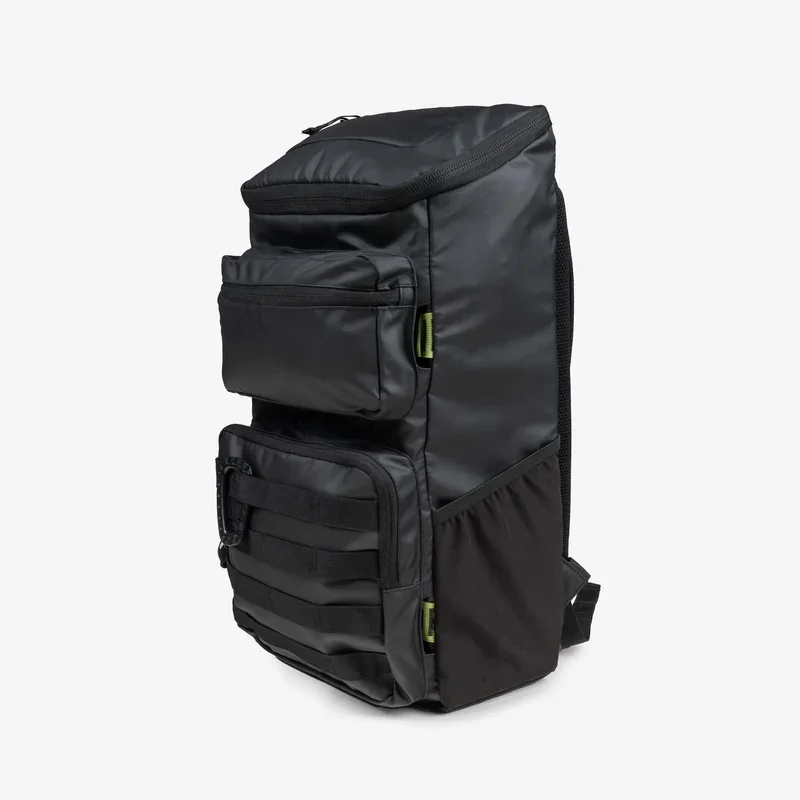
The performance sports backpack JK-044 provides the product context for this discussion. Its photograph shows the bag layout, not a thermal defect or a tested material composition. The procedure below is a proposed production-development review for synthetic or coated constructions; it is not a report of tests performed on that product.
01
What changes between an isolated sample and a working run?
SCHMETZ's Sewing Focus guide for luggage identifies thermal damage as a sewing concern for luggage materials. Friction and material construction can contribute to heat at the needle, while softened residues can interfere with the needle and thread. That is a reason to investigate the sequence of sewing, not proof that every thread break is caused by heat.
An individually prepared approval sample may involve long pauses while panels are positioned or inspected. The production operation may have a different balance of sewing and handling. Record that difference before comparing the two. A machine's displayed speed alone does not describe how long it runs between pauses or how often the same dense junction is crossed.
Keep the initial needle damage sampling review as a separate prerequisite. Needle system, point, size and layer-stack suitability still matter. This additional review asks whether the approved setup remains acceptable over the intended sequence, rather than repeating the basic needle selection exercise.
02
Build a run record before changing the setup
Choose an operation that represents the proposed backpack construction. Identify the actual shell, backing, pocket material, reinforcement, thread and binding used at that operation. Include their references and batches. A convenient loose swatch is not a substitute for the assembled junction if the concern occurs where folded seam allowances meet a pocket edge.
Ask the sewing technician and production supervisor to agree on a safe, representative trial sequence. Record the machine identification, approved needle and thread references, stitch specification, speed setting, approximate sewing and handling rhythm, and normal stopping points. Do not create an artificially uninterrupted run that the machine or operation is not intended to perform.
Keep the order of specimens visible
Number the pieces in sewing order and retain early, intermediate and later observations. Mark the seam location where an issue first appears. If a thread break interrupts the run, record it instead of silently removing that piece from the comparison. The rejected piece may explain more than a row of selected good samples.
The number of pieces and trial duration should be agreed for the operation, not copied from an unrelated bag. This is a process investigation, not a universal test standard or a statistical release plan. If a buyer requires a specified sampling method, retain that requirement separately.
03
Separate evidence of timing from a diagnosis of heat
Look for a change in seam appearance or behavior as the sequence progresses. Useful observations include thread damage, repeated breaks, deposits noticed during safe inspection, material marking and differences between the top and underside of the seam. Photograph the location and preserve the piece before cleaning or reworking it.
Those observations narrow the investigation but do not identify a cause on their own. A later break could also coincide with a different panel, a thicker junction, a thread supply issue or a machine fault. Compare the material and operation records before calling it a thermal failure. Ask a qualified technician to inspect the machine using the manufacturer's isolation and maintenance procedures.
Never judge needle temperature by touching it. If temperature measurement is needed, the technician should select a suitable method and explain what it measures and its limitations. A reading from an accessible machine surface should not be presented as the temperature at the needle-fabric interface.
04
Use controlled comparisons, not a bundle of fixes
Start with the baseline that produced the observation. Agree which variable to investigate first, then keep the other documented conditions stable as far as practical. A change in pace, an appropriate replacement needle, a supplier-recommended thread option or a revised material combination may each be worth examining, but changing all of them together obscures the reason for improvement.
Coats' technical FAQs emphasize checking thread-needle compatibility and the condition of components along the thread path. Coats also advises against adding extra lubricant or silicone to thread, citing effects including staining and inconsistent friction. Treat thread finishes as a supplier-controlled specification, not an invitation to improvise a spray-on remedy at the workstation.
Recheck the whole seam after an improvement
A setup that stops breaking thread is not automatically an acceptable production setup. Inspect stitch formation, seam appearance, feed consistency and the agreed functional requirements again. If a lower operating pace is necessary, include it in the production decision rather than approving the quality sample while planning output around the previous pace.
Any machine adjustment, cooling accessory or maintenance intervention belongs with qualified personnel and the equipment instructions. This guide does not prescribe a needle temperature, sewing speed, cooling arrangement or lubricant for every backpack fabric.
05
Include the normal stop and restart
A trial should not end just because the last uninterrupted seam looks acceptable. Include the normal pause and restart associated with the operation, with the machine left and restarted according to its instructions. Record whether the first pieces after that pause differ from the earlier sequence.
Keep restart observations distinct from the continuous-run result. A setup may need investigation if it behaves well in one phase but not the other. Preserve the associated needle or residue evidence only through safe handling procedures; do not ask an operator to remove or clean hot parts to keep a trial moving.
For example, a hypothetical front-pocket assembly might sew cleanly at the beginning, show intermittent thread damage later and restart poorly after a pause. That pattern would justify preserving samples from all three phases and checking the complete setup. It would not justify declaring a specific coating defective without further evidence.
06
Release a repeatable operation, not a selected sample
The approval record should identify the final material combination, setup revision, intended working rhythm, observed sequence and acceptance decision. Attach the rejected baseline samples or their records to the corrective trial so the reason for the change remains visible. State any limits: approval for one seam stack does not automatically cover a newly added reinforcement.
Define which changes reopen the review. A new coating supplier, thread reference, layer arrangement, machine allocation or faster planned pace can make the previous evidence incomplete. Give the sewing and quality teams the same trigger list so a production change is not treated as a minor purchasing substitution.
When discussing a sports backpack through the inquiry page, include the intended materials and the operation that causes concern. A useful development brief asks whether the seam can be reproduced through the planned run and restart, with acceptable quality and a feasible production pace. That is a more actionable question than asking for one flawless sample.
Discuss your bag development project
ANSON XIE
General Manager & Founder
Quanzhou Junkai Pengda Special Equipment Co., Ltd.
Email: ansonxie@jkpdtime.com
Phone: +86 177 5095 3355
WhatsApp: +86 177 5095 3355
Factory address: Floors 2–4, Building 1, Phase I, Huixin Intelligent Manufacturing Industrial Park, Hui'an County, Quanzhou, Fujian, China