
A sports backpack shell quoted at 200 grams per square metre is not fully specified. Before comparing that number with another quotation, identify what was weighed, how the specimen represents the supply and whether both figures describe the same finished material. Otherwise a lower number may simply describe fewer layers or a different sample condition.
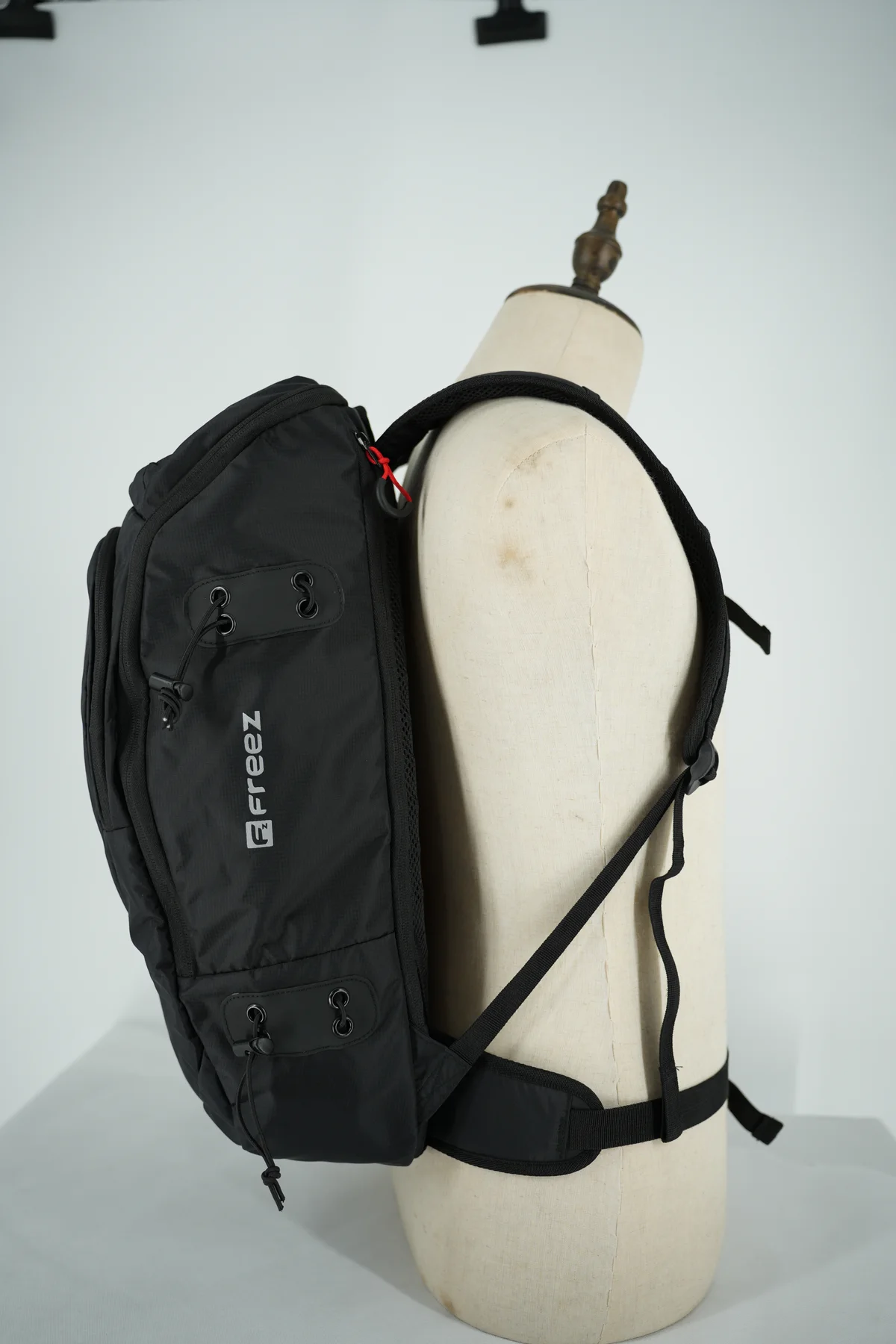
The side view of the JK-036 sports backpack provides a useful product starting point. Shell panels, reinforcement and the harness occupy different regions, but the photograph cannot reveal their fabric mass. This guide addresses the purchasing evidence behind a fabric GSM value, not the measured weight or performance of that photographed backpack.
- Compare the same material state, including identified coatings and backing.
- Keep a small-swatch result separate from a shipment-wide conclusion.
- Record area, mass, units and specimen identity together.
- Judge strength, appearance and finished-bag weight through their own requirements; GSM is not a substitute for them.
01
What exactly does the supplier's number describe?
Request the fabric article reference and the state supplied to the cutting room. A base textile, a coated textile and a laminated assembly can have different mass values even when their face looks similar. Ask whether the quoted figure includes every supplied layer, then retain that answer beside the physical swatch.
Avoid adding a coating allowance twice. If the supplier quotes the completed coated fabric, its coating is already part of the weighed material. If a separate treatment will be applied later, identify which party controls it and how its contribution will enter the revised specification. Do not infer the treatment amount from appearance.
A purchase description should also distinguish nominal value from acceptance limits. The nominal figure identifies the intended article; the agreed range supports a decision about the delivered material. Neither a convenient round number nor an attractive sample establishes a universal tolerance for sports backpack fabrics.
02
Which sample can support the decision?
ASTM D3776/D3776M-20(2025) describes different approaches for a full piece, full-width sample, small swatch and narrow fabric. Its public abstract notes that the small-swatch option describes the submitted sample, not necessarily its source lot. Ask the laboratory to identify the applicable option rather than treating every GSM report as equivalent shipment evidence.
For development, a labelled swatch can help compare candidate articles. For purchasing acceptance, agree the sampling basis for the actual supply. Record rolls, lots and selected locations as required by that plan. This article does not prescribe a sample count or reproduce a standard's test procedure.
Keep edge treatment explicit. The same ASTM abstract distinguishes approaches that include selvages from small-swatch measurements that ordinarily exclude them. If a supplier's commercial quotation uses full roll width while your cutting estimate uses usable width, preserve both records instead of silently substituting one for the other.
The usable fabric width guide addresses the cutting side of that question. Width and mass per area belong in the same material record, but they answer different questions: available layout space and mass of a defined area.
03
Can the calculation be checked independently?
For a simple arithmetic check, mass per unit area equals specimen mass divided by specimen area. Both quantities must use compatible units. A supplier worksheet should show enough information to distinguish a measured result from a rounded catalogue value, without presenting a quick calculation as proof that a complete standard method was followed.
Consider a hypothetical example, not a JKPD test: a specimen with an area of 0.01 square metre and a mass of 2.0 grams gives 200 grams per square metre. If its true area were 0.0095 square metre, the same mass would correspond to about 211 grams per square metre. An area error can therefore change the purchasing interpretation.
Check the instrument resolution and specimen preparation with the laboratory. A very small piece on an unsuitable scale can produce a seemingly precise number without useful discrimination. Likewise, stretching a flexible specimen while measuring it changes the area being used in the calculation. Follow the selected method rather than improvising a correction.
Keep raw observations with the result
Retain specimen identifiers, individual readings where required, the calculation basis and the reporting precision. A photograph of a scale display alone does not show the specimen area, material state or sampling scope. Treat that photograph as supplementary evidence, not as a complete approval record.
04
Why might two reports disagree?
First compare the identities and conditions of the samples. A report for a different finish, colourway or production stage may not describe the material being offered. Ask about conditioning and handling before concluding that one supplier's result is wrong. Do not invent a moisture correction from a generic fibre name.
Next compare the method, sampling scope, units and rounding. A result stated per linear metre cannot be compared directly with grams per square metre. Conversion requires a stated width and a clear decision about whether that width includes unusable edges. Preserve the original units alongside any purchasing calculation.
If the disagreement remains, agree a controlled comparison using identified material and a suitable laboratory. Keep the disputed samples separate from replacements. Quietly sending a different swatch can resolve the numerical disagreement on paper while leaving the original delivery question unanswered.
05
Does a heavier shell make the backpack better?
Not by itself. GSM describes mass spread over area; it does not establish tear resistance, abrasion behaviour, coating integrity or seam performance. Different constructions can share a mass value. Ask for evidence relevant to the actual wear or loading requirement before declaring the heavier candidate superior.
For a sports backpack, separate the shell's role from local reinforcement, pocket stretch and harness construction. A fabric change may alter folding, sewing and pocket bulk even when its nominal mass remains unchanged. Sample the affected operation and inspect the assembled result instead of approving the substitution from a single matching number.
Use GSM as an input to a component estimate, not as the finished backpack weight. The empty-bag mass budget guide explains configuration and component accounting. Cutting waste affects purchasing consumption, whereas only retained material contributes to the bag itself.
06
What should go into the release record?
Keep the fabric article, supplier, finish state, nominal mass, agreed limits, method reference and sampling plan together. Attach the relevant report and retained sample identity. Record whether the decision approves a development candidate, a particular delivery or a controlled ongoing specification; these approvals are not interchangeable.
For a later substitution, compare the complete material description before accepting a matching GSM claim. Revisit affected tests and sample operations when construction changes. Record who approved the change and which orders it covers, so purchasing and production do not work from different versions.
Send the intended shell application, candidate material references and available reports through the project inquiry page. The useful starting question is not simply whether a fabric is heavy enough, but whether the stated number describes the material and decision the project actually needs.
Discuss your bag development project
ANSON XIE
General Manager & Founder
Quanzhou Junkai Pengda Special Equipment Co., Ltd.
Email: ansonxie@jkpdtime.com
Phone: +86 177 5095 3355
WhatsApp: +86 177 5095 3355
Factory address: Floors 2–4, Building 1, Phase I, Huixin Intelligent Manufacturing Industrial Park, Hui'an County, Quanzhou, Fujian, China