
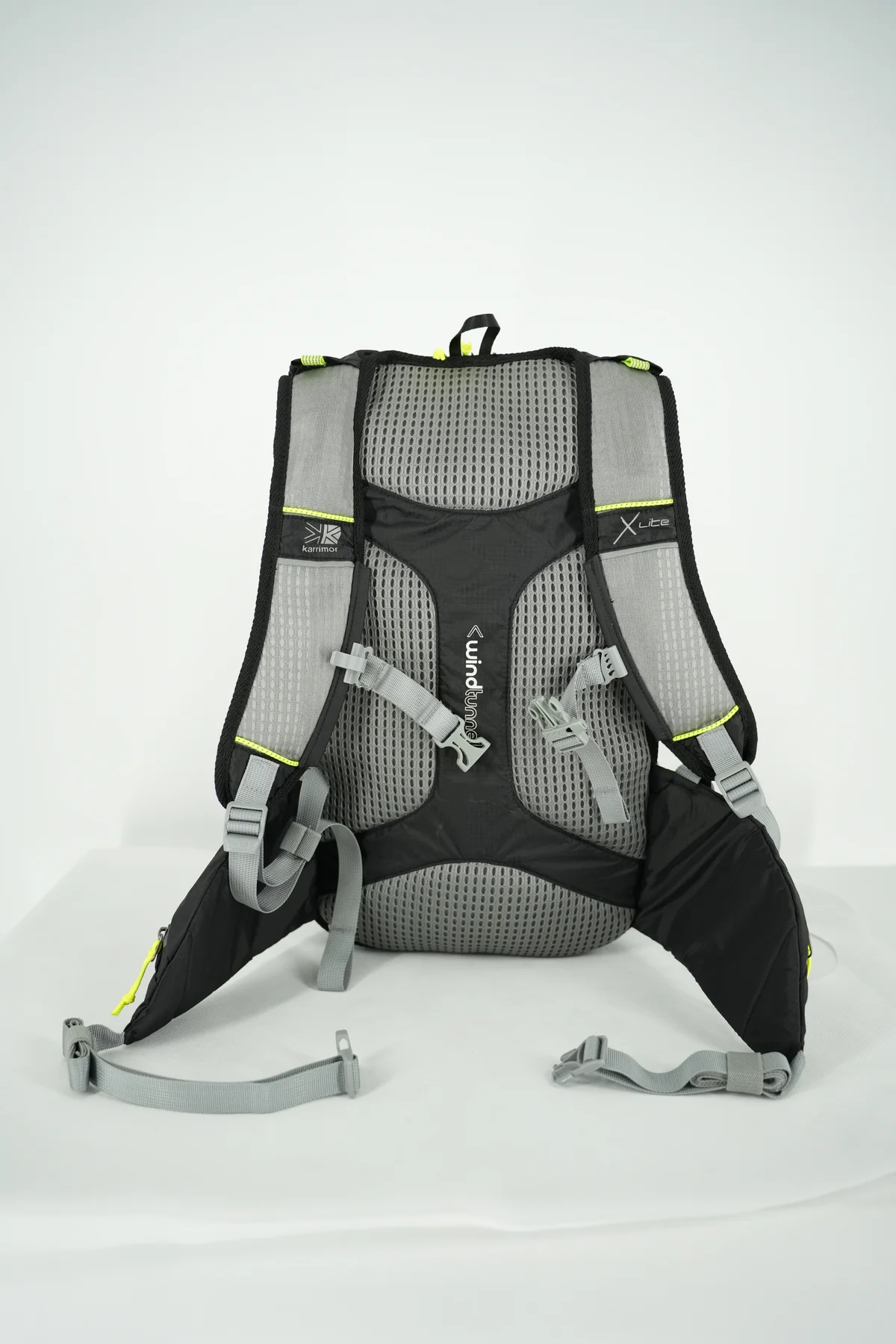
A sports backpack development team may receive two mesh swatches and two impressive airflow figures. Before ranking them, check whether the reports describe the same test area, pressure difference and specimen construction. A larger number under a different setup is not a sound reason to approve a substitution. Start with a comparable measurement, then decide what that measurement can contribute to the back-panel decision.
For a lightweight hydration backpack, the question is particularly easy to blur: the visible contact fabric, the complete padded panel and comfort while carrying are not interchangeable subjects. This guide concerns purchasing and reviewing fabric air-permeability evidence. It does not give the photographed product a laboratory result or claim that a fabric measurement predicts a cooler wearer.
01
Identify the part that the report represents
Label the intended location before asking for a test. Is the candidate fabric the body-facing cover, a shoulder-strap facing or a pocket panel? Record its supplier article, color, finish and revision. Keep a retained piece with the report so a later delivery can be traced to a specific candidate rather than a generic description such as breathable mesh.
Ask whether the submitted specimen was a loose textile, a bonded textile or a complete layered assembly. If the report covers only the face fabric, write that limitation beside the result in the approval record. Do not let a photograph of the finished backpack silently expand the scope of the test.
ISO 9237:1995 describes measurement of fabric permeability to air, including air-permeable made-up textile articles within its stated scope. The public listing is not the complete procedure. Let the laboratory confirm whether the proposed specimen and setup are suitable, especially where padded or irregular assemblies are involved.
02
Put the conditions next to the result
The RISE test-service explanation describes airflow perpendicular to a clamped specimen at an agreed pressure drop and test area. It reports airflow velocity in mm/s and explicitly requires the same area and pressure drop when comparing results. Those conditions belong beside the number, not buried in an email attachment.
Build a comparison record with a separate field for the method and edition, specimen identity, test area, pressure difference, units, tested face and any preparation or conditioning stated by the laboratory. Add the report identifier and date. Leave an unanswered field visibly unresolved; an empty cell should not be interpreted as matching the other supplier.
Avoid choosing settings merely because they produce a convenient value. Ask the laboratory which configuration suits the material and the comparison objective. This article does not prescribe a universal pressure or a pass threshold for sports backpacks. A project requirement needs its own rationale and an agreed method before candidates are ranked.
03
Separate a unit correction from a method difference
A unit conversion and a change in test conditions are different problems. Ask for results expressed consistently, with the conversion documented where necessary. Do not treat that administrative correction as a way to reconcile different pressure differences, test areas or specimen stacks.
Consider a proposed comparison in which one supplier tested bare mesh and another tested mesh attached to a backing. Even if both summaries use the same unit, they answer different questions. Request matched specimens and conditions, or maintain two separate evidence categories. An honest incomplete comparison is more useful than a precise-looking ranking built from incompatible records.
Also distinguish a reported mean from an individual reading or a marketing value without a report. Ask the laboratory how the result was summarized and what specimen variation is available. Where candidates are close, agree how measurement uncertainty and variation affect the decision instead of declaring a winner from the final displayed digit.
04
Decide where to sample an uneven panel
A backpack panel can contain a central field, bound edges, stitched channels and locally attached layers. Make the sampling question explicit. A reading from an unobstructed region should not automatically stand for every area of the assembled panel.
Provide a marked drawing and actual samples to the laboratory. Identify the regions the development team wants to compare and ask what can be tested meaningfully. Keep photographs of the tested location and face orientation with the report. If an assembly cannot be evaluated by the chosen method, record that limit and agree a separate approach rather than describing an improvised setup as standard-compliant.
Use separate labels for loose-fabric screening and assembly review. Both may be useful, but their roles differ. The first can narrow material candidates; the second addresses the selected construction. Neither should be presented as a wearing trial. The related spacer-mesh guide discusses material structure and compression; this report review focuses on whether evidence can be compared.
05
Keep the wearing question outside the fabric result
Write a claim that matches the evidence
If a laboratory reports an air-permeability value for a named specimen under stated conditions, retain that scope in the technical file. Do not translate it into an unsupported temperature reduction, drying time or all-day comfort promise. A material-selection record and a consumer-facing benefit claim need different levels of supporting evidence.
For the complete sports backpack, define a separate carrying review with the intended load, harness adjustment and clothing. Ask reviewers about the contact arrangement and operating tasks that matter to the brief. Record those observations as observations, not as a substitute laboratory measurement or an invented physiological result.
This separation also helps resolve trade-offs. A candidate may be acceptable in the fabric comparison but unsuitable for the intended edge finish or assembly. Keep the reason for rejecting it explicit. The result does not become wrong simply because another construction requirement governs the final choice.
06
Control substitutions with the same evidence chain
Release the selected article together with its supplier reference, retained specimen, report and approved assembly revision. Ask for notification before changing the face textile, finish, backing or bonding arrangement. A similar surface pattern is not enough to show that a replacement is equivalent.
When a change is proposed, identify which evidence still applies and what needs repeating. Match the comparison conditions before judging the replacement. Update the material record and the sample photographs together, so production does not receive an approved report for one stack and an assembly drawing for another.
The useful outcome is a traceable decision: these candidates were compared under these conditions, this construction was selected for these reasons, and these whole-bag questions remain separate. Share the candidate references and available reports through the JKPD project inquiry page. No universal airflow target or verified performance of the illustrated backpack is implied by this guide.
Discuss your bag development project
ANSON XIE
General Manager & Founder
Quanzhou Junkai Pengda Special Equipment Co., Ltd.
Email: ansonxie@jkpdtime.com
Phone: +86 177 5095 3355
WhatsApp: +86 177 5095 3355
Factory address: Floors 2–4, Building 1, Phase I, Huixin Intelligent Manufacturing Industrial Park, Hui'an County, Quanzhou, Fujian, China