
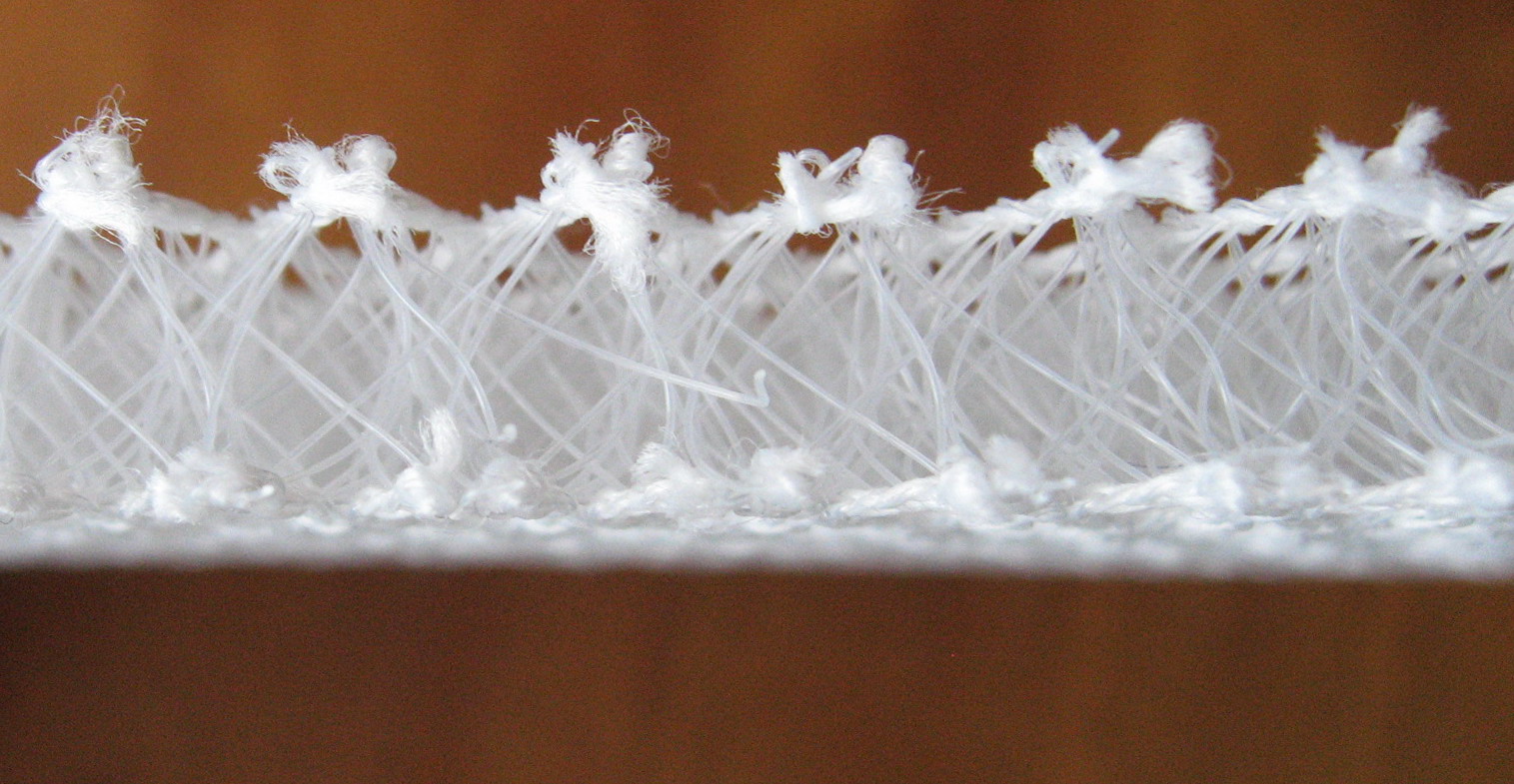
Photo: Elkagye. CC BY-SA 3.0 · Original source. Unmodified for this article. The image remains under its stated license; no endorsement or JKPD material use is implied.

01
Are the three layers necessarily glued together?
Spacer mesh commonly describes a three-dimensional textile with two surfaces and connecting yarns between them. The name does not establish that three separate sheets were glued together. Heathcoat describes its spacetec range as an integrated structure with different yarn combinations and compression options.
That is a description of a specific material family, not a universal specification for everything sold as air mesh. Ask how the two surfaces and connecting region are formed, and whether foam, adhesive or an additional backing is subsequently added.
For a bag, identify the body-facing side and the side toward the interior. Keep the surface pattern, hand feel and connecting structure on the sample record. Consistent photography of both faces helps carry that identity into cutting and assembly.
02
What does a real cross-section help you see?
The photograph shows connecting filaments between two surfaces and an open intermediate space. Cut edges are visible at the surfaces. It explains the physical separation within the textile without identifying its polymer, commercial article, connecting-yarn diameter or compression grade.
Different cross-sections can represent different formulations. Heathcoat describes variable yarn combinations within its spacer range, while DRYTEC has a specific moisture-transfer objective. A generic mesh name is therefore insufficient as a composition declaration.
Ask for face, reverse and cross-section photographs alongside the article data. Record thickness with its measuring conditions separately. The illustration is not evidence that the photographed textile is either named manufacturer product, nor that JKPD uses it.
03
Why can equal thickness produce different support?
Unloaded thickness does not independently describe support. Heathcoat lists thickness, yarn combinations and compression behavior as variables within its spacer range. For a bag, distinguish initial thickness from the spacing that remains under a defined load.
Make the comparison conditional: contact area, applied load or pressure, hold time, recovery interval and the thickness or recovery result recorded. A supplier’s “good resilience” claim needs an identified specimen and test conditions before it can guide approval.
Then compare stacks that match the proposed product. A quick hand squeeze can help screen samples, but it does not establish repeated-compression or long-duration carrying behavior. A section photograph cannot tell a buyer that the thicker option will necessarily feel more comfortable.
04
Are airflow, wicking and drying the same property?
They describe different processes. Airflow concerns air passage, wicking concerns liquid movement and drying also depends on specimen moisture and the environment. Visible holes do not establish moisture management against a person’s body.
Heathcoat’s DRYTEC explanation identifies surface-to-surface moisture transfer as a particular design objective and describes a polyester, monofilament and cellulosic-yarn combination. That manufacturer description does not establish equivalent directional transport in every polyester spacer mesh.
Discuss fabric airflow evaluation, identified in the public ASTM D737 listing, with the laboratory. Agree separately on liquid transfer, drying and assessment under compression. Keep conditions and units attached to results rather than translating an airflow number into an unsupported temperature-reduction claim.
05
What changes when mesh enters a complete strap or panel?
The assembled stack requires its own review. Foam, a stiffener, bonded areas or locally compressed seams change the proposed arrangement. The practical airflow and contact question is therefore larger than the bare mesh, so send a representative assembly rather than only a loose swatch.
Prepare a sample matching the target location. Identify the contact face, cutting direction, binding and attachment area. Check for hard edges, clothing snagging and local compression that removes the spacing the design intended to retain.
Confirm cutting and sewing details with the supplier and sample maker. Review containment of cut edges, coverage by binding, exposed connecting yarns and bulk at folds. No processing photograph is presented here, so these are proposed evaluation questions rather than claims about an observed production case.
06
Related manufacturer video
Related video:Heathcoat Drytec™ · Heathcoat Fabrics
Supplementary viewing only. The video does not certify the illustrated material or the proposed bag assembly. Use current article-specific documentation for approval.
07
What belongs in the spacer-mesh purchase specification?
Identify the article, yarn constituents in each region, surface constructions and orientation, mass per area, thickness with measuring conditions, color and finish. Add target compression and airflow requirements. Recycled content, flame resistance or antimicrobial claims need evidence for that article, rather than marketing for another product in the same brand family.
Provide the intended location and assembly stack when requesting a quotation. Ask for recommended processing and its limits. Retain raw material, the assembled sample and agreed acceptance conditions after approval; different thicknesses need not share an arbitrarily identical threshold.
Describe how the selected textile serves the particular strap or back panel instead of approving a generic “3D breathable” label. That record makes repeat-order or substitution changes traceable to composition, structure or assembly and identifies what needs fresh validation.
Related reading: strap-padding position and edge transitions.
Share the application, candidate material articles and available records through the JKPD project inquiry page.
Discuss your bag development project
ANSON XIE
General Manager & Founder
Quanzhou Junkai Pengda Special Equipment Co., Ltd.
Email: ansonxie@jkpdtime.com
Phone: +86 177 5095 3355
WhatsApp: +86 177 5095 3355
Factory address: Floors 2–4, Building 1, Phase I, Huixin Intelligent Manufacturing Industrial Park, Hui'an County, Quanzhou, Fujian, China