
Define the belt function, attachment interface and reinstallation sequence. Review the pack with the belt fitted and removed before approving the sample.
01
Define the intended belt function
Removable describes separation of a component. It does not establish a load rating or a measured reduction in shoulder loading. The official Eagle Creek Explore page lists a removable hip belt, illustrating a configuration that can be specified explicitly. It does not validate another project's attachment.
Before development, decide whether the belt is intended primarily to limit pack movement or whether the project requires it to participate in load transfer. Those objectives call for different construction and evidence. Record the intended role before choosing a detachable connection. A feature list that simply says waist belt leaves this important distinction unanswered.
02
Map the complete attachment interface
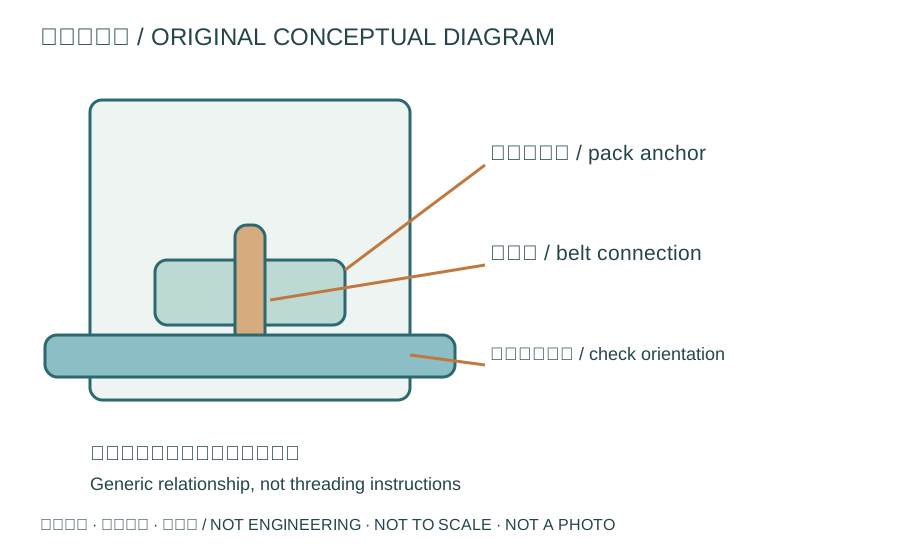
Review the pack-side anchor, belt-side connection and locating constraint as separate elements. Identify what passes through an opening, changes direction or engages another component. Then record where the connection should sit when installation is complete. This creates a shared description for the designer and sample maker.
Webbing width alone does not establish compatibility. Check the usable entrance space, thickness, folded layers, binding and room for fingers with the actual material combination. The diagram shows a generic interface relationship. It does not prescribe a threading dimension or validate a particular fastening mechanism. Confirm the chosen mechanism through its own instructions and sample.
Original conceptual diagram; not engineering, not to scale, not a photograph or product/test evidence.
03
Test reinstallation as a separate task
An attachment that is easy to remove can still be difficult to reinstall. Ask someone outside the sample-making process to follow the proposed instructions. Observe reversed faces, exchanged left and right parts, missed anchors and positions that look complete without reaching the intended location.
If correct installation depends on an invisible internal movement, consider improving visibility or access. Do not rely on the operator remembering a verbal demonstration. Show the completed arrangement and its identifying checkpoints in the approval material. Record any tools or deliberate release actions that the selected interface requires. Ease of removal and clarity of reinstallation are separate findings.
04
Observe location under the intended wearing condition
Review attachment position with the agreed load and clothing conditions. Observe whether movement turns a component over, creates local contact or moves the belt beyond its intended location. An empty pack lying on a table cannot represent every condition encountered when the bag is worn.
Record clothing, belt adjustment and load placement so the observation can be repeated. Define the intended wearer range in the project rather than deriving it from one reviewer. This article sets no universal fit size and reports no comfort trial. If a design change alters the back panel or anchor height, revisit location rather than assuming the previous fitting remains applicable.
05
Approve the pack with the belt removed
The belt-free mode needs its own review. Check exposed connection ends, empty loops against the body, loose webbing and storage of removed parts. Photograph the complete pack in that mode. A photograph of the removal action does not show the finished condition in which the user will carry it.
If removal involves withdrawing a long strap, check whether it disturbs components that should remain assembled. Explain the boundary between adjustment and release for the selected connection. Keep removed components identifiable. A removable configuration is easier to support when the project defines both the installed arrangement and a coherent belt-free state.
06
Match validation to the complete structure
Installation and location reviews answer operation and space questions. If the belt must participate in load transfer, validation needs to address the pack anchor, connecting components, belt body and adjustment area. A buckle data sheet alone cannot validate that complete arrangement.
Agree the sample condition, direction of action, repeated-operation procedure and failure criteria before testing. Record the actual fabric, reinforcement and stitching configuration. When those elements change, assess whether previous evidence still applies. Do not substitute a comfortable short fitting for structural validation. Likewise, do not present a component rating as the allowable carried load of the whole backpack.
07
Keep the interface revision with approval
Keep the reviewed combination traceable
Request the completed interface, left-right and inside-outside identification, installation and removal steps, component list and photographs of both carrying modes. Separate intended function from performance awaiting evidence. This keeps operational approval from becoming an unintended load or comfort claim.
Retain an interface revision for later samples. Reassess reinstallation and location after changing the buckle, webbing or pack-side anchor. Ask the supplier to identify substitutions rather than treating equal nominal width as interchangeability. The approval should cover a named combination and documented procedure. That makes an assembly correction traceable without requiring the team to reconstruct an earlier verbal instruction.
Related development guidance: Review the connected construction.
Discuss your bag development project
ANSON XIE
General Manager & Founder
Quanzhou Junkai Pengda Special Equipment Co., Ltd.
Email: ansonxie@jkpdtime.com
Phone: +86 177 5095 3355
WhatsApp: +86 177 5095 3355
Factory address: Floors 2–4, Building 1, Phase I, Huixin Intelligent Manufacturing Industrial Park, Hui'an County, Quanzhou, Fujian, China