
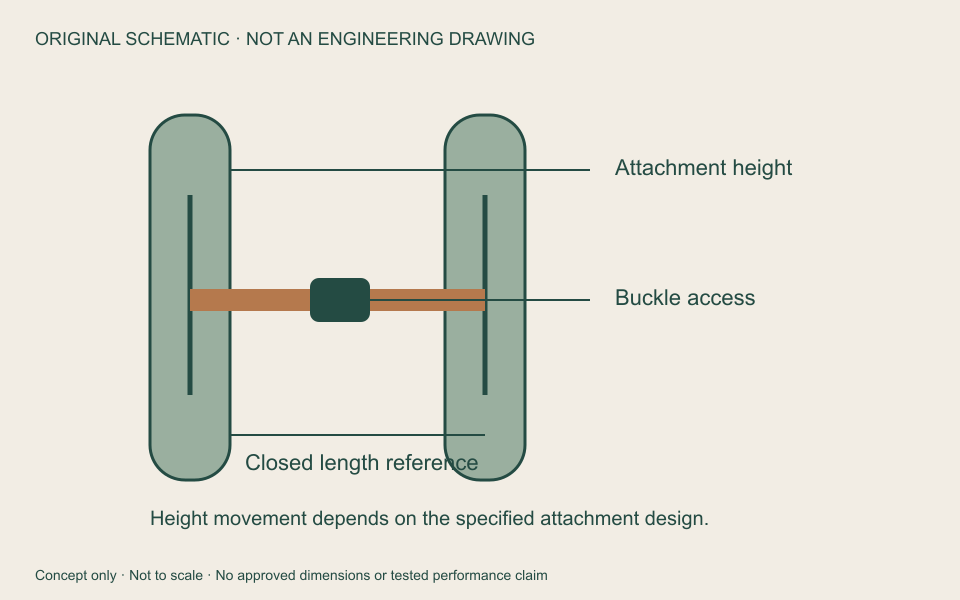
Define sternum-strap adjustment through attachment height, closed cross-chest length and buckle operation on the worn sample.
01
Separate the two adjustment directions
Identify how the sternum strap connects to the shoulder straps. Attachment-height adjustment and cross-chest length adjustment are different requirements. Describe each separately on the project drawing instead of specifying an adjustable chest buckle.
If height is fixed and only length changes, record that configuration. A visible webbing strip or adjuster does not establish vertical movement. Confirm the component arrangement and actual operation before defining positions to review.
02
Keep worn-sample conditions identifiable
Agree wearer coverage, clothing state, bag contents and the shoulder-strap setup before reviewing the sternum strap. Otherwise, changes between photographs may be incorrectly attributed to one feature. Record wearer feedback without extending one person’s experience to every user.
Review the height-and-length combinations required for the project. Use the agreed glove reference where needed and document different clothing layers separately. Do not impose unconfirmed universal body dimensions.
03
Identify the connection area on the project sample
Identify the longitudinal shoulder-strap webbing, transverse sternum-strap webbing and buckle on the project sample. Record the connection area separately from the worn height range and adjustment-retention checks.
The original schematic separates the shoulder straps, closed sternum-strap length and attachment-height references. It is not an approved engineering drawing of a particular product. Use it to locate the review points; use the project sample to establish actual operation.
04
Operate closure, release and excess webbing
Close, adjust, release and reclose the strap in the agreed worn state. Record access to the buckle, which component a hand holds during adjustment and where excess webbing rests. Link photographs to actions rather than retaining only one closed front view.
If a component shifts or webbing length changes, record conditions and location without assigning a cause prematurely. Agree separate verification for repeated operation or retention. Static photography is not durability or stability evidence.
05
State the reviewed adjustment coverage
Record attachment configuration, adjustment directions, reviewed positions, worn conditions and operation results. Link the drawing revision to a sample ID. Where appropriate, distinguish appearance and operation approval from pending retention verification.
Recheck the relevant combinations after changes to shoulder-strap width, the sternum buckle or attachment position. Buyers can identify the approved configuration and developers can assess the effect of a revision.
Share material references and sample requirements through the JKPD inquiry page.
Discuss your bag development project
ANSON XIE
General Manager & Founder
Quanzhou Junkai Pengda Special Equipment Co., Ltd.
Email: ansonxie@jkpdtime.com
Phone: +86 177 5095 3355
WhatsApp: +86 177 5095 3355
Factory address: Floors 2–4, Building 1, Phase I, Huixin Intelligent Manufacturing Industrial Park, Hui'an County, Quanzhou, Fujian, China