
Define a pole quiver’s left and right from the wearer’s body. Add the opening position, bottom direction and attachment orientation to that definition. A request to “move it to the right” can otherwise produce several different interpretations between a brand, pattern maker and sample room.
01
Establish one reference for left and right
A rear photograph and a front photograph place the wearer’s left on different sides of the image. Write “wearer’s left” or “wearer’s right” in the brief and keep an actual reference showing the viewing direction and opening position. A close crop without body context is a poor orientation reference.
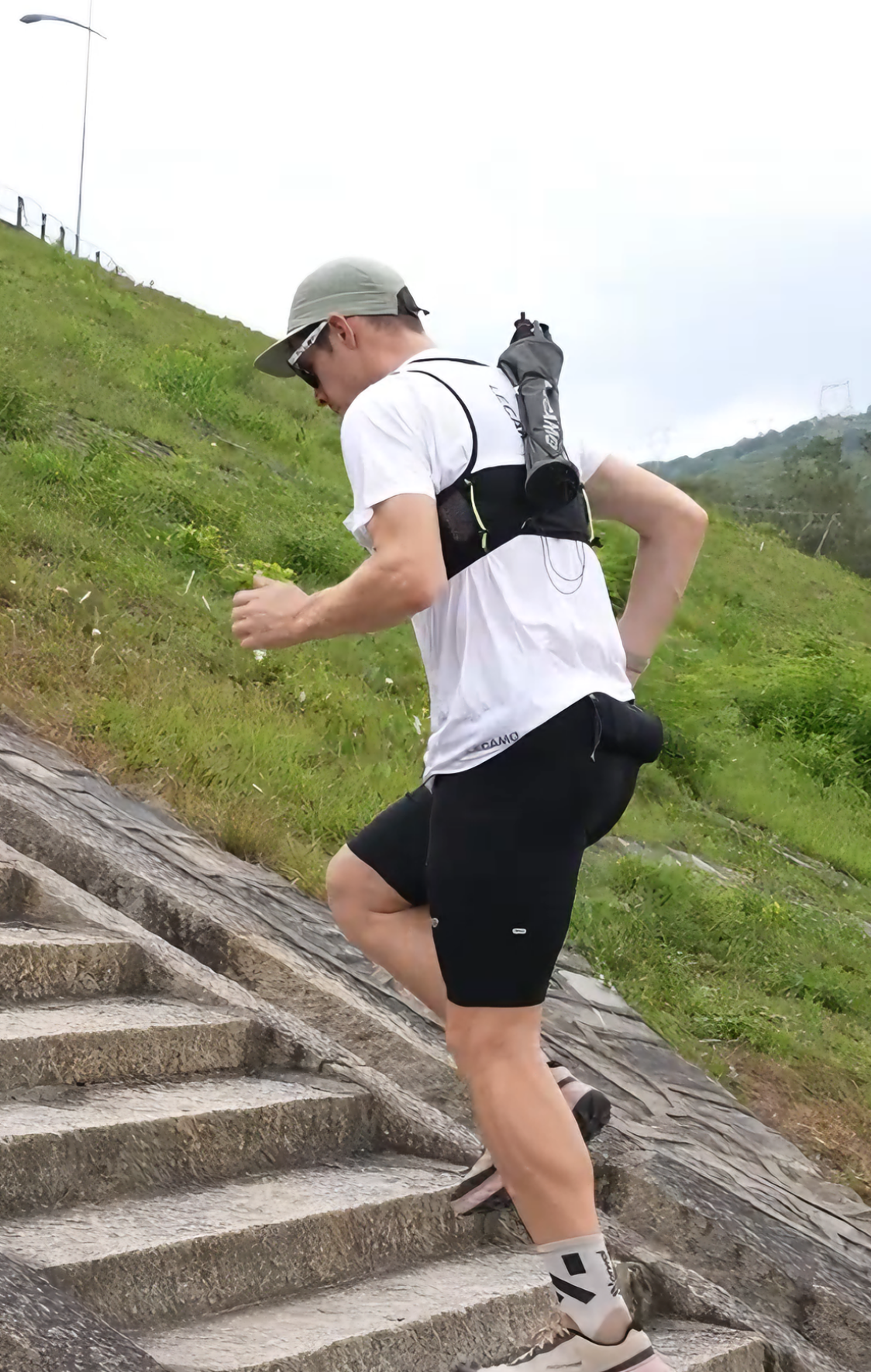
The retained wearing photograph illustrates a left-side arrangement. It does not establish that this same assembly has been verified on both sides. A right-side option needs its own installed sample and wearing photographs before it is presented as an available configuration.
02
Specify the operation as well as the preferred hand
The hand holding the poles does not, by itself, determine the installation side. A person may use the other hand to support the opening or stop to organize the bundle. Describe holding, opening, inserting and final adjustment in sequence rather than translating “right-handed use” directly into “right-side mounting.”
Record the hands and opening together during a sample review. A wearing photograph does not establish one-handed access, access without looking or successful operation while running.
Begin a sample review with stationary insertion and removal. Decide separately whether on-the-move use is an intended requirement that needs further evaluation. Keep the folded pole bundle consistent when comparing arrangements so that a different bundle is not mistaken for an orientation improvement.
03
Mirroring the silhouette does not mirror the interface
Changing sides can involve the opening angle, the front and back of attachment tabs, snap closure direction and matching anchor locations on the host pack. A sleeve that looks nearly symmetrical may still have directional connections.
An attachment close-up should identify the physical closure arrangement. Photograph the upper end, lower end and outward-facing surface separately. Match these to the intended pack and install the target pole bundle. Without that corresponding assembly, avoid describing the accessory as universally interchangeable between sides.
A useful approval record names both components: the quiver version and the host-pack version. An interface change on either component should trigger a review of the installed arrangement rather than approval from an isolated product image.
04
Review orientation around body movement
After installation, inspect the opening, pole handles, elbow area and lower loose cord from the rear and rear-side viewpoints. Still photographs record positions; they cannot replace observations during arm swing, turning or bending. If interference occurs, identify whether it comes from anchor height, sleeve angle or bundle length before revising the pattern.
Choose lightweight sleeve materials after the intended orientation is clear. Similar weight across two versions does not establish equivalent connections or clearance. Material composition and connection performance require documentation and sample evaluation; a visible grid pattern does not establish either.
05
Approve an identifiable version
Record the approved configuration
The final record should include wearer-based side, compatible pack reference, installation photographs, target pole bundle, operation sequence and sample version. Register two configurations separately when both are required. If only one has been confirmed, describe that scope clearly.
The retained construction photograph comes from the company product library; it is not performance evidence. Find further development topics in the JKPD blog.
Related: Quiver opening, attachment and bottom review. See the photographed product reference.
Discuss your bag development project
ANSON XIE
General Manager & Founder
Quanzhou Junkai Pengda Special Equipment Co., Ltd.
Email: ansonxie@jkpdtime.com
Phone: +86 177 5095 3355
WhatsApp: +86 177 5095 3355
Factory address: Floors 2–4, Building 1, Phase I, Huixin Intelligent Manufacturing Industrial Park, Hui'an County, Quanzhou, Fujian, China