
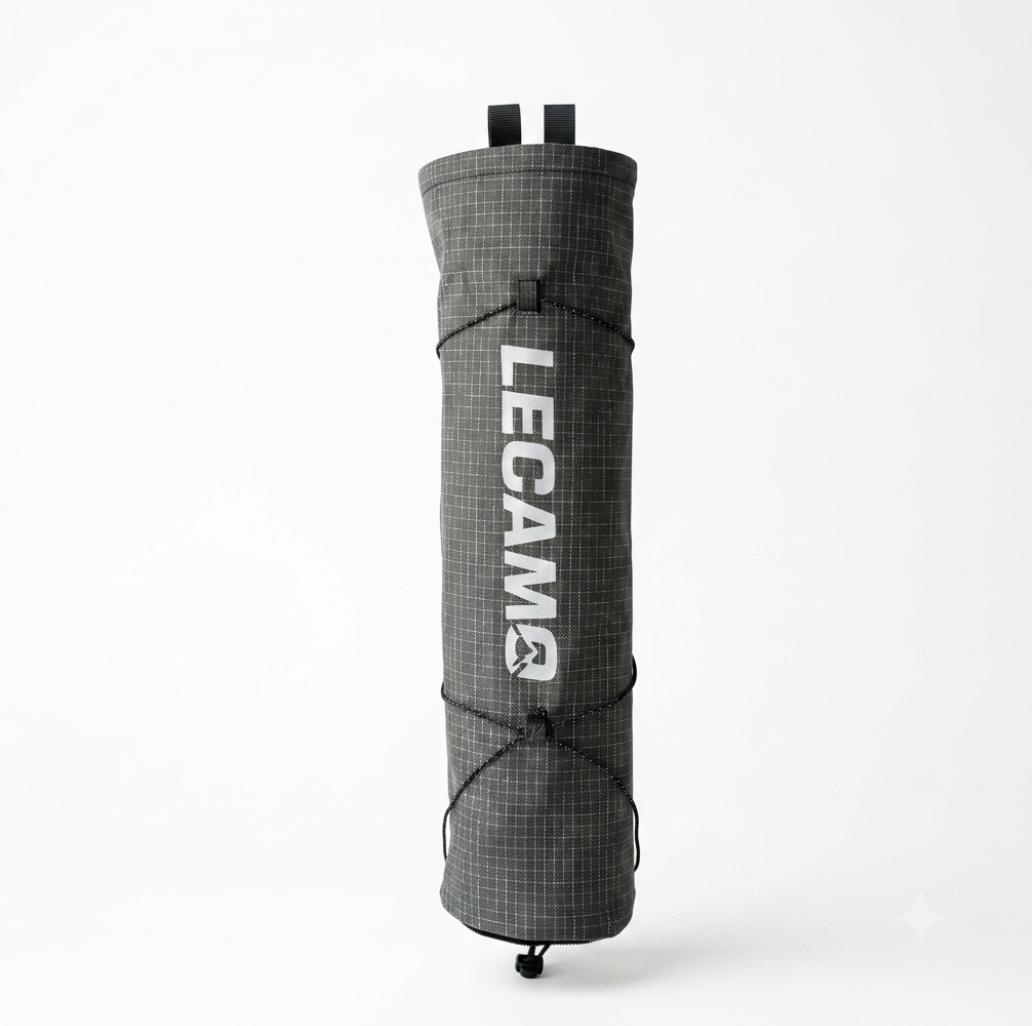
Pole-quiver compression should reduce unnecessary space while preserving a usable insertion and removal path. Pulling a cord as tight as possible does not complete volume control, attachment to the pack and pole retention at the same time.
01
Identify the region controlled by each cord
Mark the cord route on the opened sample and observe which regions change during adjustment. Gathering below the opening, shaping the middle and positioning the lower end may interact, but they should not be assumed to perform one identical task.
Salomon’s official Custom Quiver page associates a compression lace with pole stability. That describes its own product. A new design needs review of its cord route, attachment and pole bundle rather than borrowing that result.
The photo shows two cord regions and a gathered outline. It cannot identify cord elasticity, tension or the contents inside. Relate visible positions to the actual construction before comparing samples under defined conditions.
02
Position compression around the bundle shape
A folded pole bundle may have different cross-sections along its length. Grips, straps, baskets and overlapping sections need different space. Place cord zones around the target bundle rather than distributing them by sleeve length alone.
If a large section must pass through a tightened region, removal may require loosening first. That can be a valid operation, provided it becomes an explicit step rather than a reason for the user to pull harder.
Use the same bundle, insertion direction and starting arrangement to compare revisions. Observe the loose path first, then adjust individual regions. Distinguish reduced unused sleeve volume from unwanted distortion of the mouth.
03
Review thin fabric with the cord route
Gathering creates folds and contact points that differ from a flat fabric sample. Review the actual sleeve with its binding and cord guides. A flat swatch cannot establish how that combination behaves during compression.
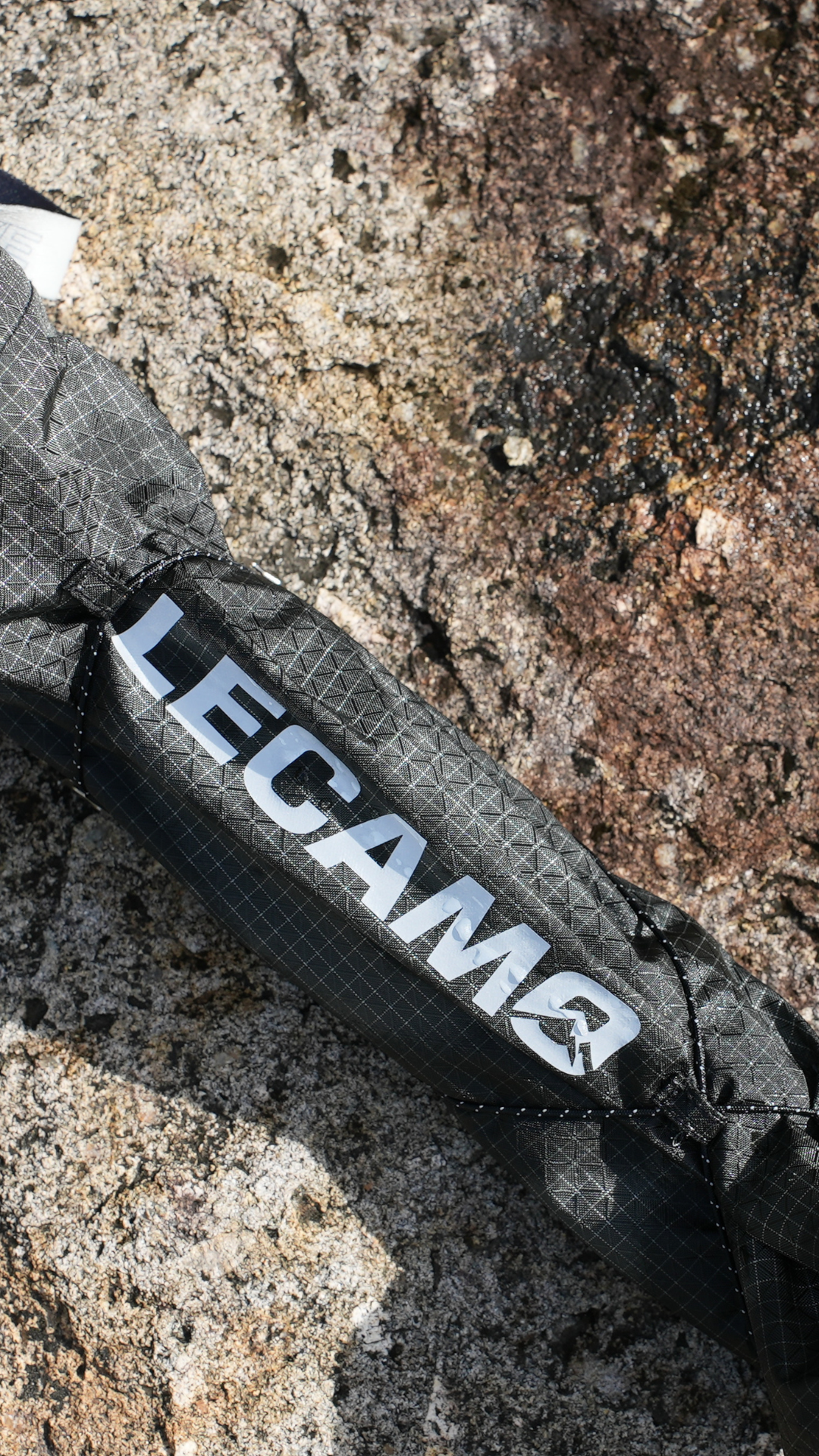
The photographs show a grid and folds, not a fabric brand, fiber identity or abrasion grade. Specify the fabric reference and coating condition, and record the regions that repeatedly contact pole sections.

Local construction may be used where the cord contacts the sleeve, but assess whether added layers interfere with folding or retrieval. Lower shell mass and suitable local structure need not mean making the whole product uniformly thicker or thinner.
04
Define transitions between empty and loaded states
Describe the empty sleeve, loosening for insertion, adjustment after insertion, preparation for removal and tidying the empty sleeve again. Each state needs an identifiable adjuster and usable cord, rather than asking the user to guess the correct pulling point.
If removal requires loosening, confirm that the adjuster remains reachable afterward. If the brief asks for retrieval without readjustment, verify the retained path with the actual poles. A “quick access” name is not an operating instruction.

The worn photograph shows a moment with both hands involved and the bundle aligned with the mouth. It does not establish one-handed operation, transition speed or running stability. Those claims need corresponding recorded observations.
05
Plan spare cord without losing adjustment
Identify the segment needed for a finger grip and the segment that should be tidied after adjustment. Cutting everything as short as possible may remove operating allowance. Leaving a long loop with no resting place is not a complete solution either.
Review spare cord relative to clothing, rear pockets and other equipment in the worn arrangement. The tidy position should retain a recognizable adjuster and allow the next loosening action.
Confirm cord-lock pairing with the actual cord and threading. A functioning cord lock alone does not approve the whole quiver. Sleeve compression, pack attachment and pole retention remain separate review tasks.
06
Record the final operating arrangement
Retain the reviewed sample configuration
An OEM brief should include the pole bundle, compression positions, cord route and threading direction, use sequence and spare-cord arrangement. Confirm the full transition with the same sample revision before changing materials or structure.
This article focuses on sleeve compression and changes of use state, separately from attachment tabs and bottom maintenance. It supplies no holding-force, abrasion-life or dynamic-test result. Send the pole sets and intended operations through the JKPD project inquiry page.
Related development guide: Pole quiver opening, attachment and bottom details. See the photographed product reference.
Discuss your bag development project
ANSON XIE
General Manager & Founder
Quanzhou Junkai Pengda Special Equipment Co., Ltd.
Email: ansonxie@jkpdtime.com
Phone: +86 177 5095 3355
WhatsApp: +86 177 5095 3355
Factory address: Floors 2–4, Building 1, Phase I, Huixin Intelligent Manufacturing Industrial Park, Hui'an County, Quanzhou, Fujian, China