
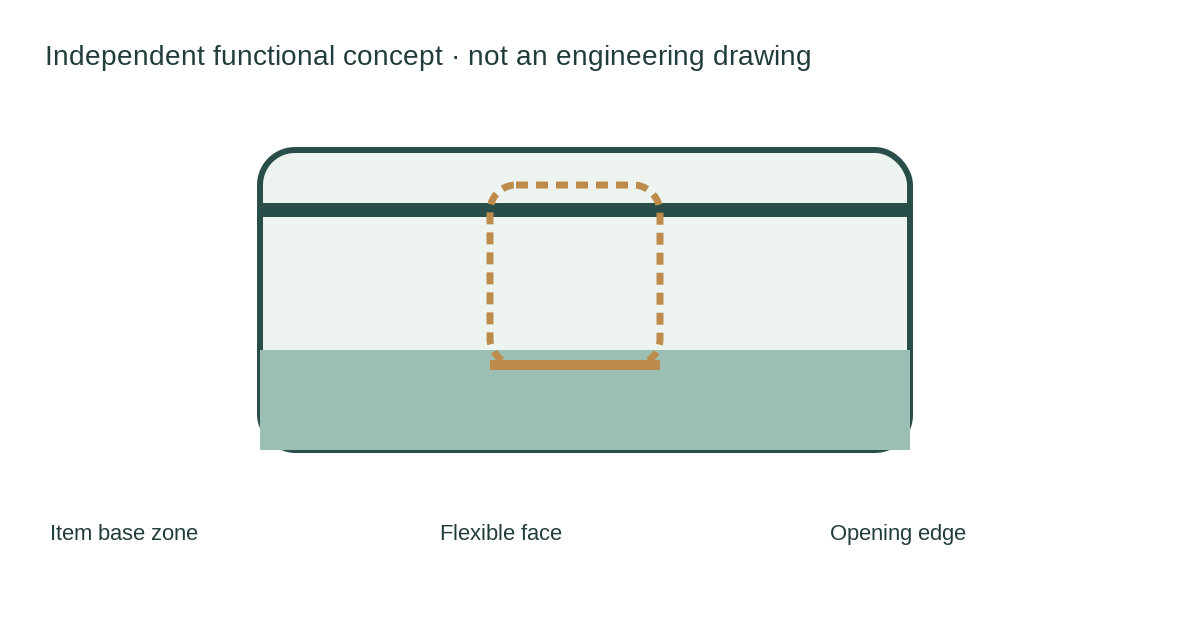
A bottle pocket needs support beneath the item, room around its body and a usable opening. Treat these as separate development zones rather than uniformly thickening the pocket, and keep visible textile structure separate from verified material performance.
01
Why separate the contact zones of one pocket?
The region beneath an item, the face around its body and the opening edge answer different questions. The base needs a suitable supporting shape, the face accommodates the outline, and the mouth balances insertion and retrieval. A request for thicker mesh everywhere can miss the particular location that needs changing.
An open pocket can look roomy without having enough space for the intended bottle. Insert that bottle in the loaded pack and see where its base rests, how the mouth opens and which point limits removal.
02
Why draw the item base beside the lower seam?
Base shape affects where an object rests. A flat, narrow or projecting bottom can contact different parts of the pocket and its edges. Supply the intended item outline rather than nominal volume alone. Containers with similar stated capacity can still require different supporting space.
An independent section concept can show whether the proposed contact lies beside a lower fold or attachment edge. It does not disclose hidden layers in a real product. Identify whether the proposed improvement should move the contact, change pocket shape or add local material before asking for a thicker whole side wall.
03
Does an open-looking mesh establish stretch or strength?
No. Holes, weave and apparent thickness can identify visible zones but do not confirm fibre, extension, recovery or abrasion resistance. Compare candidate textiles using the same sewn pattern before attributing a difference to the fabric alone.
If the face must expand around a bottle, discuss the final material state and attachment method. A textile's ability to extend does not mean the sewn pocket changes equally in every direction. Edge construction, cutting direction and the neighbouring body all influence the usable shape and belong in the same discussion.
04
How do easy reinsertion and retention interact?
A mouth that opens readily can make replacement easier, while item position also depends on depth, bottle shape and other restraint. Neither tightness nor looseness alone describes the complete pocket. A taller item projecting above the edge can also enter the operating zone of a side strap.
If a strap needs releasing before drinking, describe that step instead of using a tighter mouth to avoid a routing decision. Leave room to grasp and reposition the edge. These are operating tradeoffs, not a guarantee that a particular bottle remains retained during bending or dynamic activity.
05
How can solid and open panels divide the work?
A solid face and an open mesh face are two viable layouts. Compare flexibility, local support and edge finish around the intended bottle; neither surface establishes weight, wear resistance or water protection by appearance.
An added layer can change pocket shape, thickness and drying paths, and a new panel junction creates another edge. State the purpose of a local layer before seeking evidence for the final material and assembly. Solid fabric is not automatically a waterproof separation, and visible holes are not drainage-test results.
06
What should the purchasing information describe?
Provide the intended item outline, proposed base position, opening direction and adjacent strap route. Distinguish empty and normally packed states. Describe the base, face and mouth separately in the material list, combining them only where a common material is actually intended. That tells a supplier where reduced bulk is possible and where shape matters.
Review the next sample against the agreed contact and access questions. An independent concept explains the proposed relationships. Use the finished pocket and the actual bottle to assess material behaviour and operation.
Related guide: Lower strap and pocket clearance
Discuss your bag development project
ANSON XIE
General Manager & Founder
Quanzhou Junkai Pengda Special Equipment Co., Ltd.
Email: ansonxie@jkpdtime.com
Phone: +86 177 5095 3355
WhatsApp: +86 177 5095 3355
Factory address: Floors 2–4, Building 1, Phase I, Huixin Intelligent Manufacturing Industrial Park, Hui'an County, Quanzhou, Fujian, China