
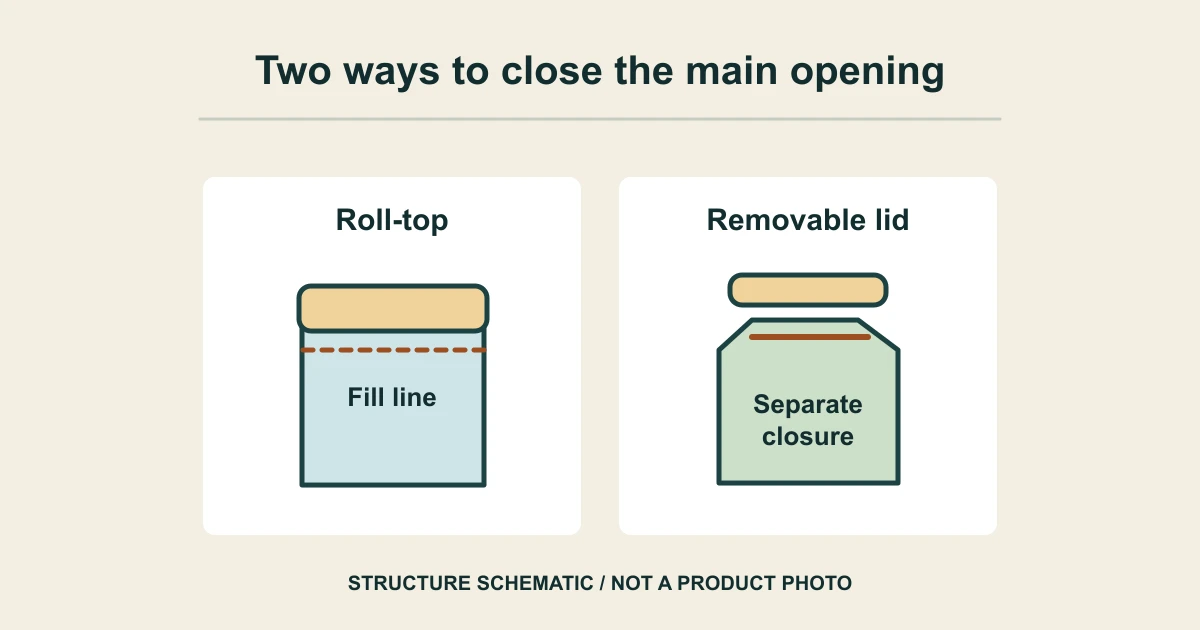
The first question is what the pack must still do after the lid comes off. If removing it changes where the keys go, how the collar closes, or whether a compression strap can still buckle, the lid is part of the operating system. A roll-top and a removable-lid top loader can both suit variable loads, but they offer different ways to manage those changes.
Key takeaways
- Reserve the upper fabric for the roll.
- Specify the lid-off main closure and storage.
- Test the changeover with the same packed load.
01
What changes when you remove the lid?
Treat lid-on and lid-off as separate configurations. In both, the drawing should show how the main opening closes and how the user transports the items ordinarily stored in the lid. A pocket that leaves with the lid is not available in the stripped-down configuration, even if it appears in the feature list.
Choose a small item with a real consequence if it goes missing, such as keys. Ask the tester to put the item away with the lid fitted, remove the lid and continue packing. If the user must improvise a new home for it, give the lid-off configuration a deliberate storage route or make that limitation clear in the instructions.
02
How much of the collar belongs to the closure?
Mark the usable fill line separately from the fabric reserved for rolling. The space above the packed load looks usable when the mouth stands open. Some of that space has to fold into the closure. An object that projects above the fill line may take away exactly the material needed to make an even fold.
Compare the same load two ways
Use a soft sack and then a rigid pouch with a similar occupied volume. Position both near the top of the load. Note whether either creates a ridge that interrupts folding or pushes the fastening points apart. ASTM F2153 addresses backpack capacity; a capacity result on its own does not describe this closure task.
03
Which parts must stay attached?
Trace the main closure, any independent compression strap and the lid's attachment points on the drawing. Mark each part as attached to the pack body or attached to the removable lid. If the same strap is used for both jobs, check where its free end goes when the lid is removed and whether it can still reach the intended buckle.
Some designs use a lid over a separately closed collar; others can only be carried as intended with the lid fitted. Either arrangement can be specified honestly. The expensive mistake is promising modular use on a sample that only functions as a complete assembly. The lid and collar coordination guide covers the separate question of how a fitted lid sits over the opening.
04
Can the owner change configurations on a trip?
Run a changeover using the actual closures, not an explanation from the designer. Start with the lid attached and the pack loaded. Have the tester take it off, secure the main opening and move the keys. Then reinstall it with straps in their original routes. Check for loose tails, parts that can drop and clips that look interchangeable but serve different purposes.
Repeat with cold-weather gloves if they are part of the use case. Keep the approved user sequence with the sample photos. If the lid can only come off conveniently when the pack is empty, distinguish a setup option from a field adjustment.
05
What should the supplier hand back?
Ask for a completed configuration sheet: main closure route, lid attachment route, storage present in each mode and the agreed loads used to demonstrate them. Include a side view of the closed pack for each condition. Add a picture of where the detachable parts go when not used.
A roll-top earns its space by closing around useful load states. A removable lid earns its complexity by leaving behind a configuration the wearer can still operate. Judge those two promises independently before choosing one for a hiking pack.
Discuss your bag development project
ANSON XIE
General Manager & Founder
Quanzhou Junkai Pengda Special Equipment Co., Ltd.
Email: ansonxie@jkpdtime.com
Phone: +86 177 5095 3355
WhatsApp: +86 177 5095 3355
Factory address: Floors 2–4, Building 1, Phase I, Huixin Intelligent Manufacturing Industrial Park, Hui'an County, Quanzhou, Fujian, China