
Compare an inward-projecting shoe compartment with a removable shoe bag, then review packing order and usable shared space.
01
Review the shoe compartment with the main compartment
Getting shoes through the entrance completes only part of the review. When a soft shoe compartment expands inward, its loaded shape changes the space available for clothing and other equipment. Approve the combination rather than the shoe pocket in isolation.
Define which items must fit alongside the shoes, then assess normal closure, access and separation. This article proposes a general development approach. It does not assign a tested capacity or protective performance to a particular bag.
02
Choose a fixed compartment or a removable bag
A fixed inward-projecting compartment and a removable shoe bag are different proposals. The official ASICS gym-bag page explicitly lists a detachable shoe bag. That example illustrates why procurement terminology needs detail; it is not an image reference or a performance claim for this project.
For a fixed compartment, define its attachment, expansion direction and empty storage state. For a removable bag, define retention, use outside the main bag and its packed position. The phrase separate shoe pocket does not settle those decisions.
03
Define the shoe reference and packing orientation
Record the intended footwear types, size range and agreed orientation: side by side, offset or individually bagged. The same nominal size does not establish the same sole width, upper height or protrusions across different footwear. Use references that match the project.
Do not demonstrate fit by flattening an upper unless that action is part of the accepted use case. Review the hand movement at the entrance too. A shoe can pass through an opening while the user’s hand still struggles to place or retrieve it.
04
Show the shared space explicitly
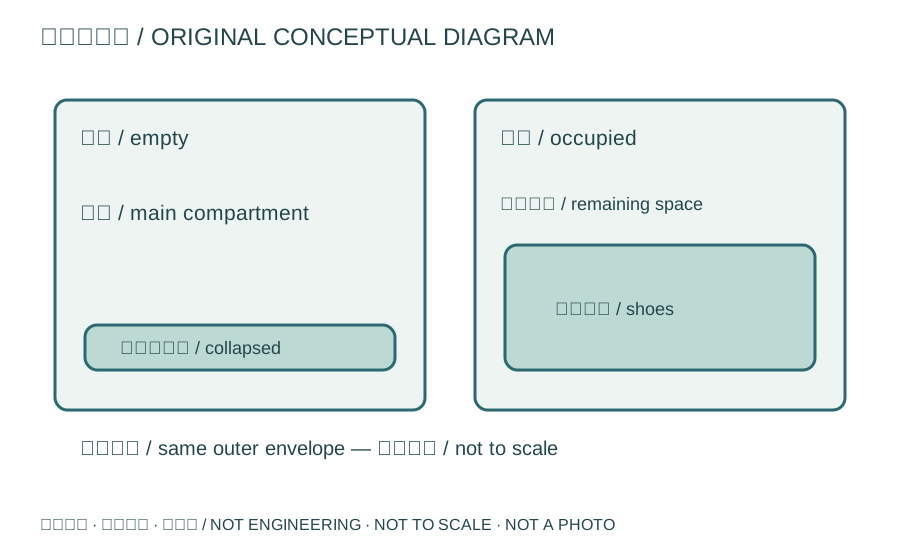
The conceptual diagram compares an empty soft compartment with the same inward-projecting compartment occupied. The occupied compartment sits within the same outer bag envelope. It does not create extra external space, so avoid simply adding its nominal volume to the main compartment figure.
The illustration has no scale and represents no specific product. Review the physical sample with the agreed contents. If a volume declaration is required, separately agree the measurement method and the state of every internal compartment before assigning a number.
Original conceptual diagram; not engineering, not to scale, not a photograph or product/test evidence.
05
Change packing order to expose interference
Packing shoes before clothing and inserting shoes after filling the main compartment can reveal different obstructions. Record tension at the shoe entrance, main closure, bottom and divider. Photograph the shape of the remaining space rather than relying on an empty-bag capacity statement.
Include retrieval in the review. Can users remove the shoes without emptying unrelated contents? Does loose compartment fabric enter the zipper path? Is a loaded removable bag easy to grasp? Use these observed actions to guide revisions.
06
Separate organisation from performance claims
Physical separation does not automatically establish waterproofing, antibacterial action or odour control. Even a coated material requires a separate review of seams, openings and attachment points. A ventilation feature alone does not establish a drying rate.
If the project needs a cleanable inner surface, agree the cleaning method, access to corners and treatment of removable parts with the supplier. Each additional marketing claim needs relevant evidence. Do not derive those claims from the word independent in a compartment description.
07
Approve a repeatable packing combination
Keep the reviewed combination traceable
The review sheet should identify footwear references, orientation, the accompanying packing list, both loading sequences, closure condition and photograph revision. When space is insufficient, locate the conflict before deciding whether to change the compartment or the bag envelope.
Ask the supplier to confirm attachments, removable-part configuration, empty storage and dimensional control in production. The approval then describes a reproducible packing arrangement. It is more useful than approving an empty-bag photograph that merely appears to contain many compartments.
Related development guidance: Review the connected construction.
Discuss your bag development project
ANSON XIE
General Manager & Founder
Quanzhou Junkai Pengda Special Equipment Co., Ltd.
Email: ansonxie@jkpdtime.com
Phone: +86 177 5095 3355
WhatsApp: +86 177 5095 3355
Factory address: Floors 2–4, Building 1, Phase I, Huixin Intelligent Manufacturing Industrial Park, Hui'an County, Quanzhou, Fujian, China