
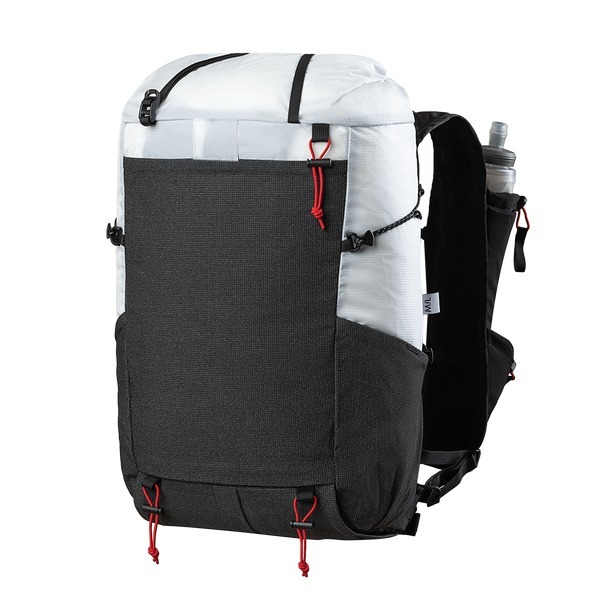
Most hiking packs are designed around walking. This one is designed around moving fast — running the flats and downhills, hiking the climbs, and keeping everything reachable without stopping. It weighs 584 grams in its smaller sizes, holds 23 to 31 litres depending on size, and carries its most-used gear on the shoulder straps rather than in the main compartment.
A fastpack combines a running-vest harness with a backpack body. This reference design has a roll-top, a front stretch pocket and six shoulder-strap pockets for water, snacks and small gear. It is not a JKPD product.
01
At a glance
| Feature | S/M | L |
|---|---|---|
| Weight | 584 g (652 g with two soft flasks) | 612 g (680 g with two soft flasks) |
| Volume | 23 L main compartment, 26 L total | 28 L main compartment, 31 L total |
| Dimensions | 40.6 × 24.1 × 19.1 cm | 44.5 × 24.1 × 18.4 cm |
| Main fabric | 100-denier high-tenacity nylon diamond ripstop | Same |
| Pocket fabric | Stretch-woven UHMWPE and nylon 66 | Same |
Compare pack-only and flask-loaded weights separately. The roll-top extension changes how much of the compartment is usable with the closure properly rolled.
02
Why this pack matters: a vest that carries like a pack
A conventional day pack puts most of its storage behind the wearer. To drink, eat or check a map, the pack has to come off. A running vest solves that by putting pockets on the chest straps — but a vest carries little and has no real frame or volume for a full day in the mountains.
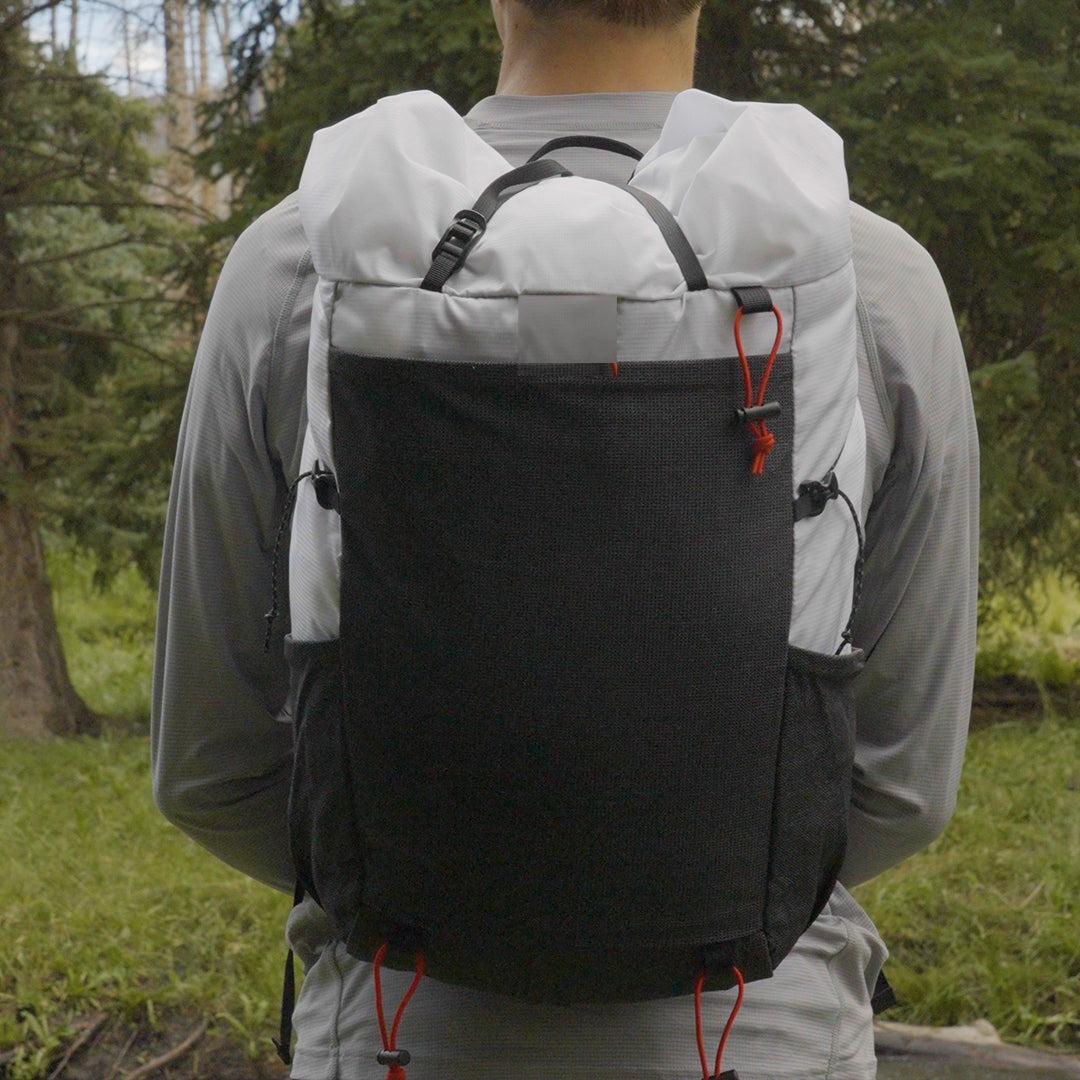
This pack combines the two ideas. The shoulder straps are wide, vest-style straps with six pockets between them, so water and food stay on the front of the body. Behind them is a proper pack: a roll-top main compartment of 23 to 31 litres, a stretch-mesh front pocket, side pockets for litre bottles, and a cut-out foam back panel. The whole thing weighs under 600 grams.
That combination defines the fastpack category. It is for hikers who move quickly — trail runners going long, fast hikers on big days, and anyone who wants to keep moving without stopping to dig through a pack.
03
Functions and features
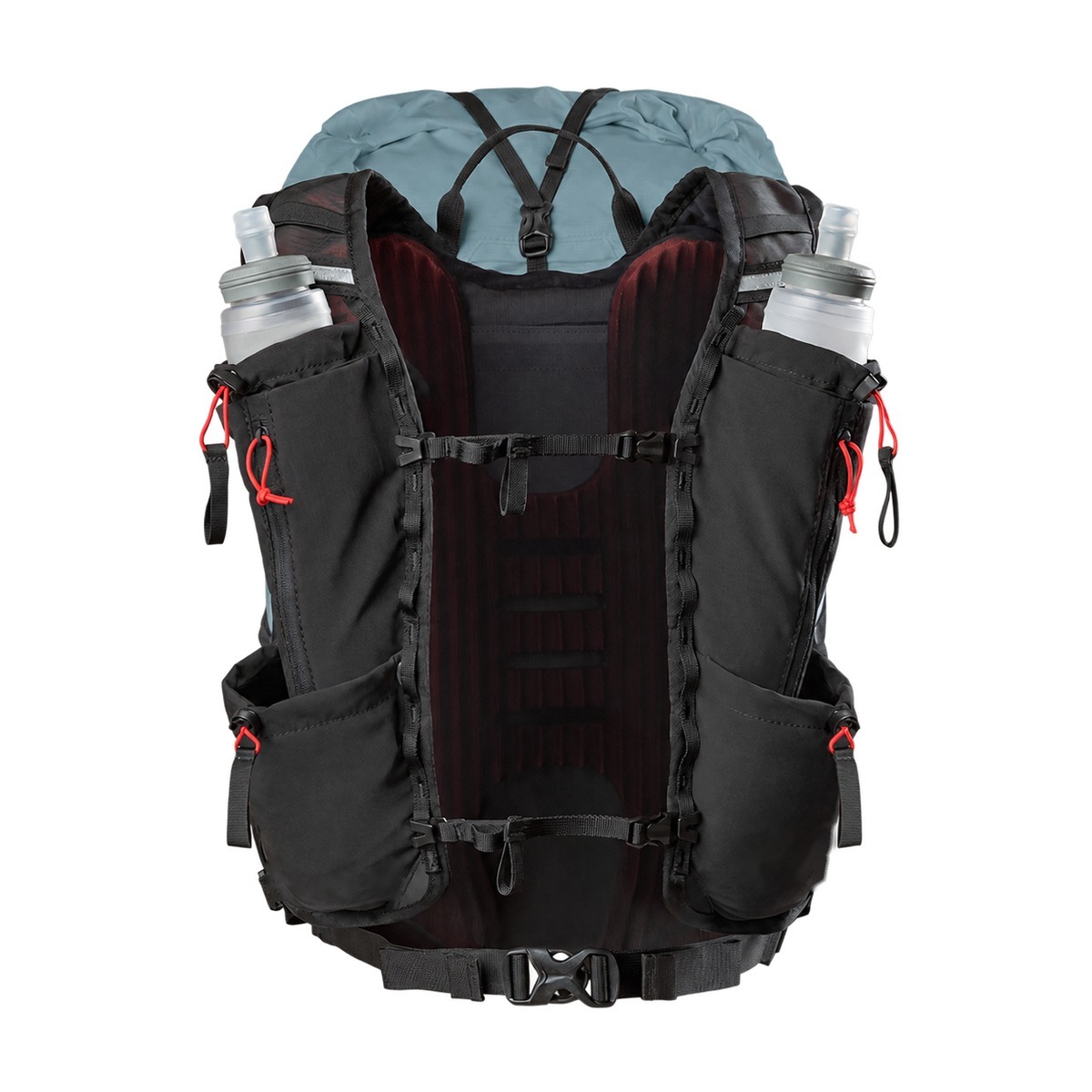
Six pockets on the shoulder straps
The most distinctive feature is the harness. Each shoulder strap carries three pockets:
- An upper flask pocket, holding a 500 ml soft flask. Two flasks are included with the pack, so a litre of water rides on the chest, reachable while moving.
- A middle zip pocket with a lanyard clip, for a phone, keys or small essentials that need to stay secure.
- A lower bungee pocket, a stretch pocket that expands to hold snacks, a small camera, gloves or a headlamp.
Six pockets on the straps changes how the pack is used. Water, food, navigation and a phone are all on the front of the body. The main compartment only needs opening at rest stops. The trade- off is weight on the chest: with two full flasks and full strap pockets, the front of the pack feels heavier than a conventional day pack, and the straps need to be adjusted well to sit comfortably.
Two adjustable sternum straps connect the shoulder straps. Both their tension and their vertical position can be adjusted, which matters because the strap pockets change the balance of the pack as they are loaded and emptied.
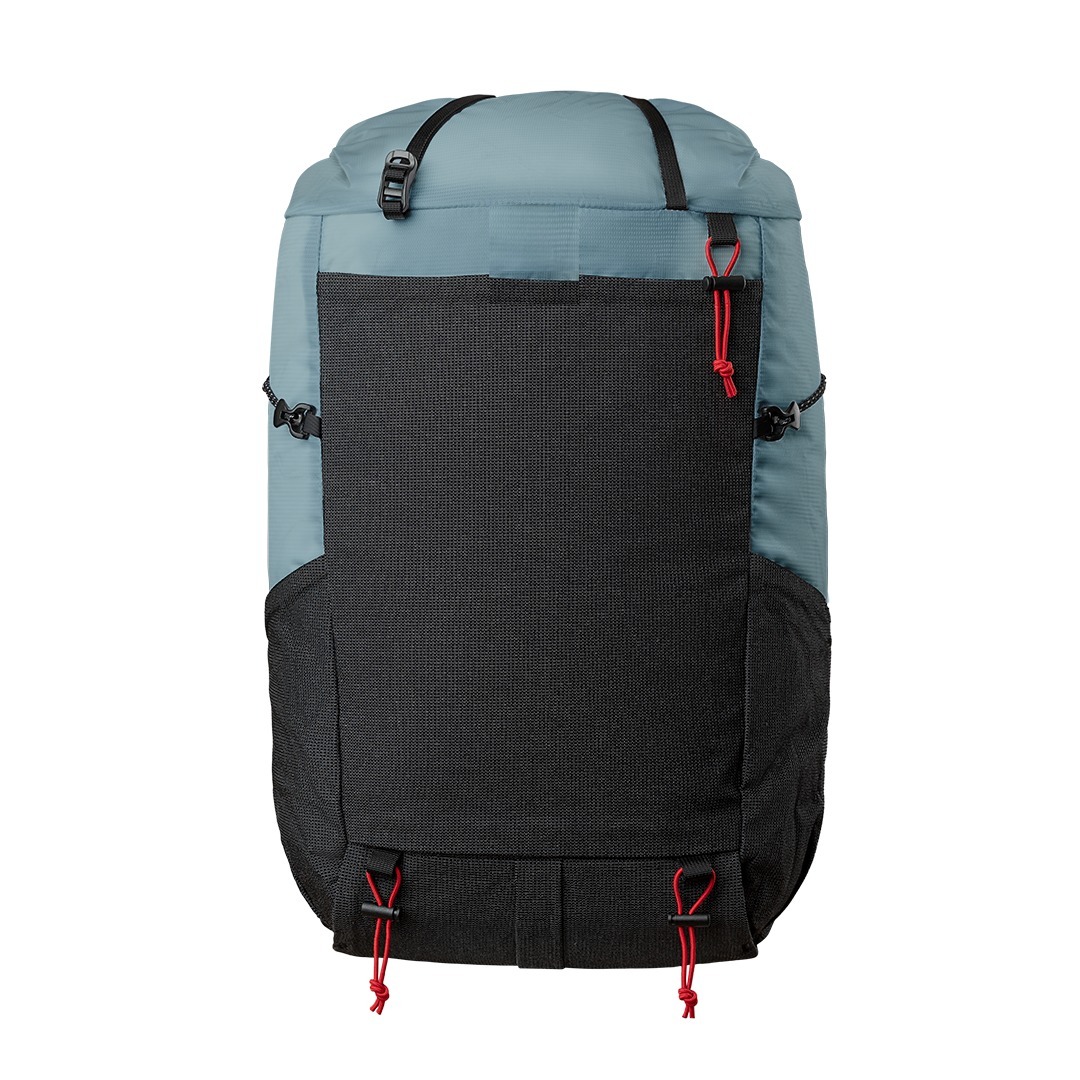
Roll-top closure with a V compression strap
The roll-top is held down by an over-the-top V-shaped compression strap. The rolled height can change with the load. Compare capacity with the opening rolled to its intended closed position rather than with the collar fully unrolled.
The V strap does two jobs at once. It holds the rolled top closed and compresses the load, pulling it in towards the back so the pack does not bounce while running. Compression matters more on a fastpack than on a walking pack, because a bouncing load is felt with every stride.
The stretch-mesh front pocket and the bottom pockets
The front of the pack is a large pocket made from a stretch-woven fabric that blends ultra-high-molecular-weight polyethylene (UHMWPE) with nylon 66. The same fabric is used for the bottom and side pockets. It is very resistant to punctures, tears and abrasion for its weight, and it stretches to hold bulky items — a wet rain jacket, a pair of gloves, or a map.
Below the front pocket, the base of the pack has two separate pockets: a zippered pocket and a stretch pass-through sleeve pocket. The sleeve is useful for stashing items that need to be grabbed quickly from below, such as a light layer or a pair of gloves. The zippered pocket is separate storage, not a way into the main compartment — there is no bottom access to the main compartment, so anything in the middle of the pack still has to be reached from the top.
Side pockets for litre bottles
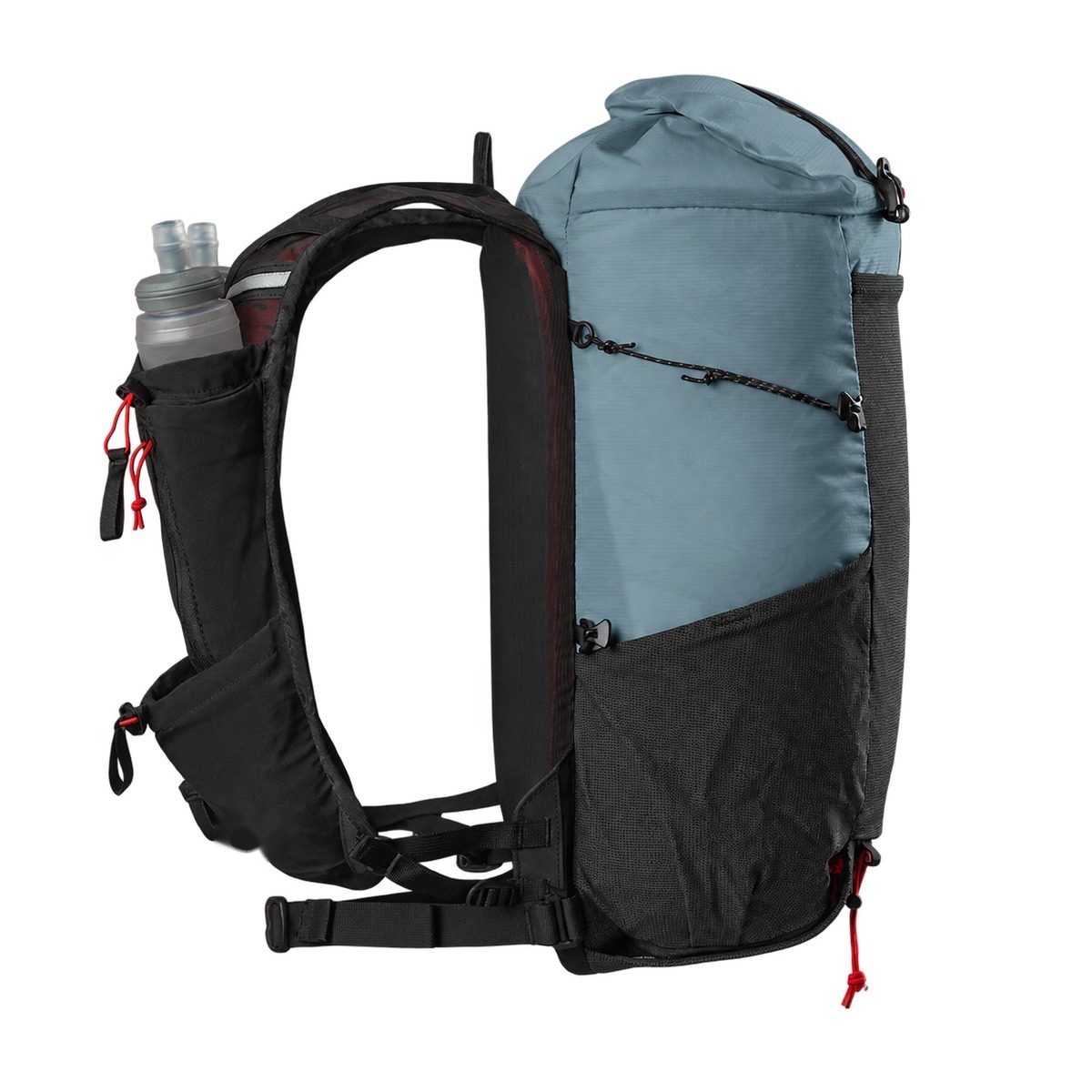
Each side of the pack has a stretch pocket sized for a 1-litre bottle. That gives the pack a second water-carrying option beyond the two chest flasks: two litres on the sides plus a litre on the chest. For long, dry routes that combination matters, and the side pockets sit low enough to be reached without taking the pack off.
Three loops for trekking poles or an ice axe run down the pack — one at the top and two lower ones — so poles can be carried vertically or horizontally. A hydration sleeve and hose port inside the main compartment give a third water option for hikers who prefer a reservoir.
A cut-out back panel and a webbing waist strap
The back panel is a sheet of EVA foam with large cut-outs, covered in mesh. The cut-outs save weight and let air move behind the pack, while the remaining foam gives the pack its shape and some cushioning against the back. Perforated foam is used in the shoulder straps as well, for the same reason: less weight, more airflow.
There is no padded hip belt on this pack. Instead, a removable webbing waist strap wraps around the body at about diaphragm level and fastens with a buckle. It steadies the pack and stops it bouncing while running, but it does not transfer load to the hips the way a padded hip belt does. That is consistent with the pack's load rating: at loads up to about 9 kilograms, most of the weight rides on the shoulders, and the waist strap is there for stability rather than load transfer.
04
Fabric and material combinations
The fabric choices are the pack's other main story.
- Main body: 100-denier high-tenacity nylon diamond ripstop. The nylon gives the fabric its abrasion resistance and suppleness; the diamond ripstop grid stops small tears from spreading.
- Pockets: a stretch-woven blend of UHMWPE and nylon 66. The weave allows the pocket to expand around contents; check recovery after repeated use.
- Water resistance: a fabric hydrostatic result is not a waterproof rating for the complete pack. Inspect seams and the roll-top with a representative load; use a liner for sensitive gear if needed.
- Back panel: EVA foam with large cut-outs, mesh-covered, balancing shape, cushioning and airflow.
- Straps: perforated foam in the shoulder straps, saving weight and improving breathability where the straps sit on the body.
The blend is a deliberate compromise. A heavier fabric would last longer but would push the pack over its weight target; a lighter fabric would save grams but would not survive being set down on rock or dragged through brush. The UHMWPE stretch pockets are the clever part: they put the toughest, most expensive fabric exactly where the pack is handled most — the pockets that are stuffed, pulled and scraped on every outing.
05
Who is it for?
- Trail runners going long, who want more capacity than a running vest without giving up front access to water and food.
- Fast hikers on big days, covering long distances with a light load and wanting to keep moving.
- Hikers moving from a conventional day pack to ultralight, who want to cut weight without losing the ability to carry a litre bottle on each side and a full layer in the front pocket.
- Mountain runners and sky racers, for whom the six strap pockets replace the need to stop for supplies.
- Light overnight hikers, who can fit a minimal kit into 23 to 31 litres and use the roll-top extension for extra food.
06
Pain points it solves
- Stopping to drink or eat. Two flasks and four more pockets on the chest straps keep water and food reachable while moving.
- Roll-top packs that are hard to organise. Six strap pockets and a large front pocket keep the small things out of the main compartment.
- Bouncing loads while running. The V compression strap, the webbing waist strap and the vest-style harness hold the load close to the body.
- Wet gear with nowhere to go. The large stretch-mesh front pocket takes a wet jacket or tent fly outside the main compartment.
- Not enough water capacity for dry routes. Two chest flasks, two litre side pockets and a hydration sleeve cover long stretches between water sources.
07
Design strengths
- A lightweight roll-top body with frequent-use storage distributed across the harness.
- Six pockets on the shoulder straps — two flask pockets, two zip pockets with lanyard clips, and two bungee pockets.
- Stretch-woven pockets with UHMWPE and nylon; compare wear and recovery using the actual fabric.
- Roll-top and V compression strap, allowing adjustment of the packed height and movement.
- Two 500 ml soft flasks included, so the chest hydration system works out of the box.
- Cut-out EVA back panel and perforated strap foam, saving weight while keeping airflow.
- Three pole and ice-axe loops, a hydration sleeve and port, and side pockets sized for litre bottles.
08
Limitations to keep in mind
- Load trade-off. The frameless pack has a stabilising waist strap rather than a padded, load-bearing hip belt. Check shoulder pressure at the intended loaded weight.
- No padded hip belt. The webbing waist strap steadies the pack but does not transfer load to the hips. Hikers used to a hip belt carrying most of the weight will need to adjust.
- No bottom access to the main compartment. The bottom zip is a separate pocket. Anything buried in the main compartment has to be reached from the top.
- Weight on the chest. Six loaded strap pockets put weight on the front of the body, which takes some getting used to and needs careful strap adjustment.
- Not designed as a waterproof enclosure. Check sewn seams and closures independently of the shell fabric.
09
What the design teaches
The most useful lesson in this pack is where it puts the storage. Most packs hide everything behind the wearer and accept that the pack has to come off to reach anything. This pack moves the small, frequently used things — water, snacks, phone — onto the chest, and leaves the main compartment for the things that only come out at rest stops. That single decision shapes everything else: the wide vest straps, the dual sternum straps, the V compression strap that stops the load bouncing.
The second lesson is where to spend weight. The body uses light ripstop; the stretch-woven fabric is reserved for pockets that are repeatedly opened or come into contact with the ground.
For development, test drinking, eating and using the navigation pocket while the pack is worn. Compare access with the front pockets loaded at the same time.
10
Prototype brief
Useful inputs for a fastpack prototype include:
- Target weight, capacity and recommended maximum load.
- Harness design: vest-style straps, strap pocket count and layout, and how the sternum straps adjust.
- Closure and compression: roll-top, V strap, or both, and how the load is stabilised while moving.
- Fabric by zone: nylon ripstop weights for the body, and UHMWPE stretch-woven fabric for the pockets.
- Pocket layout: front mesh pocket, bottom pockets, side bottle pockets, and hydration options.
- Sizing: torso lengths, and whether the waist strap should be webbing or padded.
Related guide: Hiking Side Pouches: Plan Width and Flap Clearance
Discuss your bag development project
ANSON XIE
General Manager & Founder
Quanzhou Junkai Pengda Special Equipment Co., Ltd.
Email: ansonxie@jkpdtime.com
Phone: +86 177 5095 3355
WhatsApp: +86 177 5095 3355
Factory address: Floors 2–4, Building 1, Phase I, Huixin Intelligent Manufacturing Industrial Park, Hui'an County, Quanzhou, Fujian, China